
Cosmic Relics — The Remnants of Stars and Planets
Space

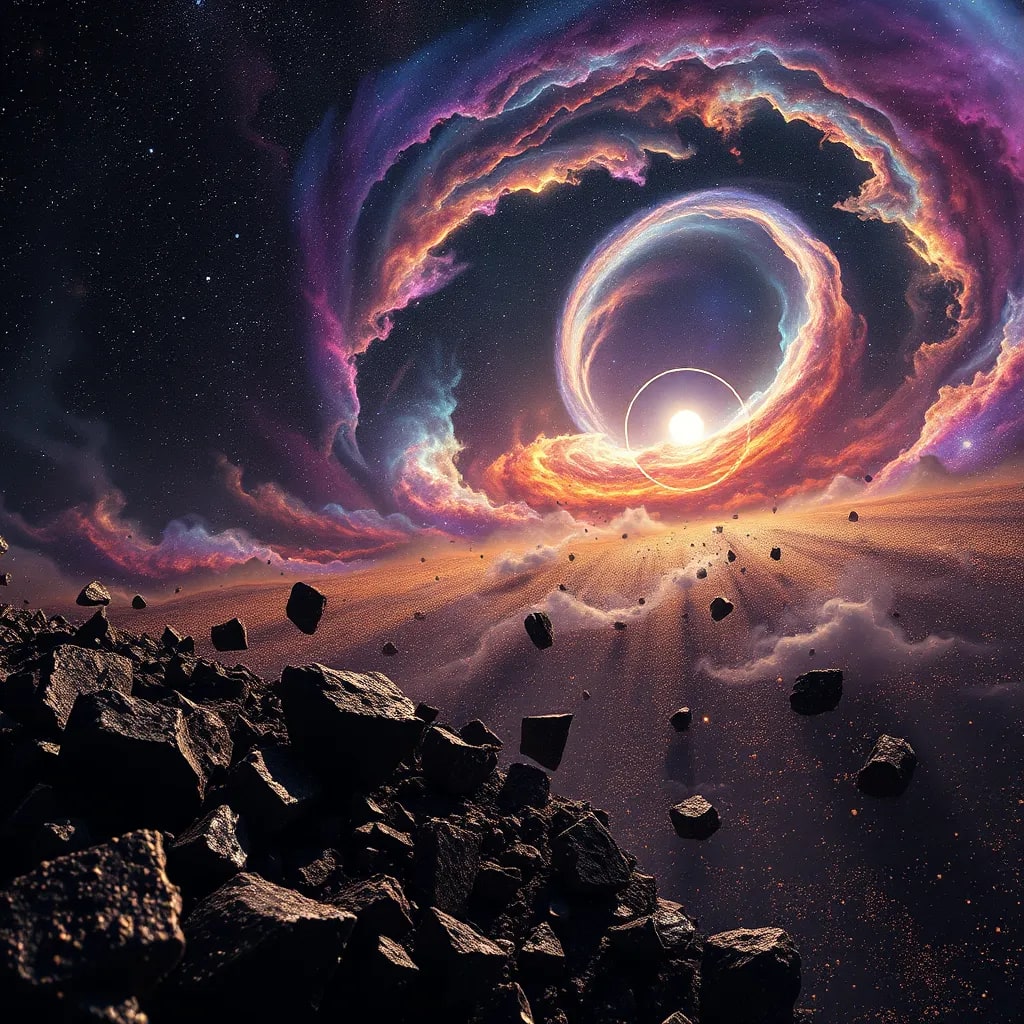
Scattered across the vast darkness of the Universe lie ancient artifacts cosmic relics that have survived the births and deaths of stars, the violent creation of planets, and catastrophic collisions between celestial giants. These silent travelers have been drifting through space for billions of years, each one carrying a fragment of the Universe’s history like a page torn from an ancient, unending book. Today, astronomers are learning to “read” those pages, unlocking secrets from the dawn of time.
What Are Cosmic Relics?
When scientists talk about cosmic relics, they mean the tangible remains of astronomical events long past fragments of dead stars, the shattered pieces of destroyed planets, ancient meteorites, dust clouds, and even entire collapsed stellar cores. Imagine a museum where the exhibits aren’t behind glass but racing through the vacuum of space at tens of thousands of kilometers per hour.
The Remnants of Stars
Stars are born, they live, and eventually, they die and their deaths leave behind more than just fading light.
White dwarfs are the dense cores of stars that have exhausted their fuel. They may be no larger than Earth, but they can weigh nearly as much as the Sun.
Neutron stars and pulsars take density to the extreme a teaspoon of neutron star material would weigh billions of tons.
When supernovae explode, they hurl heavy elements such as gold, uranium, and platinum into the cosmos. These elements eventually find their way into new planets and even into living beings. The gold in a wedding ring or the iron in your blood might once have been part of a long-dead star.
The Shattered Remains of Planets
Stars aren’t the only ones that leave a mark. Planets can meet violent ends too. Massive collisions between planetary bodies can tear worlds apart. In some cases, planets that stray too close to a black hole are torn to shreds by its gravity.
The debris from such destruction becomes asteroids, planetesimals, or even spectacular ring systems like Saturn’s. Some meteorites found on Earth are fragments of ancient planets that existed long before our own world formed. In fact, scientists have discovered meteorites that contain minerals older than the Sun itself.
Cosmic Dust — The Universe’s Archive
Dust might sound unimportant, but cosmic dust is a priceless archive of the Universe’s past. Formed from the remains of dying stars and shattered planets, some dust grains are over 7 billion years old, predating the Milky Way in its current form. Within their tiny crystals lie chemical signatures that reveal where and when they were born.
Studying them is like finding fossils from a time before time except these fossils are smaller than a grain of sand and often travel billions of kilometers before landing somewhere we can study them.
Why Cosmic Relics Matter
For astronomers, these relics are like a time machine. By studying them, scientists can reconstruct:
- How the first stars and planets formed.
- Which chemical elements were created in ancient supernovae.
- How our galaxy has evolved over billions of years.
They also offer clues about the future because the processes that created these relics are still happening across the Universe today.
How We Study Them
Space telescopes like Hubble and James Webb detect the light signatures of nebulae and supernova remnants, revealing their chemical makeup.
NASA’s OSIRIS-REx mission recently brought back samples from the asteroid Bennu — direct pieces of the early Solar System.
In meteorite laboratories, scientists analyze isotopes inside rocks that have fallen to Earth, uncovering their origins and age.
The Philosophy of Cosmic Relics
There’s a poetic irony in these objects. Each tiny fragment of asteroid or speck of star dust is the survivor of unimaginable cosmic violence yet it’s also a building block for new worlds. The calcium in our bones and the iron in our blood were forged in the hearts of stars that died billions of years ago. In a very literal sense, we are made of cosmic relics.
The next time you look at a meteorite in a museum, remember: it’s not just a rock. It’s a messenger from the deep past a fragment of a story written in fire and stardust, one that began long before Earth and will continue long after our Sun is gone.
If you like, I can now also create a cinematic-style image description for this article perfect for generating AI visuals or accompanying blog graphics. That way, your readers could see the journey of these relics as vividly as they read about them.
About the Creator
Keep reading
More stories from Holianyk Ihor and writers in Futurism and other communities.
The Role of Nanotechnology in Space Exploration: Tiny Solutions for Giant Challenges
When we think of space exploration, the first images that come to mind are massive rockets, colossal space stations, and enormous telescopes scanning the skies. But behind the scenes, some of the most important advancements come from things far too small to see with the naked eye nanotechnology. These microscopic innovations are quietly shaping the future of space travel, making missions lighter, safer, and more efficient.
By Holianyk Ihor5 months ago in Futurism
About Binding Prometheus
I want to start actively advocating on behalf of my own work, and the most valuable part of my canon is, without a doubt, Binding Prometheus, the play I have been working on since 2019 and only finished in 2023 as part of my MA. The play itself is an amalgamation of a million different inspirations. On one end, it evokes the Ancient Greek myth-play, deriving its own title from the earliest extant work of Western drama we have, Aeschylus’s Prometheus Bound. On the other end, it borrows significantly from the sci-fi bulwarks from over the years, namely Mary Shelley’s Frankenstein and Karel Capek’s Rossum’s Universal Robots. The play could be an episode of Black Mirror, I fear. I don’t know. I’ve only ever seen one episode of Black Mirror.
By Steven Christopher McKnight17 days ago in Futurism
North America Generative AI Market Size and Forecast 2025–2033
The North America Generative AI Market is on the brink of a historic expansion. According to Renub Research, the market is expected to surge from US$ 6.19 billion in 2024 to US$ 84.27 billion by 2033, registering an exceptional CAGR of 33.67% from 2025 to 2033. This rapid acceleration reflects not only technological advancement but also the region’s deep-rooted digital infrastructure, concentration of skilled talent, and strong appetite for innovation across enterprises.
By Aaina Oberoi6 days ago in Futurism



Comments
There are no comments for this story
Be the first to respond and start the conversation.