
Mirror-like Exoplanets: Alien Worlds Reflecting Light Like Giant Cosmic Mirrors
Space

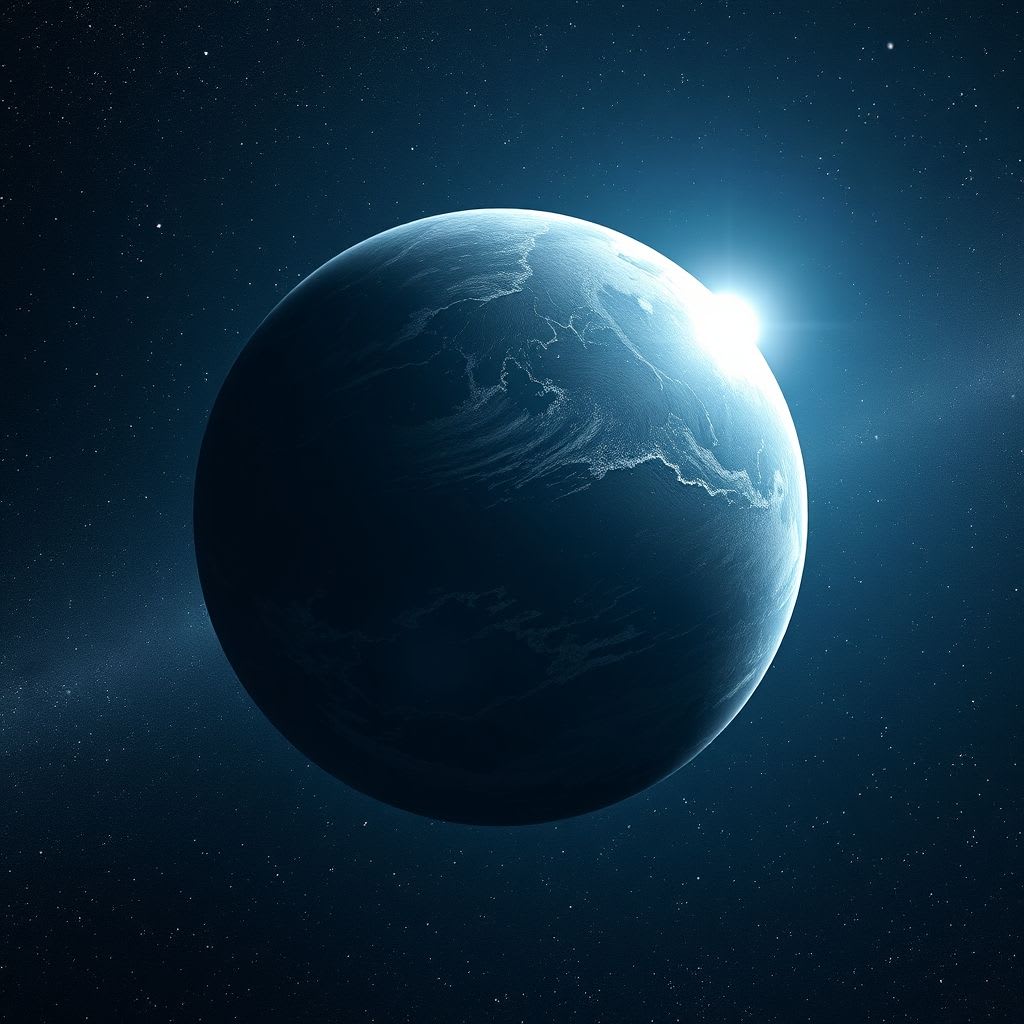
In the infinite depths of space, astronomers are discovering more than just new planets—they’re uncovering worlds that defy expectations. One of the most fascinating recent discoveries is the existence of mirror-like exoplanets: distant planets whose surfaces are so reflective, they shine like cosmic beacons, bouncing their star’s light back into the void like giant interstellar mirrors.
These shimmering orbs aren't just pretty—they challenge our understanding of planetary formation, composition, and even the search for life beyond Earth.
What Are Mirror-Like Exoplanets?
Exoplanets are planets that orbit stars outside our Solar System. Most of the thousands identified so far fall into familiar categories: rocky like Earth, gaseous like Jupiter, or icy like Neptune. They often have thick atmospheres with clouds of methane, ammonia, or water vapor. But among these, scientists have found a rare and striking class—planets with exceptionally high albedo (a measure of how much light a surface reflects).
Some of these planets reflect over 80% of the light that hits them. To compare, Earth reflects about 30%, and Venus—one of the brightest objects in our night sky—reflects around 75%. That makes these exoplanets even more reflective than anything we see in our own Solar System.
A leading example is Kepler-10b, a rocky exoplanet located about 560 light-years from Earth. It is believed to have a surface covered in silicate or metallic crystals, giving it a mirror-like gleam. In telescope imagery, Kepler-10b almost appears like a drop of liquid mercury suspended in the darkness.
How Does a Planet Become a Mirror?
While it may sound like science fiction, there are several scientific explanations for how such dazzling planetary surfaces might form.
1. Metallic Clouds and High-Temperature Atmospheres
Some exoplanets orbit so close to their parent stars that their day sides can reach temperatures above 2,000°C (3,600°F). At those extreme temperatures, metals like titanium, vanadium, and aluminum can vaporize. When the atmosphere cools just slightly, these vaporized metals condense into tiny crystals, forming highly reflective clouds that behave like giant, drifting mirrors.
One such example is WASP-121b, a “hot Jupiter” whose atmosphere is suspected to contain reflective metal vapors. Observations with space telescopes like Hubble and James Webb have revealed hints of such exotic weather systems.
2. Molten Lava Oceans and Frozen Glass Fields
On some planets, especially younger or extremely hot ones, the surface may be composed of molten rock or lava oceans. As these oceans cool and solidify, they can form smooth, glossy surfaces similar to obsidian or volcanic glass. If the terrain is relatively flat, the result can be a planetary surface with mirror-like properties—essentially a cosmic sheet of glass.
3. Airless Worlds with Crystal-Covered Surfaces
Just like our Moon, some planets may lack atmospheres entirely. Without winds, weather, or erosion, shiny materials on their surfaces—like salt flats or crystalline mineral layers—remain undisturbed. These materials can reflect a significant amount of light. Imagine a world where the surface glitters like a desert of diamonds, untouched by time or turbulence.
Why Mirror Worlds Matter
Mirror-like exoplanets are more than just visual marvels. Their extreme reflectivity makes them easier to detect with space telescopes, even when they’re orbiting bright stars. Since most planets are relatively dim compared to the stars they orbit, this high reflectivity helps scientists observe and analyze their light spectra more accurately.
This reflectivity also complicates how we interpret planetary temperatures. A planet that reflects most of the light it receives might appear cooler than it really is. It could be hiding a searing-hot surface beneath its glistening shell.
Even more intriguingly, the presence of mirror-like surfaces might help us identify potential signs of artificial structures—should they exist.
Could They Be Artificial?
The more reflective a planet is, the more likely it is to raise eyebrows among scientists. Could such high albedo be a sign of something not naturally occurring?
Some researchers have entertained the bold idea that these surfaces might not be natural at all. What if we’re seeing alien megastructures—giant solar mirrors, energy collectors, or planetary-scale satellites built by advanced civilizations?
Though this remains in the realm of speculation, it’s not completely ruled out. Projects like the Search for Extraterrestrial Intelligence (SETI) often include such possibilities in their theoretical frameworks. Still, current evidence favors natural explanations, supported by spectroscopy, models, and simulations.
Reflections of the Unknown
Mirror-like exoplanets serve as shimmering clues in our quest to understand the universe. They’re helping astronomers test the limits of planetary physics, explore new atmospheric chemistry, and even question whether we might one day spot the handiwork of an intelligent species far from Earth.
These cosmic mirrors reflect more than just starlight—they reflect the curiosity and wonder that drive humanity to explore the stars. As our telescopes grow sharper and our questions bolder, who knows what truths might be hiding behind those radiant, alien reflections?
About the Creator
Keep reading
More stories from Holianyk Ihor and writers in Futurism and other communities.
Planets Covered in Liquid Metal: Science Fiction Becoming Reality
Imagine standing on the shore of a planet where oceans shimmer not with water, but with molten iron, zinc, or sodium. The air is thick with metallic vapors. A red, swollen star hangs overhead, casting eerie reflections across a glowing mercury sea. It sounds like a scene from a futuristic movie, but recent scientific discoveries suggest such planets might not only exist—they may already be within our reach.
By Holianyk Ihor8 months ago in Futurism
About Binding Prometheus
I want to start actively advocating on behalf of my own work, and the most valuable part of my canon is, without a doubt, Binding Prometheus, the play I have been working on since 2019 and only finished in 2023 as part of my MA. The play itself is an amalgamation of a million different inspirations. On one end, it evokes the Ancient Greek myth-play, deriving its own title from the earliest extant work of Western drama we have, Aeschylus’s Prometheus Bound. On the other end, it borrows significantly from the sci-fi bulwarks from over the years, namely Mary Shelley’s Frankenstein and Karel Capek’s Rossum’s Universal Robots. The play could be an episode of Black Mirror, I fear. I don’t know. I’ve only ever seen one episode of Black Mirror.
By Steven Christopher McKnight15 days ago in Futurism
Metaverse Market: Brand Engagement, Virtual Advertising & New Revenue Streams
According to IMARC Group's latest research publication, global metaverse market size reached USD 132.60 Billion in 2024. Looking forward, IMARC Group expects the market to reach USD 1,583.87 Billion by 2033, exhibiting a growth rate (CAGR) of 36.35% during 2025-2033.
By Andrew Sullivanabout 14 hours ago in Futurism


Comments (1)
This is some seriously cool stuff. I had no idea there were planets out there that reflect so much light. It makes me wonder how common these mirror-like exoplanets really are. Do you think we'll find more like Kepler-10b in the future? And what about the implications for finding life? If a planet is so reflective, does that mean it's less likely to support life? It's fascinating to think about all the questions these discoveries raise.