
Mars: Earth’s Quiet Little Brother, and Maybe Our Second Chance
Once full of promise, now silent and cold—Mars may hold the key to our future, if we're brave enough to reach for it.

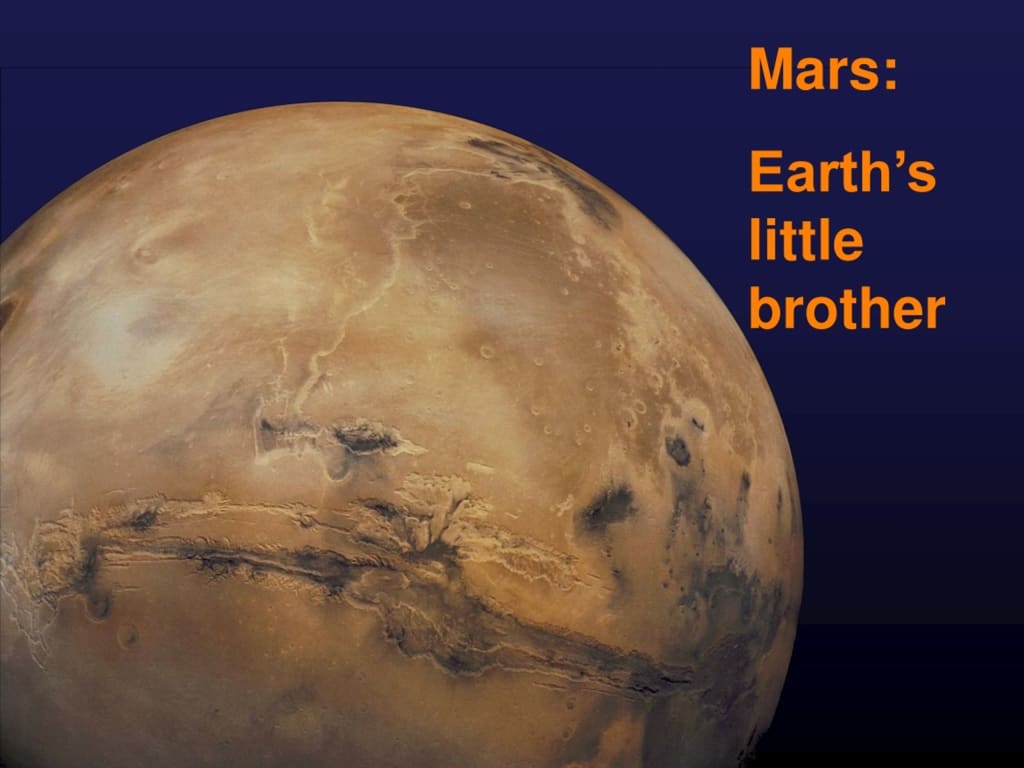
I remember the first time I saw Mars through a telescope. It looked like a rusty marble suspended in a black ocean. They call it Earth’s little brother, and honestly, that makes sense. He’s smaller, quieter, a little colder—but still part of the same family. Not as flashy, not as full of life, but somehow just as fascinating.
Mars has always been there, staring back at us with a kind of silent mystery. Ancient people looked up at the red dot in the sky and imagined gods of war and fire. They saw something powerful in its blood-red glow. But truthfully, Mars doesn’t feel violent. It feels lonely.
Unlike our vibrant Earth—blue with oceans, green with forests, loud with storms and full of life—Mars is dust and silence. The kind of silence that stretches for millions of years. But if you squint a little, you start to see the resemblance. Mars has seasons. Ice caps. Dust storms. Once upon a time, it had rivers. Maybe even oceans. Maybe even life.
That’s the part that gets me. Scientists now believe Mars might have been warm and wet billions of years ago. Imagine that—ancient Mars, not red and dead, but blue and alive. Water flowing through valleys, lakes forming under soft skies. And then… something changed. Something massive.
The planet lost its magnetic field, they say. Without it, the atmosphere peeled away under the force of solar wind. The water vanished. The warmth faded. The planet dried up and froze over, like a movie paused mid-story. If life ever did emerge there, it didn’t stand a chance. Mars became a graveyard of potential.
That’s heartbreaking, in a weird way. It’s like watching your little brother grow up full of hope and promise, only to lose his way. But here’s the wild part—he’s still out there. Still waiting. Still watching. And maybe, just maybe, we’re not done with him yet.
Because despite everything Mars lost, he might still have something left to give. Not to himself—but to us.
This is why we keep going back. All those missions, all those rovers crawling across the dust—it’s not just science. It’s curiosity. It’s hope. We’re not just looking for signs of life. We’re looking for a new beginning. A second chance. Mars, in all his quiet, broken beauty, might be the next place we call home.
Sure, it’s a long shot. Living on Mars won’t be easy. It’s cold. The air’s unbreathable. Radiation’s a problem. But none of that has stopped the dreaming. Elon Musk talks about building cities there. NASA has plans to send astronauts in the next decade. People are seriously considering how to terraform the place—bring back the warmth, thicken the air, maybe even grow green things again.
It’s a crazy idea. But maybe that’s exactly what makes it feel so human. We look at a lifeless world and don’t just see rocks—we see possibility. We see home, even in the unlikeliest place. That says more about us than it does about Mars.
And maybe that’s what makes Mars feel like family. He’s not just the little brother who fell behind—he’s the one who reminds us who we are. Adventurers. Fixers. Dreamers.
Sometimes I catch myself daydreaming about it—waking up on Mars, brushing dust off my boots, watching the pink sky stretch out forever. Earth would just be a bright dot in that sky, far away. But not forgotten. Just… different.
Maybe one day, kids will grow up on Mars and learn about Earth the way we learn about ancient lands. Maybe they’ll wonder what it was like to live on the big, blue planet before things changed. Maybe they’ll do better with their world than we did with ours.
I don’t know if we’ll ever get there. But I do know this—Mars isn't just a dead rock in space. He’s a mirror. He shows us what we’ve lost, what we could lose, and what we still might find.
So next time you look up and see that little red dot glowing in the night sky, think about him—not just as a planet, but as a little brother. Quiet. Watching. Waiting. And maybe, just maybe, hoping we come home.
About the Creator
Keep reading
More stories from Mustafa Amin and writers in Futurism and other communities.
About Binding Prometheus
I want to start actively advocating on behalf of my own work, and the most valuable part of my canon is, without a doubt, Binding Prometheus, the play I have been working on since 2019 and only finished in 2023 as part of my MA. The play itself is an amalgamation of a million different inspirations. On one end, it evokes the Ancient Greek myth-play, deriving its own title from the earliest extant work of Western drama we have, Aeschylus’s Prometheus Bound. On the other end, it borrows significantly from the sci-fi bulwarks from over the years, namely Mary Shelley’s Frankenstein and Karel Capek’s Rossum’s Universal Robots. The play could be an episode of Black Mirror, I fear. I don’t know. I’ve only ever seen one episode of Black Mirror.
By Steven Christopher McKnight20 days ago in Futurism
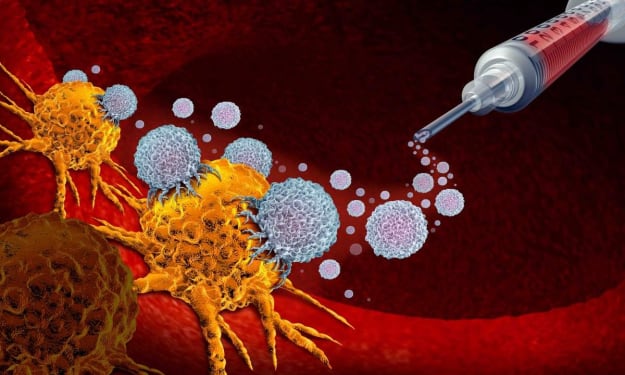
Saudi Arabia Cancer Immunotherapy Market Advancing Treatment Adoption and Healthcare Innovation
According to IMARC Group's latest research publication, Saudi Arabia cancer immunotherapy market size reached USD 1,303.4 Million in 2025. The market is projected to reach USD 2,611.6 Million by 2034, exhibiting a growth rate (CAGR) of 8.03% during 2026-2034.
By Suhaira Yusuf6 days ago in Futurism


Comments
There are no comments for this story
Be the first to respond and start the conversation.