
Marketing Funnel: The Mental Model Behind All Great Marketing Analytics
How to understand, analyze, and optimize the customer journey—from the first click to closed deals

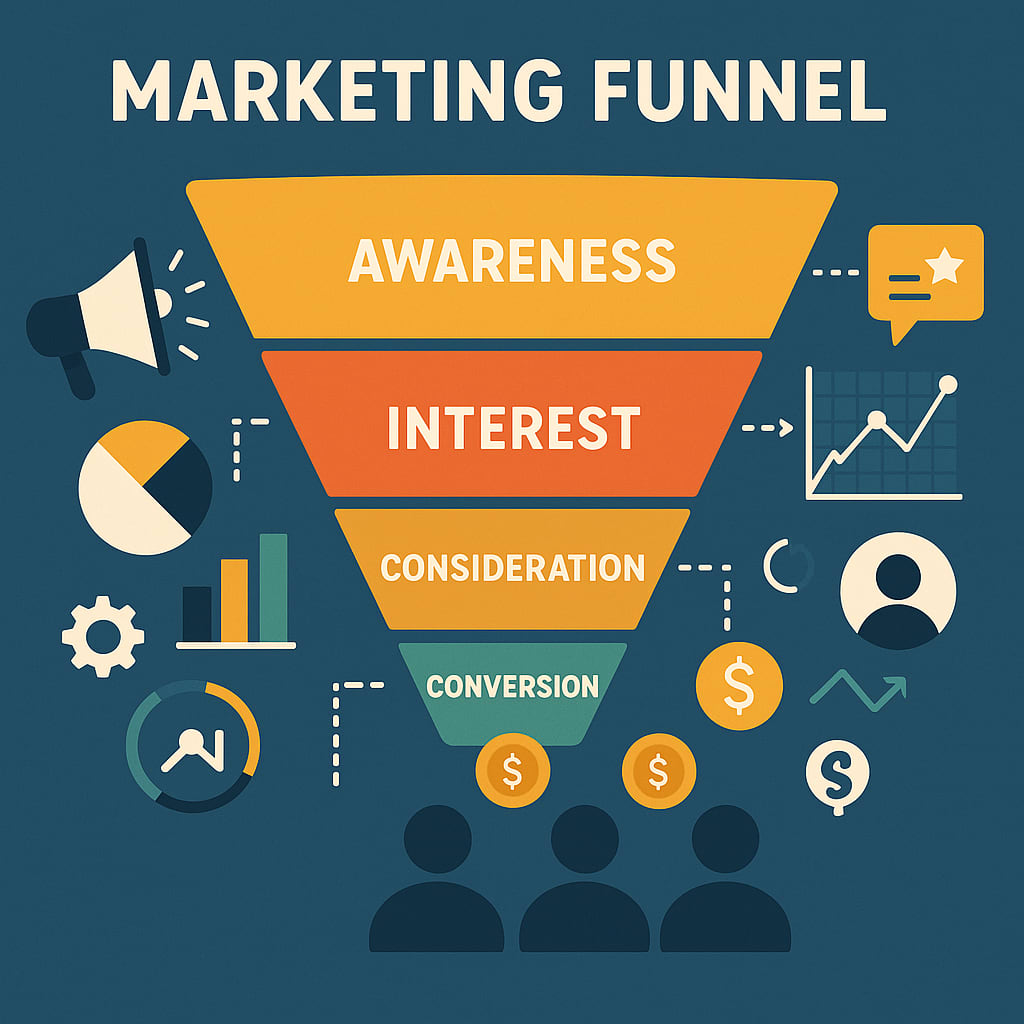
If you want to break into marketing analytics, growth, CRO, or experimentation, this is the mental model you need to master first:
The Marketing Funnel.
Why? Because everything you work on—landing pages, ad performance, email flows, A/B tests—only makes sense in the context of where it fits in the funnel. Without it, you're just optimizing in the dark.
The funnel gives structure to the chaos of user behavior. It connects traffic to revenue. It makes business questions measurable.
In this guide, we’ll break down:
What the funnel is, and why it matters
Every stage from Awareness to Expansion, explained
How marketing and sales funnels work together
Key metrics and analyst responsibilities at each stage
A glossary of must-know terms used in real teams
What Is a Marketing Funnel?
The funnel is a simplified map of how people move from total strangers to loyal customers (and beyond).
At the top, people are just becoming aware of your brand. By the bottom, they’ve made a purchase—or become evangelists.
It's called a funnel because it narrows: many people will visit your site or see an ad, but only a fraction will convert, and fewer will become long-term customers.
As a marketing analyst or growth professional, your job is to:
- Track how people move through each stage
- Spot drop-offs or friction
- Recommend experiments, optimizations, or strategies that improve flow
The Full Funnel: 7 Core Stages You Need to Understand
1. Awareness
This is the moment a potential customer first discovers you exist.
- They see a paid ad
- They hear about you on a podcast
- They read a social post or blog
Goal: Put your brand in front of the right people.
You care about: Impressions, reach, CPM, branded search volume, engagement rate.
2. Acquisition
Now they’ve taken the first step: they visit your site, click an ad, engage with content, or follow you.
Goal: Get them to engage or show intent.
You care about: Click-through rate (CTR), bounce rate, time on site, session count, cost-per-click (CPC), new user acquisition.
3. Activation
They take a meaningful first action. This could be:
- Signing up
- Starting a free trial
- Creating an account
- Submitting a form
This is where interest becomes intent.
Goal: Deliver value quickly and guide them to the next step.
You care about: Conversion rate (CVR), form completion rate, trial-to-signup %, time to activation.
4. Consideration
Now they’re evaluating. They’re comparing you to alternatives. They might:
- Schedule a sales call
- Review a case study
- Ask a teammate for input
- Visit your pricing page multiple times
Goal: Build trust, demonstrate value, reduce doubt.
You care about: Return visits, demo requests, repeat sessions, email open rate, content engagement.
5. Conversion (Purchase)
They decide. They buy. They subscribe. They convert.
Goal: Turn intent into action.
You care about: Sales volume, cost-per-acquisition (CPA), funnel conversion %, revenue per user.
6. Retention
A customer becomes a repeat user. They stick around. They use the product often and don’t churn.
Goal: Deliver value consistently.
You care about: Retention rate, DAU/MAU, churn rate, support tickets, NPS (Net Promoter Score).
7. Expansion
The customer doesn’t just stay—they grow with you. They may:
- Refer others
- Upgrade to a premium plan
- Expand their team’s usage
- Buy add-ons
Goal: Increase LTV and turn customers into advocates.
You care about: Expansion revenue, referral rate, upsell %, customer lifetime value (LTV).
Where Sales Comes In: The Marketing-to-Sales Funnel Handoff
In most companies—especially in B2B or high-ticket sales—marketing and sales work hand-in-hand. The marketing team warms up leads, and the sales team converts them.
This collaboration usually kicks in between the Activation and Consideration stages.
Here’s how companies commonly define the handoff points—and what each stage actually means:
Lead
Someone who has submitted a form, subscribed, or signed up.
They’ve raised their hand but haven’t been evaluated yet.
MQL (Marketing Qualified Lead)
A lead that meets basic criteria set by marketing:
- Fits your ideal customer profile (ICP)
- Shows buying intent (e.g. visited pricing page, downloaded whitepaper, returned 3+ times)
Marketing’s job is to generate MQLs—people worth passing to sales.
SQL (Sales Qualified Lead)
A sales rep has reviewed the lead and agrees they’re worth pursuing.
They’ve met a more specific checklist:
- Budget
- Authority
- Need
- Timeline (known as BANT)
This is where the real 1:1 selling begins.
Opportunity
A qualified lead who is actively in the sales process.
A deal is being worked. Proposals are being exchanged. Demos are being done.
Opportunities are tracked in CRMs like Salesforce, HubSpot, or Close.com.
Closed Won
The deal is done. Money is in the bank. The lead becomes a paying customer.
Closed Lost
The deal didn’t close. Either the prospect said no, ghosted, or chose another vendor.
Why This Handoff Matters for You (as an Analyst or Marketer)
- These labels drive revenue forecasts, reporting, and strategy
- Understanding the pipeline helps you analyze what’s working—and what isn’t
- You can track how marketing campaigns lead to revenue, not just leads
- You’ll work better with sales by speaking their language
Your dashboards and insights become 10x more valuable when you can connect the dots from campaign → lead → MQL → SQL → Closed Won.
Dictionary: Funnel Terms You’ll Hear In the Wild
- TOFU (Top of Funnel): Awareness and acquisition stages
- MOFU (Middle of Funnel): Activation and consideration stages
- BOFU (Bottom of Funnel): Conversion and sales engagement
- ICP (Ideal Customer Profile): A detailed description of your best-fit customer
- MQL: A lead that fits your ICP and shows interest
- SQL: A vetted lead that sales has agreed to pursue
- Opportunity: An active sales deal in progress
- LTV: Lifetime Value — how much revenue a customer generates over time
- CAC: Customer Acquisition Cost — how much it costs to acquire a new customer
- ROAS: Return on Ad Spend — revenue generated per dollar spent on ads
- NPS: Net Promoter Score — a loyalty metric based on how likely a user is to refer you
Final Thoughts
The funnel isn’t just a diagram—it’s the blueprint for every growth system.
When you understand it, you:
- Ask better questions
- Run smarter experiments
- Tell clearer stories with data
- Build dashboards that leaders care about
- Spot bottlenecks and opportunities before others do
If you’re starting a career in marketing analytics, this is the mental model that ties everything together.
Master it. Speak it. Use it.
If this was helpful, subscribe to Experimentation Career for more career-building breakdowns like this.
Any questions or suggestions? leave a comment or reply below:
Let’s build your career—one insight at a time.
—Atticus
🤝 Connect with me on LinkedIn to swap ideas.
About the Creator
Experimentation Career
Helping students & early career pros land $100K+ roles in analytics, marketing, and experimentation. Hiring manager at NRG (Fortune 500, $28B+ revenue).
Keep reading
More stories from Experimentation Career and writers in Futurism and other communities.
The Social Execution
I woke up six months later in a sterile room that smelled of bleach and lost hope. Consciousness didn't return all at once; it arrived in agonizing increments, a slow-motion reconstruction of a man who had been shattered into a million jagged pieces. For weeks, the world was nothing but the rhythmic hiss of a ventilator and the fluorescent hum of a ceiling I hadn't designed. When I finally found the strength to open my eyes, I didn't recognize the landscape of my own body.
By Nathan McAllisterabout 20 hours ago in Futurism
Australia Animal Health Market: Companion Animal Care Expansion, Livestock Disease Management & Veterinary Technology Innovation
According to IMARC Group, the Australia animal health market reached a value of USD 801.6 Million in 2025 and is projected to reach USD 1,025.3 Million by 2034, growing at a compound annual growth rate (CAGR) of 2.69% during 2026–2034. The market is expanding steadily as rising pet ownership, increasing demand for livestock health management and growing awareness of animal welfare continue shaping the industry landscape. Australia’s strong agricultural and livestock sectors rely heavily on effective veterinary healthcare solutions to ensure animal productivity and disease prevention. At the same time, the increasing popularity of companion animals such as dogs and cats is encouraging pet owners to invest in advanced veterinary care, preventive medicines and nutritional supplements. Technological advancements in veterinary diagnostics, pharmaceuticals and digital health monitoring tools are further supporting the development of the animal health industry. Government biosecurity initiatives and regulatory frameworks are also strengthening disease surveillance and prevention programs across the country.
By Shrestha Roy3 days ago in Futurism



Comments
There are no comments for this story
Be the first to respond and start the conversation.