
Lunar Lava Tubes: Humanity’s First True Shelters Beyond Earth
Space

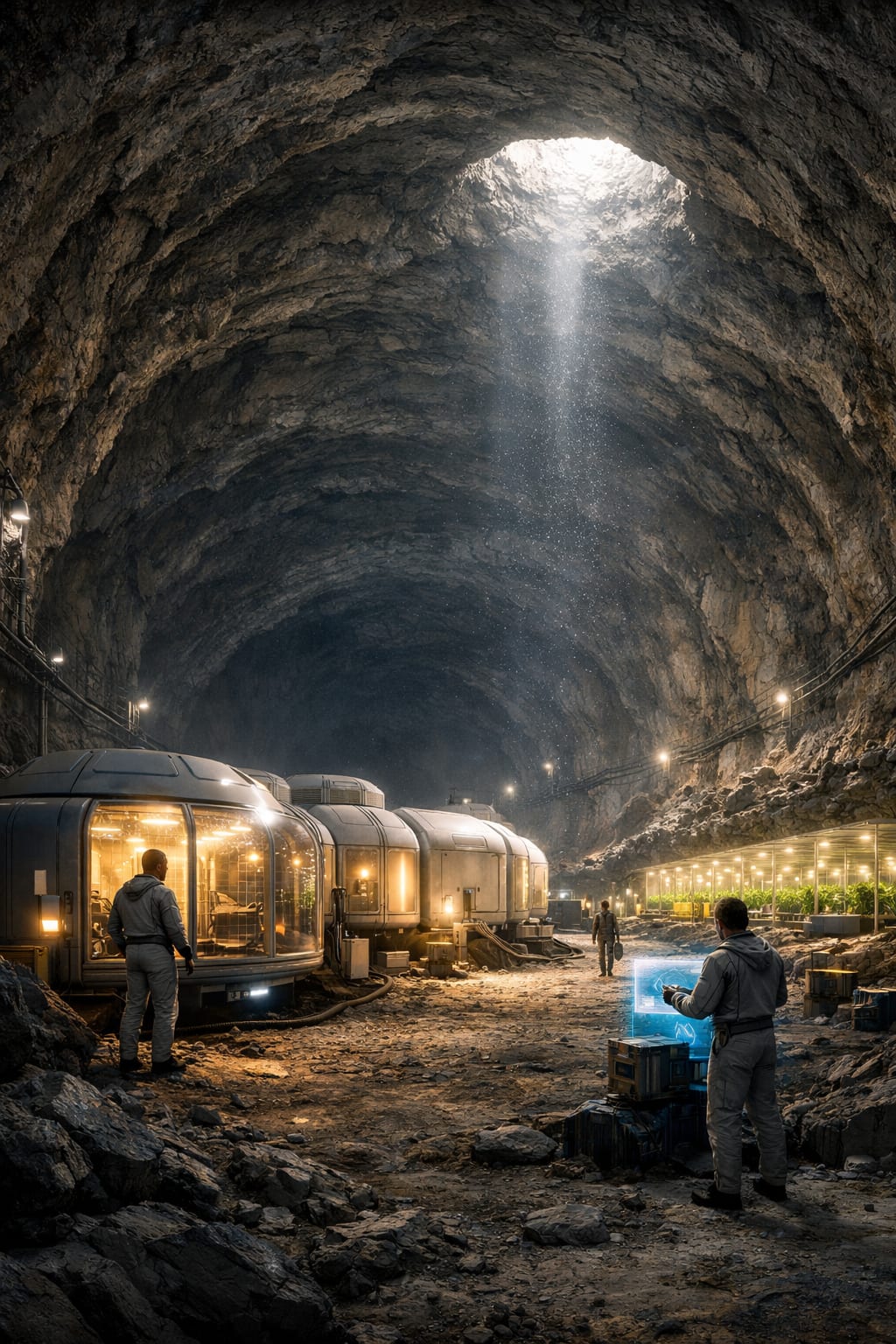
When people imagine humans living on the Moon, they often picture futuristic domes rising from a gray, dusty surface, astronauts walking beneath transparent ceilings while Earth hangs in the black sky above. This vision has dominated science fiction and even early space architecture concepts for decades. Yet the most realistic future for long-term human survival on the Moon may lie not above its surface, but deep beneath it — inside vast, ancient lava tubes carved by volcanic forces billions of years ago.
These hidden structures, long overlooked, are now considered one of the most promising solutions to the Moon’s harsh environment. Rather than fighting the Moon’s dangers with heavy shielding and complex engineering, lava tubes offer something far more elegant: natural protection already built into the lunar crust.
What Are Lunar Lava Tubes?
Lava tubes are underground tunnels formed during periods of volcanic activity. When molten lava flows across the surface, its outer layer can cool and harden while the interior continues moving. Once the lava drains away, it leaves behind a hollow tunnel. On Earth, lava tubes can be found in places like Hawaii, Iceland, and the Canary Islands — impressive, but relatively modest in size.
On the Moon, however, gravity is six times weaker. This allows lava tubes to grow to enormous proportions. Scientists estimate that some lunar lava tubes may be hundreds of meters wide and stretch for tens of kilometers. In theory, entire cities could fit inside a single tube, protected beneath layers of solid rock.
Why the Moon’s Surface Is So Dangerous
The Moon is a beautiful but extremely hostile place for humans. It lacks a thick atmosphere and a global magnetic field, leaving its surface exposed to constant bombardment by cosmic radiation and solar particles. Long-term exposure to this radiation significantly increases the risk of cancer, nervous system damage, and other serious health problems.
Temperature is another challenge. A single lunar day lasts about 14 Earth days, followed by 14 days of night. Surface temperatures can swing from over 120°C (250°F) in sunlight to below -170°C (-275°F) in darkness. Add to this the threat of micrometeorites — tiny but fast-moving particles that can puncture equipment — and it becomes clear why building permanent surface habitats is so difficult.
Lava tubes naturally solve many of these problems at once.
Nature’s Ready-Made Shield
A lava tube buried beneath tens of meters of lunar rock provides exceptional protection. The thick ceiling blocks most cosmic radiation, reducing exposure to levels comparable to or even lower than those on the International Space Station. Micrometeorites are no longer a threat, and temperatures inside the tube remain relatively stable, likely hovering around -20°C to -30°C year-round.
This stability dramatically reduces the energy and materials required to keep habitats safe and livable. Instead of constructing massive radiation shields on the surface, future settlers could rely on the Moon itself as their armor.
From Theory to Observation
For many years, lava tubes were largely theoretical. That changed with modern lunar missions. Spacecraft from NASA, the European Space Agency, and the Japanese Aerospace Exploration Agency have identified skylights — deep pits in the lunar surface believed to be collapsed sections of lava tube ceilings.
In 2017, Japan’s Kaguya spacecraft used radar data to confirm the existence of a massive underground cavity beneath the Sea of Tranquility, the same region where Apollo 11 once landed. This structure appears to be large, stable, and potentially accessible, making it a prime candidate for future exploration.
These discoveries transformed lava tubes from speculative ideas into concrete engineering targets.
Building a City Underground
A future lava tube settlement would not involve sealing the entire tunnel. Instead, engineers envision placing pressurized habitat modules inside selected sections of the tube. Inflatable structures or rigid modules could be anchored to the floor, creating living quarters, laboratories, storage areas, and communal spaces.
For example, one section might house greenhouses illuminated by artificial sunlight, where plants recycle carbon dioxide into oxygen and provide fresh food. Another could contain research labs studying lunar geology or testing technologies for Mars missions. Over time, multiple connected modules could form an underground neighborhood — protected, expandable, and remarkably Earth-like.
Robots would likely play a key role in early construction, mapping tunnels in 3D, assessing structural stability, and preparing the environment long before humans arrive.
Resources Beneath the Surface
Lava tubes may also sit near valuable lunar resources. In some regions, especially near the Moon’s poles, water ice has been detected within permanently shadowed areas. Water is the cornerstone of space settlement: it supports life, produces breathable oxygen, and can be split into hydrogen and oxygen for rocket fuel.
Living underground also makes it easier to process lunar regolith — the fine dust covering the Moon — into building materials using techniques like 3D printing. In this sense, lava tubes are not just shelters, but central hubs for a self-sustaining lunar economy.
A Training Ground for Mars
The importance of lava tubes extends beyond the Moon. Mars also contains similar underground structures. If humanity can learn to explore, modify, and inhabit lava tubes on the Moon, it will gain critical experience for future Martian colonies.
The Moon, only three days away from Earth, becomes a testing ground — a place to refine life-support systems, psychological adaptation to underground living, and long-term sustainability before venturing farther into the Solar System.
Humanity’s First Off-World Homes
Perhaps the most surprising idea is not that humans might live underground on the Moon, but that this may feel more natural than living on its surface. Protected from radiation, shielded from extreme temperatures, and surrounded by solid rock, lava tube habitats could become the first places in space where humans truly feel safe.
In a poetic twist, our path to the stars may begin not by reaching upward, but by going underground — finding refuge in the ancient volcanic veins of another world. Lunar lava tubes are more than geological curiosities. They may be the foundations of humanity’s first permanent homes beyond Earth.
About the Creator
Keep reading
More stories from Holianyk Ihor and writers in Futurism and other communities.
Mars Was Almost Habitable — Why the Red Planet Missed Its Chance
Today, Mars looks like a frozen, lifeless desert. Its surface is bombarded by radiation, its atmosphere is incredibly thin, and liquid water cannot exist for long under current conditions. Yet over the past two decades, planetary science has revealed a striking and somewhat tragic truth: Mars was once very close to being a habitable world. In many ways, it resembled an early version of Earth. So why did Mars fail where Earth succeeded?
By Holianyk Ihor2 months ago in Futurism
The Dark Side of AI Nobody Talks About
Artificial intelligence is often described as one of the greatest technological breakthroughs of the modern world. From helping doctors analyze medical data to allowing businesses to automate complex tasks, AI is rapidly becoming part of everyday life.
By Baseer Shaheen 4 days ago in Futurism
Lithium Niobate Market Encouraged Growth To USD 8.6 Billion by 2034 at 7.2% CAGR
Overview The Global Lithium Niobate Market is expected to be worth around USD 8.6 billion by 2034, up from USD 4.3 billion in 2024, and is projected to grow at a CAGR of 7.2% from 2025 to 2034.
By Hayden Kulasabout 17 hours ago in Futurism




Comments
There are no comments for this story
Be the first to respond and start the conversation.