
Mars Was Almost Habitable — Why the Red Planet Missed Its Chance
Space

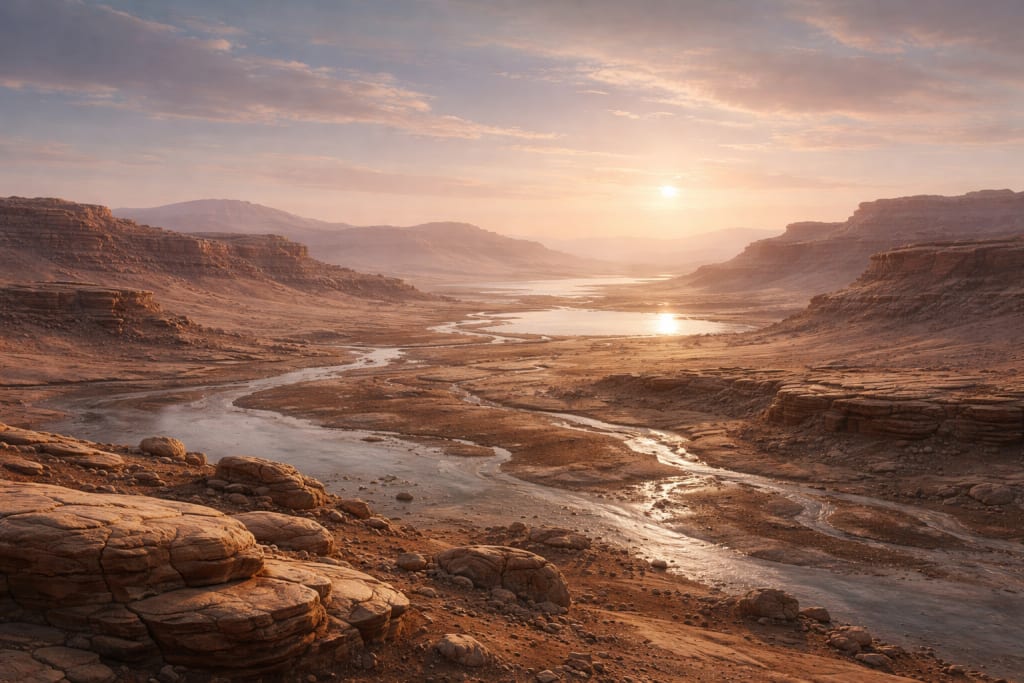
Today, Mars looks like a frozen, lifeless desert. Its surface is bombarded by radiation, its atmosphere is incredibly thin, and liquid water cannot exist for long under current conditions. Yet over the past two decades, planetary science has revealed a striking and somewhat tragic truth: Mars was once very close to being a habitable world. In many ways, it resembled an early version of Earth. So why did Mars fail where Earth succeeded?
The answer lies in a fragile chain of planetary conditions — and how one broken link can change the destiny of an entire world.
A Lost World of Water and Warmth
Around 4 billion years ago, Mars was not the barren planet we see today. Orbital imagery and data from rovers such as Curiosity and Perseverance show clear evidence of ancient rivers, lakebeds, and deltas. Some scientists even argue that a shallow ocean once covered much of Mars’ northern hemisphere.
Minerals like clay and sulfates, which form only in the presence of liquid water, are widespread across the planet. These discoveries point to a Mars that was warmer, wetter, and far more Earth-like than previously imagined. For millions — possibly hundreds of millions — of years, liquid water flowed on the surface.
On Earth, similar conditions led directly to the emergence of life. So why not on Mars?
Almost Earth, But Not Quite
Early Mars shared several key features with early Earth:
- Liquid water on the surface
- Active volcanism
- A thicker atmosphere
- Access to essential chemical elements
Both planets also orbited within the Sun’s so-called “habitable zone,” where temperatures allow water to remain liquid. But despite these similarities, one crucial difference changed everything: planetary size.
Mars is only about half the diameter of Earth and roughly one-tenth its mass. That may sound like a minor difference, but in planetary physics, size matters enormously.
The Disappearance of Mars’ Magnetic Shield
One of the most important protections for life on Earth is its global magnetic field. Generated by the movement of molten material in Earth’s core, this magnetic field creates a protective bubble — the magnetosphere — that deflects harmful solar radiation and prevents the solar wind from stripping away the atmosphere.
Mars once had a magnetic field too. Evidence of magnetized rocks in its crust suggests it existed early in the planet’s history. But because Mars is smaller, its interior cooled faster. As the core solidified, the magnetic field weakened and eventually vanished.
This was a turning point.
Without a magnetic shield, Mars became vulnerable to the solar wind — a continuous stream of charged particles from the Sun. Over time, this solar wind literally blew away much of Mars’ atmosphere.
NASA missions have confirmed that atmospheric loss is still happening today, though at a slower rate.
When the Air Thinned, the Water Vanished
As Mars lost its atmosphere, surface pressure dropped dramatically. Liquid water became unstable. It either evaporated into space or froze beneath the surface.
Even if microbial life had already appeared, the planet was becoming increasingly hostile:
- Surface temperatures dropped
- Radiation levels increased
- Water cycles collapsed
Life, especially complex life, needs long-term environmental stability. On Earth, oceans persisted for billions of years, giving evolution time to experiment, adapt, and diversify. On Mars, the habitable window may have been too short.
Mars was not lifeless — it was impatiently young in cosmic terms.
Did Life Ever Begin on Mars?
Scientists are careful not to rule out the possibility of ancient Martian life. Simple organisms, similar to bacteria on Earth, could have emerged in warm, wet environments such as lakebeds or hydrothermal systems.
If life did appear, it likely faced three possible fates:
- It died out as conditions worsened
- It never spread widely enough to survive
- It retreated underground, where liquid water and protection from radiation may still exist
Current missions are searching for biosignatures — chemical or structural traces of past life — locked within ancient rocks. The samples being collected by Perseverance may one day provide a definitive answer.
Mars as a Cautionary Tale
Mars is more than a scientific curiosity. It is a warning written in stone.
The planet shows how quickly habitability can be lost when key systems fail. A stable atmosphere, a magnetic field, and active geology are not guaranteed forever — even for planets that start out promising.
For Earth, this has profound implications. While our planet is currently thriving, Mars reminds us that planetary environments are fragile, and that long-term survival depends on maintaining complex, interconnected systems.
Why Mars Still Matters to Humanity
Understanding why Mars failed helps scientists refine the search for life beyond our solar system. Thousands of exoplanets have already been discovered, many labeled “potentially habitable.” Mars teaches us that being “almost right” is not enough.
For future human explorers and settlers, Mars is both a challenge and a lesson. It shows what a world looks like when its defenses are gone — and what technology would need to replace naturally.
Mars is a glimpse into an alternate version of planetary history: a world that stood on the edge of life, leaned forward… and fell back.
It was almost a living planet. And that “almost” makes all the difference.
About the Creator
Keep reading
More stories from Holianyk Ihor and writers in Futurism and other communities.
GITAI and the Rise of Robot Astronauts: Will Humans Be Replaced in Space?
For more than half a century, space exploration has been inseparable from the human image. Astronauts floating in zero gravity, performing spacewalks, and gazing at Earth through the cupola became powerful symbols of humanity’s ambition to go beyond its home planet. Yet in the 21st century, this image is undergoing a quiet but profound transformation. A new generation of robot astronauts is emerging, and one of the most striking representatives of this shift is the company GITAI.
By Holianyk Ihor3 months ago in Futurism
AI in Visual Effects Market Demand to Hit USD 9.6 Billion By 2033
The Global AI in Visual Effects Market is projected to reach approximately USD 9.6 Billion by 2033, rising from USD 1.6 Billion in 2023, reflecting a CAGR of 19.6% during the forecast period from 2024 to 2033. The market expansion is supported by the increasing use of artificial intelligence technologies in film production, gaming, advertising, and digital media.
By Roberto Crum4 days ago in Futurism
The digital radiology market grows as hospitals shift to digital workflows.
According to IMARC Group's latest research publication, the global digital radiology market size reached USD 3.3 Billion in 2024. Looking forward, IMARC Group expects the market to reach USD 5.0 Billion by 2033, exhibiting a growth rate (CAGR) of 4.23% during 2025-2033.
By sujeet. imarcgroupa day ago in Futurism
Lycan Lore
As the students of my 10am mythology class take their seats, I decide to steer the day's curriculum away from Greek and dive into a Western European discourse on the misaligned beliefs of the Werewolf. A tale of truth or fiction. No one really knows.
By Lamar Wigginsabout 12 hours ago in Fiction


Comments
There are no comments for this story
Be the first to respond and start the conversation.