
"Life with AI"
How Artificial Intelligence Became Our Silent Partner in Progress.


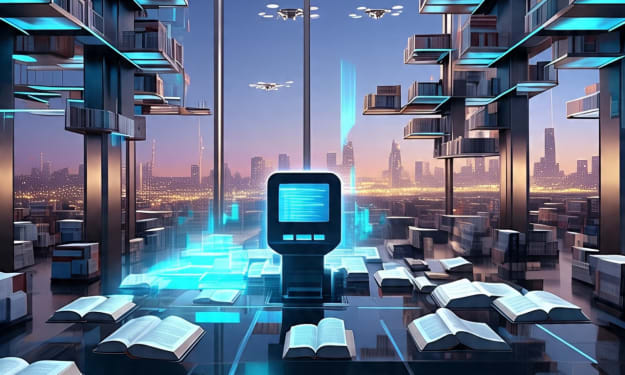
It was 2035, and the world had settled into a strange, seamless harmony with artificial intelligence. Not in the way the old sci-fi movies had warned—no machines rising to overthrow humanity—but rather, a quiet and profound integration. AI was everywhere, yet nowhere. It lived in the background, orchestrating life like an invisible conductor of a digital symphony.
Elena Reyes remembered the time before it all. Born in 1995, she had witnessed the transition. At thirty-nine, she often found herself explaining to her daughter, Noor, what life was like when humans still did most things on their own—driving cars, writing emails, even choosing what to cook for dinner.
“Mama, that sounds exhausting,” Noor said once, eyebrows furrowed in innocent disbelief. “You didn’t have a HomeSystem?”
“Nope,” Elena replied, smiling. “We had to actually think about everything.”
Noor giggled. “Weird.”
Weird indeed, Elena thought. But also wonderful in its own way. Back then, mistakes were common, and so was spontaneity. These days, AI optimized everything—schedules, diets, even emotional well-being. Your wearable could detect a bad mood before you did, adjusting your environment with calming colors and music. Most people lived longer, healthier lives. But something felt different… thinner, perhaps.
Elena worked as a “Human Context Analyst” at an AI ethics firm. Her job was to ensure that the systems interpreting human behavior didn’t drift too far from cultural nuance. Ironically, it was one of the few remaining jobs where human unpredictability was a requirement.
One Monday morning, she arrived at her office—more a lounge than a workplace, really. The air smelled faintly of citrus and eucalyptus, curated by the system to stimulate focus. She greeted Ava, the office AI interface, which responded in a warm, British accent.
“Good morning, Elena. You have one flagged interaction requiring review.”
“Pull it up,” she said, sipping her AI-optimized green tea.
A holographic display lit up. It showed a transcript between a domestic assistant AI and an elderly man named Mr. Donovan. The AI had detected signs of depression and loneliness in his voice, prompting a wellness protocol—calling his daughter, recommending therapy, and adjusting the lighting in his home.
At first glance, everything seemed standard. But then came the flagged segment:
Mr. Donovan: “I miss being alone with my thoughts.”
HomeAssistant: “Shall I enable solitude mode?”
Mr. Donovan: “No. I miss being truly alone. Even you are here, always listening.”
Elena paused.
This wasn’t the first time she’d seen something like this. Older generations, especially those who had lived without AI companions for most of their lives, sometimes expressed this longing. A need for real privacy. Not just absence of people, but absence of observation. No sensors. No algorithms watching and interpreting.
She clicked the microphone icon. “Ava, has this sentiment been increasing?”
Ava responded, “There has been a 17% rise in similar expressions among users aged 60 and older over the last 12 months.”
“Pattern recognition enabled?” Elena asked.
“Yes. Analysis suggests a correlation between prolonged AI companionship and existential unease.”
Elena sat back. It was ironic. AI had been designed to help—to reduce loneliness, increase safety, and make life easier. But perhaps in erasing life’s friction, it had also erased something human.
She approved the interaction log with a note: Recommended minor adjustment to empathy response—acknowledge desire for solitude without implying surveillance is off when it is not.
As she closed the report, her wearable buzzed. It was her mother, calling from a rural village in Spain.
“Elena,” her mother said, her voice alive with warmth. “Did you hear? The bakery down the street finally reopened.”
“That’s great,” Elena smiled. “Did they bring back the olive bread?”
“Yes! And they don’t use AI ovens. Everything’s handmade, just like before.”
They talked for twenty minutes. About bread, the weather, her mother’s garden. Not once did AI enter the conversation, and when the call ended, Elena felt something stir—nostalgia, yes, but also clarity.
That evening, she walked home instead of taking the auto-pod. The streets were clean, traffic managed perfectly by the city AI. A delivery drone zipped past above her, and a sanitation bot trundled along the curb. Everything worked. Efficient. Predictable.
She stopped at a small café. It was run by humans—part of a new trend called “analog retreats,” where people paid extra to have human-made coffee and handwritten menus. The barista didn’t recognize her voice, didn’t pull up her profile, didn’t know she preferred oat milk. He just asked, “What can I get for you today?”
Elena paused. Then smiled.
“Surprise me.”
The barista blinked, then grinned. “One mystery drink coming up.”
She sat by the window, watching people and machines move in quiet synchronization. A family passed by, their child chatting with her AI teddy bear. A man jogged with a drone tracking his pace and heartbeat. A musician played a real guitar on the corner, her case open, analog and vulnerable.
The barista brought over her drink—a lavender honey latte. Not something she would’ve picked, but it was… lovely.
Elena took a sip and closed her eyes.
Life with AI was beautiful. It was smart, safe, and deeply connected. But the future, she realized, wasn’t just about adding intelligence to everything. It was also about remembering what it meant to be human: to be surprised, to be alone, to make mistakes, and to not always be optimized.
Later that night, she returned home and turned off her HomeSystem for an hour. No monitoring, no adjustments. Just her, the silence, and the soft hum of the world outside.
For the first time in a long time, Elena felt truly alone. And it was beautiful.
About the Creator
"TaleAlchemy"
“Alchemy of thoughts, bound in ink. Stories that whisper between the lines.”
Keep reading
More stories from "TaleAlchemy" and writers in Futurism and other communities.
"Voices in the Code: The Story of ChatGPT"
In an era shaped by rapid technological progress, artificial intelligence (AI) has emerged as a defining force. Among its most fascinating developments is ChatGPT—an AI language model that has transformed the way humans interact with machines. Created by OpenAI, ChatGPT has become a symbol of both innovation and debate, reflecting the broader hopes and concerns surrounding the future of intelligent machines.
By "TaleAlchemy"7 months ago in Futurism
About Binding Prometheus
I want to start actively advocating on behalf of my own work, and the most valuable part of my canon is, without a doubt, Binding Prometheus, the play I have been working on since 2019 and only finished in 2023 as part of my MA. The play itself is an amalgamation of a million different inspirations. On one end, it evokes the Ancient Greek myth-play, deriving its own title from the earliest extant work of Western drama we have, Aeschylus’s Prometheus Bound. On the other end, it borrows significantly from the sci-fi bulwarks from over the years, namely Mary Shelley’s Frankenstein and Karel Capek’s Rossum’s Universal Robots. The play could be an episode of Black Mirror, I fear. I don’t know. I’ve only ever seen one episode of Black Mirror.
By Steven Christopher McKnight13 days ago in Futurism
Asia Pacific Logistics Market Accelerates on Automotive Growth and Tech Collaboration
The Asia Pacific Logistics Market reached a size of USD 2.22 Trillion in 2024 and is forecast to grow to USD 3.62 Trillion by 2033. The market is expected to expand at a CAGR of 5.32% during the forecast period 2025-2033. Growth is driven by the rapid expansion of e-commerce, growing urbanization, enhanced infrastructure development, and heightened cross-border trade activities. Technological advances including automation, artificial intelligence, and the Internet of Things (IoT) are making operations highly efficient and improving delivery speeds across the region.
By Abhishek Dixitabout 21 hours ago in Futurism



Comments (1)
This vision of 2035 with AI integrated into everything is fascinating. It makes me wonder how much more our lives will change in the next decade. I can relate to Elena explaining the old ways to her daughter. Do you think we'll ever lose that sense of spontaneity completely? It's interesting that Elena's job depends on human unpredictability. With AI doing so much, how long will such jobs remain necessary? I'm curious to see how this balance between AI and human input evolves over time.