Latest Stories
Most recently published stories in Futurism.
Outrun Stories #56
Video available here: https://youtu.be/tq_AHXTF-0w He’s on the edge of his seat now, fat, balding and sweaty old Chapman. This case might make his fucking career, give him that pension he’s always dreamed of, well, I’m not going to disappoint, am I?
By Outrun Stories8 years ago in Futurism
Why 'Timeless' Deserves to Get Cancelled, AGAIN
No, this is no case of deja vu, nor the result of a closed time-like curve. Timeless fans are looking at their favorite show, potentially being canceled again, because that's what happens when you do the same thing over and over. You get the same results. Einstein even said so and added, that to expect anything different is the definition of insanity. As a result, if the show producers, writers, and their beloved Clockblockers thought anything else would be happening now, they're all nuts, which of course, doesn't surprise me at all. I predicted these circumstances way before the middle of its first season, when I was still a fan. All that's over now.
By Marshall Barnes8 years ago in Futurism
Outrun Stories #55
Video available here: Youtube “Yeah, promises, right? Just like the government promised to try and help the incident zones out? Just like the people in the unaffected areas said they’d protest for us. Just like you agency spooks said you’d do something about the mutants in the past,” I say and grimace.
By Outrun Stories8 years ago in Futurism
Project Blue Book
Project Blue Book started with the Roswell UFO crash of 1947. What the extraterrestrials are doing is studying us as they have watched over us for billions of years, since life began on this planet and went through many evolutionary changes. Project Blue Book has some heavy documentation on various sightings from 1947-1969. Thousands of UFO sightings were reported, and other projects had been undertaken such as Sign in 1947, and Grudge (1949). Project Blue Book was used to determine whether UFOs are a threat to national security, and to analyze scientific data collected on them.
By Iria Vasquez-Paez8 years ago in Futurism
Review of 'The Crossing' 1.7
On the heels of ABC's announcement that it would not be picking up The Crossing for a second season, it posted a strangely satisfying and important episode. Of course, that's just a coincidence, since the episode was written and produced long before the cancellation, but it somehow seems significant nonetheless.
By Paul Levinson8 years ago in Futurism
'The Crossing': A Comment on Our Present and a Prediction for Our Future
Warning: Minor series spoilers below. ABC's new show The Crossing, created by the same producers who brought us Lost, follows the story of a police sheriff named Jude Ellis who discovers tons of bodies washed up on a beach in his small town. After talking to the few survivors, it doesn't take long for him to realize that this isn't just a shipwreck, these people have a more interesting story to tell.
By Sarah Franchi8 years ago in Futurism
Comparing Apes to Early Hominins
Sociologists, anthropologists, psychologists, and other scientists often use data collected by field researchers to draw comparisons between humans and apes. Jane Goodall's research with chimpanzees is legendary. Diane Fossey researched gorillas. Primate centers from around the world have given us reams of data—enough to last several lifetimes of compilation. Their groundbreaking research gave science all it needed to interpret this data to model early hominin evolution, instead of seeing it for what it was: a detailed view of ape life today. The data is valuable in that we now know apes almost as certainly as we know ourselves. The problem is, it is often used to extrapolate "facts" about the LCA (last common ancestor). The truth is simple; apes have been evolving for 5-8 million, as have we. Apes bear no more resemblance to the LCA than we do. We don't think the LCA had agriculture, architecture, or dashing commuters, so why do some researchers insist that apes give us insight to early hominins? Apes are not primitive. They are the current apex of their individual species, as we are of ours. It took millions of years for apes to get where they are. We evolved to speak, walk on two legs, and see the abstract. They evolved to be quadrupedal tree climbers that can live in their environment without destroying it.
By Monica Bennett8 years ago in Futurism
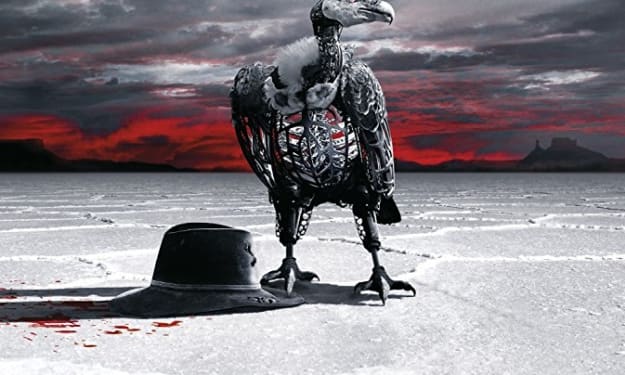
Review of 'Westworld' 2.4
We already knew that the AI technology used to construct hosts could construct a host-like version — an android — of a human being who once was alive. That, after all, is what Bernard is. But in Westworld 2.4, we get a poignant and telling exposition of how this figures (or figured) in the life of William, whose older self, apparently obtained through just natural aging (though, who knows), is The Man in Black.
By Paul Levinson8 years ago in Futurism
For the Love of Star Wars
Why is Star Wars regarded by millions as the greatest movie franchise of all time? Well, what’s not to love about heroes and heroines fighting against evil and darkness with lightsaber duels, laser blasters, and cross-galaxy hyperspace chases thrown into the mix?
By Eric Allen8 years ago in Futurism
'Nature-Culture': Embracing Genetic Modification
From unprecedented globalisation to industrial refuse, the contemporary world has changed the face of the earth, prompting geologists to define it as the Anthropocene, “the age of humans” (Purdy, 2015: 1). Jedediah Purdy elucidates that as “a driver of global change, humanity has outstripped geology,” eliciting tensions and anxieties toward future conditions of the earth (Purdy, 2015: 1). Science fiction illustrates these feelings in futuristic stories, usually situated in a post-apocalyptic world where a revelation often portends that worse conditions await regarding environmental sustainability and human lives. Molly Wallace argues that such fictions intend to “suggest that the means to the apocalyptic futures are already in the works and […] to prevent the outcome imagined” (Wallace, 2016: 98). Science fiction accentuates present conditions in an imaginary future, resonating with Fredric Jameson’s claim that science fiction does not aim to “give us ‘images’ of the future […] but rather to defamiliarize and restructure our experience of our own present” (Jameson, 1982: 151). By positioning the present in unfamiliar contexts, one is able to dissociate from the present and thus gain a broader perspective, encouraging the chance to take preventative actions against the depletion and devastation of the earth. Perceived as both preventative and aggravating, genetic modification often features in science fiction novels, either as a necessary action to enable human survival or as a man-made evil that inevitably becomes humanity’s downfall.
By Harriet Weston8 years ago in Futurism