
Laptop Market Size and Forecast 2025–2033: Global Industry Outlook, Growth Drivers, and Future Trends
How Portability, Remote Work, and Digital Lifestyles Are Reshaping the Global Laptop Industry

Global Laptop Market Outlook 2025–2033
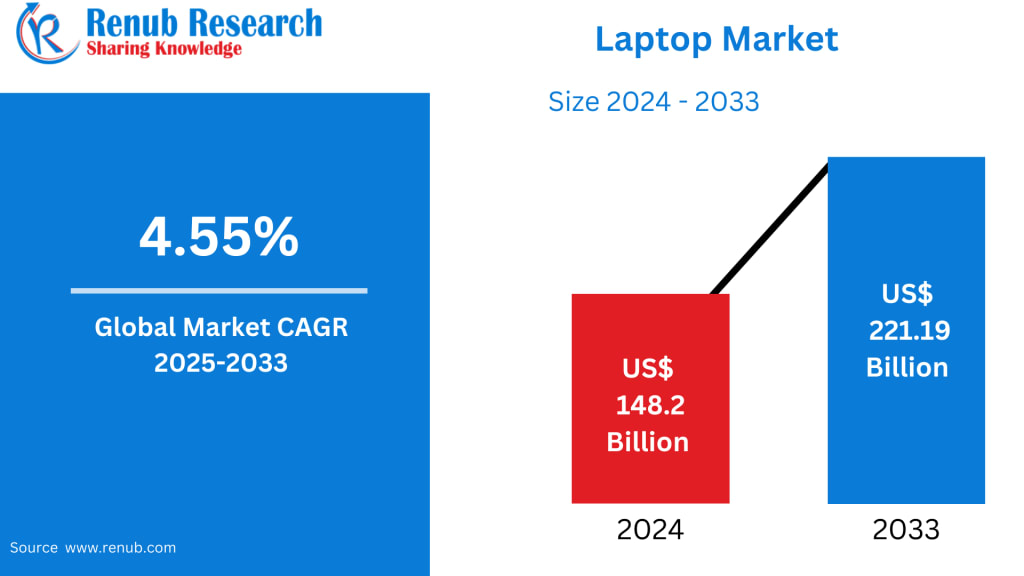
The Global Laptop Market is entering a new phase of sustained growth, driven by evolving work cultures, rapid digital transformation, and rising demand for portable computing solutions. According to Renub Research, the global laptop market was valued at US$ 148.2 billion in 2024 and is expected to reach US$ 221.19 billion by 2033, growing at a CAGR of 4.55% from 2025 to 2033.
This steady expansion reflects the growing role of laptops as essential tools for work, education, entertainment, and communication. As the boundaries between professional and personal life blur, laptops have transformed from simple computing devices into productivity hubs that support hybrid work, e-learning, digital creativity, and online collaboration.
Global Laptop Industry Overview
A laptop, also known as a notebook computer, is a portable personal computer designed for flexibility, convenience, and performance. It integrates all the functions of a desktop computer into a compact form, including a keyboard, display, touchpad, processor (CPU), memory (RAM), storage (SSD/HDD), and connectivity options such as Wi-Fi, Bluetooth, and USB ports.
Modern laptops are capable of handling everything from basic browsing and document creation to demanding tasks like software development, video editing, gaming, data analysis, and graphic design. The increasing reliance on digital tools in everyday life has elevated laptops from optional gadgets to indispensable necessities.
As more people work remotely, study online, or travel while working, laptops provide unmatched portability and versatility. They have become the backbone of the global digital ecosystem.
Key Factors Driving the Laptop Market Growth
1. Rise of Digital Transformation and Remote Work
Digital transformation across industries has fundamentally changed how people work. Companies are increasingly adopting cloud-based tools, virtual collaboration platforms, and remote access systems, making laptops the primary work device for millions of professionals worldwide.
Hybrid work models have become standard in many sectors, requiring employees to stay productive from home, coworking spaces, or while traveling. As a result, demand for laptops with strong security, long battery life, high-quality webcams, and noise-canceling microphones has surged.
Enterprises now prioritize laptops that ensure seamless connectivity, data protection, and performance, making them central to modern workplace strategies.
2. Rapid Expansion of the Education Sector
The education sector has emerged as one of the strongest drivers of laptop demand. The shift toward e-learning, digital classrooms, and virtual collaboration has made laptops essential for students and educators alike.
Laptops support online lectures, digital assignments, research, and interactive learning platforms. Governments and educational institutions are increasingly investing in digital infrastructure, encouraging laptop adoption at all academic levels.
As education becomes more technology-driven, laptops are no longer optional learning tools—they are foundational to the future of education.
3. Growing Need for Portability and Mobility
Mobility has become a defining feature of modern lifestyles. Professionals, students, freelancers, and digital nomads all need computing devices that are lightweight, compact, and powerful.
Laptop manufacturers are responding by designing ultra-thin devices that combine portability with performance. Advances in battery technology, processors, and materials have enabled laptops to deliver desktop-level performance in portable formats.
This demand for mobility continues to fuel consistent market growth across regions.
4. Growth of Gaming and Creative Communities
The global rise of gaming, content creation, and digital entertainment has also boosted laptop sales. High-performance gaming laptops with advanced GPUs, fast refresh-rate displays, and superior cooling systems are increasingly popular.
Similarly, creators and designers prefer laptops capable of handling graphics-intensive workloads. As creative industries expand, laptops are becoming essential tools for professional and hobbyist users alike.
Challenges Facing the Laptop Market
Changing Consumer Preferences
The rise of tablets, smartphones, and hybrid devices has altered consumer behavior, especially for casual users. Many users now rely on mobile devices for everyday tasks such as browsing, streaming, and communication.
This shift has reduced demand for traditional laptops in some segments, pushing manufacturers to innovate through 2-in-1 devices, touchscreen laptops, and AI-powered models to maintain relevance.
Intense Market Competition
The laptop industry is highly competitive, with major brands offering similar hardware specifications. This has resulted in price pressure, reduced margins, and heavy marketing investments.
To differentiate themselves, companies are focusing on design innovation, sustainability, software optimization, customer experience, and ecosystem integration. However, maintaining profitability remains challenging in such a saturated market.
Laptop Market Overview by Regions
North America
North America continues to dominate the high-performance laptop segment, driven by strong demand from professionals, students, and enterprises. Remote work adoption, advanced infrastructure, and high purchasing power support market growth.
United States Laptop Market
The U.S. laptop market is shaped by diverse consumer needs, ranging from business professionals to gamers and students. The widespread adoption of remote work and online education has significantly increased laptop sales.
Manufacturers are also focusing on sustainability, introducing energy-efficient devices and recycled materials to appeal to environmentally conscious consumers. Innovation remains a defining feature of the U.S. market.
United Kingdom Laptop Market
In the UK, laptop demand is being fueled by AI integration, hybrid work models, and cloud computing adoption. Consumers increasingly prefer smart laptops that deliver improved performance, intelligent features, and seamless connectivity.
The UK market is expected to grow steadily as digital transformation accelerates across industries.
India Laptop Market
India is one of the fastest-growing laptop markets globally. Rising digital literacy, government digitization initiatives, remote work adoption, and online education are driving strong demand.
AI-powered laptops, affordable devices, and locally manufactured models are gaining popularity. With a young population and expanding tech ecosystem, India presents long-term growth opportunities for manufacturers.
Middle East & Africa
The laptop market in the Middle East, including Saudi Arabia and the United Arab Emirates, is expanding due to increasing digital adoption, smart city initiatives, and hybrid work culture.
Government investments in technology and education are further supporting market growth, making the region an emerging hotspot for laptop sales.
Laptop Market Segmentation
By Type
Traditional Laptop
2-in-1 Laptop
By Screen Size
Up to 10.9”
11” to 12.9”
13” to 14.9”
15” to 16.9”
More than 17”
By End Use
Personal
Business
Gaming
Regional Outlook
North America: United States, Canada
Europe: France, Germany, Italy, Spain, United Kingdom, Belgium, Netherlands, Turkey
Asia-Pacific: China, Japan, India, Australia, South Korea, Thailand, Malaysia, Indonesia, New Zealand
Latin America: Brazil, Mexico, Argentina
Middle East & Africa: South Africa, Saudi Arabia, United Arab Emirates
Key Companies in the Global Laptop Market
The global laptop market is highly competitive, with leading players focusing on innovation, performance, and ecosystem integration.
Major companies include:
Acer Inc.
Apple Inc.
ASUSTeK Computer Inc.
Dell
HP Development Company, L.P.
Huawei Technologies Co., Ltd.
LG
Lenovo
These companies compete on design, battery life, processing power, sustainability, and software integration, continuously launching new models to capture market share.
Future Trends Shaping the Laptop Market
The next decade will see laptops evolve into AI-powered, energy-efficient, and highly personalized devices. Features such as on-device AI processing, smarter battery management, enhanced security, and cloud integration will define next-generation laptops.
Sustainability will also become a major differentiator, with manufacturers increasingly using recycled materials and energy-efficient components. As digital lifestyles continue to expand, laptops will remain central to work, education, and entertainment worldwide.
Final Thoughts
The global laptop market is on a steady growth trajectory, driven by remote work, digital education, mobility, and technological innovation. With the market projected to reach US$ 221.19 billion by 2033, laptops will remain indispensable tools in the modern digital economy.
As work, learning, and entertainment become increasingly digital and location-independent, laptops will continue to evolve—offering smarter, lighter, and more powerful solutions that meet the demands of a connected world.
About the Creator
Keep reading
More stories from Aaina Oberoi and writers in Futurism and other communities.
Global Logistics Market Size and Forecast 2025–2033: The Backbone of Modern Global Commerce
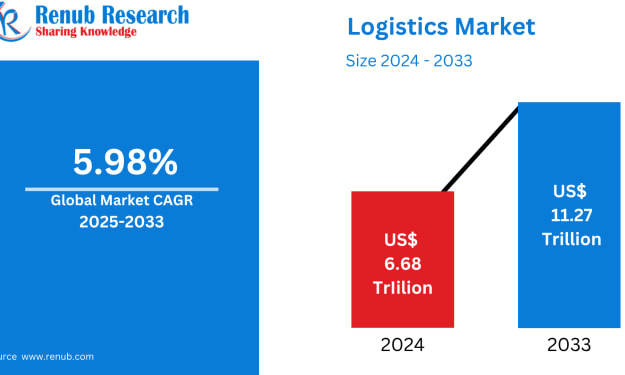
Introduction: Logistics as the Engine of Global Trade In 2024, the Global Logistics Market was valued at US$ 6.68 trillion and is projected to reach US$ 11.27 trillion by 2033, expanding at a robust CAGR of 5.98% during 2025–2033, according to Renub Research. This rapid growth reflects the expanding role of logistics as a critical enabler of global commerce, industrial development, and digital trade.
By Aaina Oberoiabout 10 hours ago in Futurism
About Binding Prometheus
I want to start actively advocating on behalf of my own work, and the most valuable part of my canon is, without a doubt, Binding Prometheus, the play I have been working on since 2019 and only finished in 2023 as part of my MA. The play itself is an amalgamation of a million different inspirations. On one end, it evokes the Ancient Greek myth-play, deriving its own title from the earliest extant work of Western drama we have, Aeschylus’s Prometheus Bound. On the other end, it borrows significantly from the sci-fi bulwarks from over the years, namely Mary Shelley’s Frankenstein and Karel Capek’s Rossum’s Universal Robots. The play could be an episode of Black Mirror, I fear. I don’t know. I’ve only ever seen one episode of Black Mirror.
By Steven Christopher McKnight23 days ago in Futurism
Saudi Arabia Renewable Energy Market: Clean Power Expansion, Investment Momentum & Outlook
According to IMARC Group's latest research publication, Saudi Arabia renewable energy market size reached 2.09 Gigawatt in 2025. The market is projected to reach 40.42 Gigawatt by 2034, exhibiting a growth rate of 35.07% during 2026-2034.
By Faisal Al-Harbiabout 23 hours ago in Futurism
Affection and Healing for Yourself
During the night of the last quarter moon, I gathered my ritual supplies. I carefully handled the chunk of black tourmaline that would protect me from your overall negative and narcissistic energy. I carefully walked the house with my stick of selenite in hand, asking the universe to cleanse our working space.
By Alisha Wilkins ✒️🦋🖋️4 days ago in Fiction


Comments
There are no comments for this story
Be the first to respond and start the conversation.