
Global Logistics Market Size and Forecast 2025–2033: The Backbone of Modern Global Commerce
How e-commerce expansion, global trade, and smart technologies are reshaping a US$11.27 trillion logistics industry

Introduction: Logistics as the Engine of Global Trade
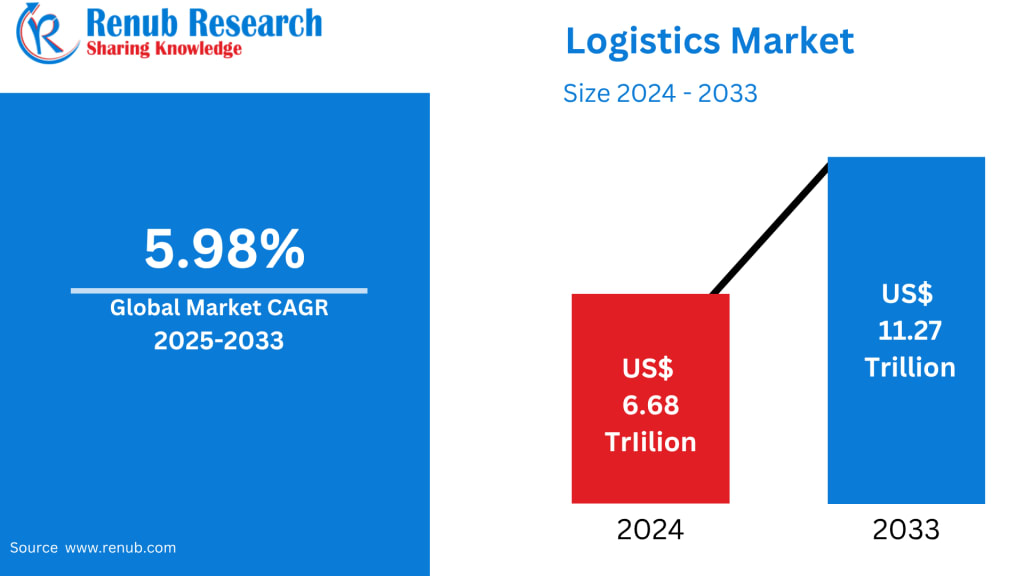
In 2024, the Global Logistics Market was valued at US$ 6.68 trillion and is projected to reach US$ 11.27 trillion by 2033, expanding at a robust CAGR of 5.98% during 2025–2033, according to Renub Research. This rapid growth reflects the expanding role of logistics as a critical enabler of global commerce, industrial development, and digital trade.
From the seamless delivery of online purchases to the complex movement of industrial raw materials across continents, logistics is no longer just a support function—it is a strategic industry driving economic competitiveness. As businesses globalize operations and consumers demand faster, cheaper, and more reliable deliveries, logistics has evolved into a technology-powered ecosystem that connects producers, suppliers, and customers worldwide.
Global Logistics Market Outlook
Logistics refers to the planning, implementation, and control of the efficient flow and storage of goods, services, and related information from origin to consumption. It includes transportation, warehousing, inventory management, packaging, and supply chain coordination.
Today, logistics underpins nearly every industry. In e-commerce and retail, it ensures rapid order fulfillment. In manufacturing, it supports just-in-time supply chains. In healthcare, it enables the secure delivery of life-saving medicines and vaccines. Agriculture relies on cold-chain logistics for perishables, while construction and infrastructure projects depend on timely material availability.
With globalization accelerating cross-border trade, logistics has become the backbone of international commerce. Emerging technologies such as AI, IoT, blockchain, and robotics are transforming supply chains by enabling real-time tracking, predictive planning, and automated operations. As a result, logistics is becoming faster, smarter, and more resilient than ever before.
Key Growth Drivers in the Global Logistics Market
1. Rapid Growth of E-Commerce
The explosive growth of e-commerce has fundamentally reshaped logistics networks. Consumers now expect same-day or next-day delivery, flexible return options, and real-time tracking, forcing logistics companies to modernize operations.
Automated warehouses, micro-fulfillment centers, digital inventory systems, and optimized last-mile delivery models are becoming standard. Both domestic and cross-border parcel volumes are surging, making e-commerce logistics one of the fastest-growing segments.
In June 2024, Kuehne+Nagel began construction of a major e-commerce warehouse near Dubai’s Al Maktoum Airport. The facility, scheduled to open in 2025, will offer over 23,000 square meters of capacity and 45,000 pallet positions, highlighting how logistics players are expanding to meet online retail demand.
2. Technological Advancements in Supply Chain Management
Technology is redefining logistics efficiency. AI-powered demand forecasting, IoT-enabled tracking, blockchain-based transparency, and robotics-driven warehouses are reducing costs and errors while improving reliability.
In April 2024, Manhattan Associates partnered with Agility Robotics to deploy bipedal robots in warehouses, addressing labor shortages and boosting productivity. Predictive analytics and route optimization tools are also enabling faster deliveries and lower fuel consumption.
As companies increasingly depend on digital logistics platforms, technology-driven logistics services are becoming a core competitive differentiator.
3. Globalization and International Trade Expansion
Global trade continues to expand as manufacturers source materials internationally and serve customers across borders. Free trade agreements and emerging market consumption are driving cross-border freight volumes.
To manage complex regulations and multimodal transport, businesses are relying on multinational logistics providers with integrated global networks. In September 2024, FedEx partnered with Nimble Robotics to enhance autonomous fulfillment, reflecting the industry’s focus on scalable, automated international logistics.
Challenges in the Global Logistics Market
Rising Fuel and Transportation Costs
Fuel price volatility remains a major challenge, especially for road and air freight. Rising freight rates, driver shortages, and environmental regulations are increasing operational costs, forcing logistics providers to optimize routes, invest in alternative fuels, and adopt energy-efficient fleets.
Infrastructure Gaps in Emerging Markets
In many developing economies, logistics growth is constrained by poor roads, congested ports, inefficient customs procedures, and limited modern warehousing. These bottlenecks increase costs and delivery times, highlighting the need for large-scale infrastructure investment to unlock regional logistics potential.
Segment Analysis: Key Areas Driving Market Expansion
Transportation Services Logistics Market
Transportation remains the backbone of global logistics, covering road, rail, air, and sea freight. Digital fleet management, GPS tracking, and intermodal connectivity are improving delivery accuracy and reducing transit times, making transportation services the largest and most vital segment.
Inventory Management Logistics Market
Advanced inventory management systems now use real-time data and automation to prevent stockouts and overstocking. This segment is crucial for e-commerce, retail, and manufacturing industries where availability and efficiency directly affect revenue and customer satisfaction.
E-Commerce Logistics Market
E-commerce logistics has transformed the industry from bulk shipping to high-volume, small-parcel movement. Fulfillment centers, automated packaging, and reverse logistics systems for returns are driving innovation. Fast delivery and hassle-free returns have become critical competitive factors.
3PL Logistics Market
Third-party logistics providers offer integrated solutions including transportation, warehousing, and distribution, allowing businesses to focus on core operations. The 3PL market is expanding rapidly due to its scalability and cost efficiency.
In July 2023, CJ Logistics invested US$57 million to expand logistics centers in North America, strengthening its capabilities in automation, AI, and data analytics to support growing export volumes.
Forward Logistics Market
Forward logistics manages the flow of goods from manufacturers to end consumers. Technologies like RFID, barcode scanning, and real-time tracking have improved visibility and accuracy, particularly for retail and consumer goods sectors.
Domestic Logistics Market
Domestic logistics focuses on intra-country transport. Urbanization and rapid delivery expectations are driving investments in regional hubs and urban distribution centers. Government infrastructure investments are further strengthening this segment.
Waterways Logistics Market
Sea and inland water transport remains essential for bulk cargo such as oil, machinery, and agricultural products. Smart ports and automated cargo handling are improving efficiency, making waterways logistics indispensable for global trade.
Healthcare Logistics Market
Healthcare logistics demands strict temperature control, traceability, and compliance. With the rise of biologics and personalized medicine, cold chain logistics and time-sensitive deliveries are becoming increasingly important for pharmaceutical supply chains.
Regional Market Insights
United States Logistics Market
The U.S. is the world’s most advanced logistics market, driven by strong e-commerce demand and cutting-edge automation. In May 2024, Maersk opened a new air freight gateway in Miami, improving connectivity between Asia, Latin America, and the U.S., and reinforcing the country’s role as a global logistics hub.
France Logistics Market
France benefits from strategic geographic positioning, strong infrastructure, and sustainability initiatives. Investments in green logistics and last-mile delivery solutions are shaping the market. UPS’s acquisition of MNX Global Logistics in 2023 strengthened its healthcare logistics capabilities across Europe.
India Logistics Market
India’s logistics sector is rapidly transforming through government initiatives like Gati Shakti and the National Logistics Policy. In December 2024, Amazon launched Amazon Freight and Amazon Shipping services across India, expanding affordable B2B and B2C logistics solutions nationwide.
Saudi Arabia Logistics Market
Saudi Arabia’s Vision 2030 strategy is turning the Kingdom into a global logistics hub. Investments in ports, railways, and logistics zones are accelerating growth. In December 2024, SAL Saudi Logistics Services announced plans for an IPO, highlighting investor confidence in the sector.
Market Segmentation Overview
By Service:
Transportation, Warehousing & Distribution, Freight Forwarding, Inventory Management, Value-Added Services, Integration & Consulting
By Category:
Conventional Logistics, E-Commerce Logistics
By Model Type:
2PL, 3PL, 4PL
By Type:
Forward Logistics, Reverse Logistics
By Operation:
Domestic, International
By Mode of Transport:
Airways, Railways, Roadways, Waterways
By End Use:
Manufacturing, Retail, Consumer Goods, Food & Beverages, Healthcare, IT Hardware, Chemicals, Automotive, Construction, Telecom, Oil & Gas, Others
Key Players Covered
Deutsche Post AG
United Parcel Service of America, Inc.
FedEx
Maersk
CEVA Logistics (CMA CGM Group)
DB Schenker
Kuehne + Nagel
Nippon Express
Each company is analyzed across overview, key personnel, strategies, and revenue performance, providing a comprehensive competitive landscape.
Final Thoughts: Logistics as the Future of Global Growth
The global logistics industry is entering a transformative era. As e-commerce volumes soar, global trade intensifies, and technology reshapes supply chains, logistics will continue to evolve as a strategic pillar of economic development.
With the market projected to exceed US$11 trillion by 2033, logistics providers that invest in automation, sustainability, and digital platforms will define the next decade of global commerce. In a world that demands speed, reliability, and transparency, logistics is no longer behind the scenes—it is at the very heart of progress.
About the Creator
Keep reading
More stories from Aaina Oberoi and writers in Futurism and other communities.
Global Artificial Insemination Market Size and Forecast 2025–2033
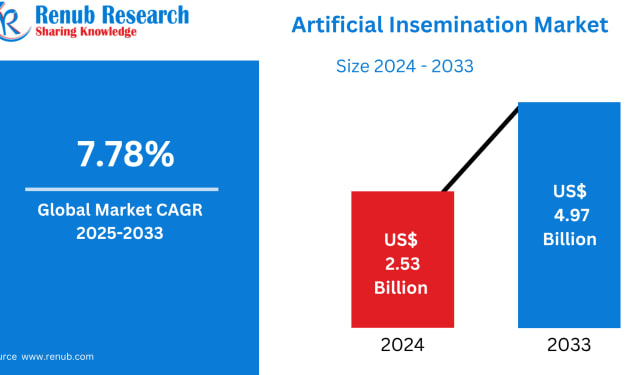
Global Artificial Insemination Market Overview The global artificial insemination market is entering a phase of sustained growth, driven by rising infertility rates, rapid technological innovation, evolving family structures, and expanding healthcare infrastructure. According to Renub Research, the market is expected to grow from US$ 2.53 billion in 2024 to US$ 4.97 billion by 2033, registering a strong CAGR of 7.78% during 2025–2033.
By Aaina Oberoi2 days ago in Futurism
About Binding Prometheus
I want to start actively advocating on behalf of my own work, and the most valuable part of my canon is, without a doubt, Binding Prometheus, the play I have been working on since 2019 and only finished in 2023 as part of my MA. The play itself is an amalgamation of a million different inspirations. On one end, it evokes the Ancient Greek myth-play, deriving its own title from the earliest extant work of Western drama we have, Aeschylus’s Prometheus Bound. On the other end, it borrows significantly from the sci-fi bulwarks from over the years, namely Mary Shelley’s Frankenstein and Karel Capek’s Rossum’s Universal Robots. The play could be an episode of Black Mirror, I fear. I don’t know. I’ve only ever seen one episode of Black Mirror.
By Steven Christopher McKnight23 days ago in Futurism



Comments
There are no comments for this story
Be the first to respond and start the conversation.