
Killer Asteroid: How Humanity Is Preparing for the Inevitable Impact
Space

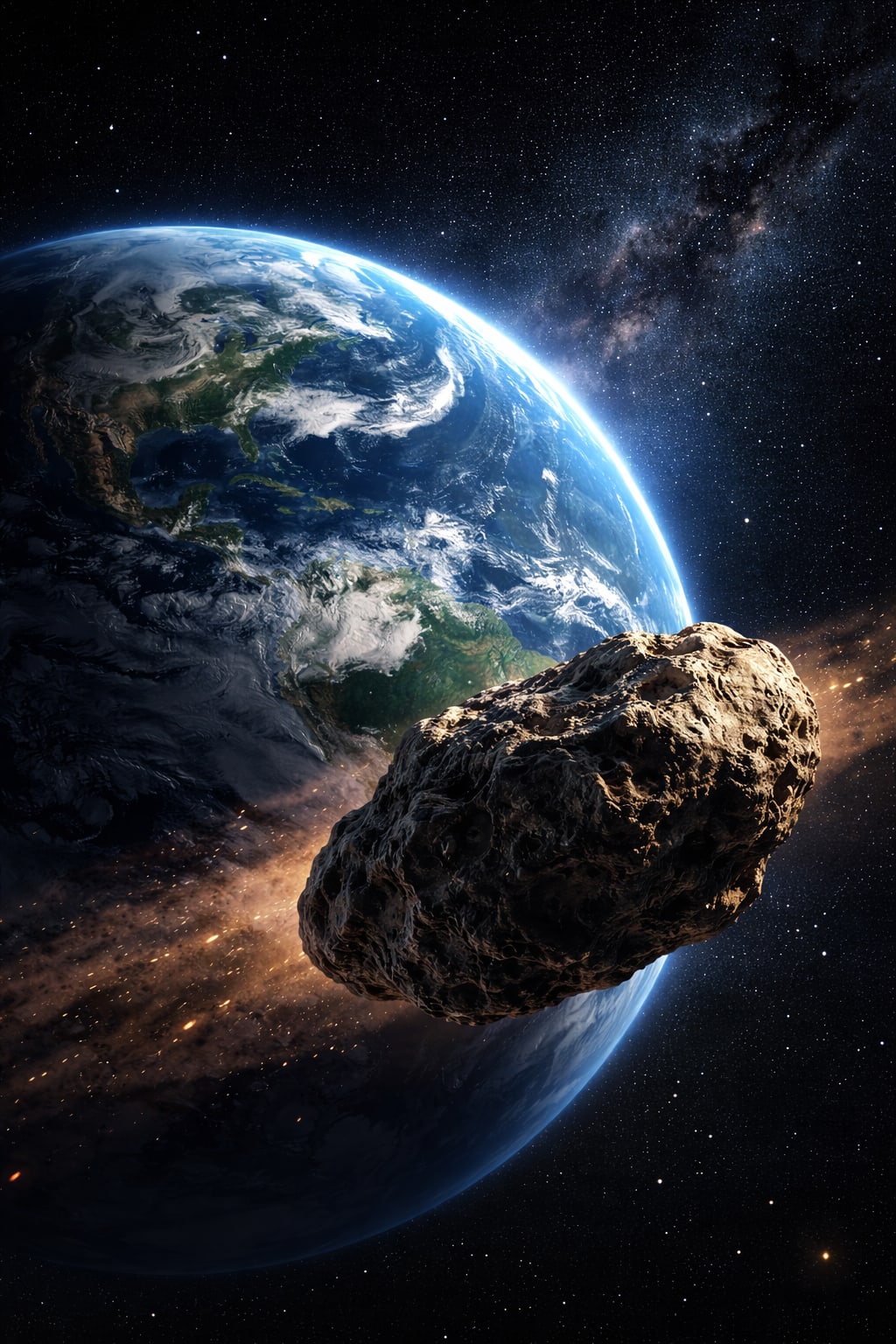
Sixty-six million years ago, a cosmic rock roughly 10 kilometers in diameter ended the age of dinosaurs in a catastrophic instant. Today, humanity stands as the first species on Earth capable not only of predicting such a disaster but also of preventing it. The only question is: will we be ready in time?
The Threat Is More Real Than You Think
Orbiting our planet right now are approximately one million asteroids larger than 40 meters across—big enough to penetrate our atmosphere and cause serious damage. Around 25,000 of these are classified as potentially hazardous objects, their orbits passing dangerously close to Earth. While the chances of a collision with a large asteroid in the coming decades remain relatively low, the consequences of such an event would be nothing short of catastrophic.
The 2013 Chelyabinsk meteor serves as a stark reminder of our vulnerability. An object merely 20 meters in size exploded over the Russian city with the energy equivalent of 30 Hiroshima atomic bombs. More than 1,500 people were injured, primarily from shattered glass as shockwaves rippled through the city. The truly terrifying part? This was a tiny space rock by cosmic standards, and nobody saw it coming. It approached from the direction of the sun, rendering it invisible to our detection systems until it was too late.
If a 20-meter rock can cause such damage, imagine what a kilometer-sized asteroid could do. Scientists estimate that an impact from an object just 500 meters across would release energy equivalent to thousands of nuclear weapons, potentially killing millions and triggering global climate disruption. A dinosaur-killer-sized asteroid would effectively end civilization as we know it.
Space Defense: From Theory to Reality
The first line of defense is detection. NASA and other space agencies conduct systematic surveys of near-Earth objects. Programs like Pan-STARRS in Hawaii and the orbiting NEOWISE telescope scan the skies in search of potential threats. By 2040, scientists aim to have catalogued 90% of all asteroids larger than 140 meters—the size capable of causing regional devastation.
However, knowing about an approaching danger is only half the battle. What happens once a threat is identified?
In September 2022, humanity made history by deliberately altering an asteroid's trajectory for the first time. NASA's DART (Double Asteroid Redirection Test) mission rammed into a small asteroid called Dimorphos, the moon of a larger asteroid named Didymos. The refrigerator-sized spacecraft crashed into the 160-meter object at approximately 14,000 miles per hour. The results exceeded all expectations: Dimorphos's orbital period changed by 33 minutes—far more than the minimum success threshold of 73 seconds.
This was a watershed moment in planetary defense. We proved that we possess the technology to protect our planet. The mission demonstrated that with sufficient warning time, we can nudge a dangerous asteroid onto a safer path. Italian astronomer Galileo Galilei once said that we cannot teach people anything; we can only help them discover it within themselves. DART helped humanity discover something profound: we are no longer helpless against cosmic threats.
The Arsenal of Planetary Defense
The kinetic impactor, like DART, represents just one method in our growing arsenal of planetary defense. Scientists are developing several strategies depending on the specific threat scenario:
- The gravity tractor involves parking a spacecraft near an asteroid for an extended period. The weak gravitational attraction between them would gradually alter the space rock's trajectory. This method works slowly but predictably—ideal if we have decades to prepare. Think of it as gently herding a cosmic sheep rather than hitting it with a stick.
- Nuclear detonation remains the ultimate option for the most dangerous scenarios. Contrary to Hollywood movies, the goal isn't to blow up the asteroid (which could create multiple dangerous fragments) but to detonate a device near it. The explosion's energy would vaporize part of the surface, creating a rocket-like thrust that pushes the object off its collision course. NASA and the U.S. National Nuclear Security Administration are already studying the HAMMER spacecraft concept for such missions. It's the cosmic equivalent of a controlled avalanche—using enormous force with surgical precision.
- Solar sails and laser ablation represent more exotic concepts. The former involves deploying a giant reflective sail on an asteroid, allowing solar radiation pressure to gradually push it away. The latter uses powerful lasers to vaporize material from the asteroid's surface, creating thrust in the desired direction. While these sound like science fiction, they're genuine proposals under serious consideration.
- Mass drivers propose landing equipment on an asteroid to launch material from its surface into space, using the recoil to slowly change its orbit. This method would take years but could work on asteroids too large for other techniques.
The Weak Link: Time and Politics
The biggest challenge in planetary defense isn't technology—it's time. The earlier we detect a threat, the more options we have. A small nudge 10-20 years before impact is enough to make an asteroid miss Earth entirely. But if we only have months or a few years, we'll need more drastic and risky measures.
This is precisely why investments in early detection systems are crucial. The European Space Agency plans to launch the NEOMIR mission, which will patrol the space between Earth and the Sun—a zone where asteroids are particularly difficult to spot from Earth. It's like installing a doorbell on the side of your house you can't normally see.
Another problem is international coordination. Asteroids don't respect borders, and defending against them requires global cooperation. Who decides to launch a deflection mission? Who finances the operation? What if one country's actions accidentally redirect an asteroid toward another nation's territory? These questions transcend science and engineering, entering the realm of geopolitics and international law.
The United Nations established the International Asteroid Warning Network and the Space Mission Planning Advisory Group specifically to coordinate global efforts. But the real test of these institutions will only come when we face an actual threat.
The Next Generation of Planet Defenders
The DART mission is just the beginning. ESA plans to launch the Hera spacecraft to study the results of DART's collision with Dimorphos in detail, measuring the crater and changes in the asteroid's structure. This data will help refine future deflection missions.
China has announced plans for its own asteroid deflection mission, targeting near-Earth object 2015 XF261. The growing interest from space powers in planetary defense is encouraging—the more countries develop the necessary capabilities, the better our chances of a swift and effective response to any threat.
When the Clock Starts Ticking
Statistically, a collision with a dinosaur-killer-sized asteroid occurs once every 100-200 million years. We might be lucky, and such an event won't happen for millions more years. Or we might be unlucky, and it could happen tomorrow—the cosmos doesn't follow a schedule.
But for the first time in planetary history, one of Earth's inhabitants has a fighting chance to change the outcome. We're no longer helpless against cosmic threats. We have telescopes to see danger from afar, rockets capable of delivering countermeasures anywhere in the solar system, and the knowledge and technology to alter an asteroid's path.
The key is maintaining vigilance. The skies must be scanned constantly, technologies refined, and international cooperation strengthened. Because when—not if, but when—the next serious threat appears on our radars, humanity will have only one chance to get it right.
The dinosaurs couldn't save themselves. We can. And that makes our era truly extraordinary.
About the Creator
Keep reading
More stories from Holianyk Ihor and writers in Futurism and other communities.
Space Tech in Your Pocket: The Cosmic Origins of Everyday Life
You wake up to your smartphone alarm, check the weather forecast, brew your morning coffee, and head to work guided by GPS navigation. Sounds like an ordinary day, right? Actually, you've just used at least five technologies born from space exploration programs. And it's not even 9 AM yet.
By Holianyk Ihora day ago in Futurism
About Binding Prometheus
I want to start actively advocating on behalf of my own work, and the most valuable part of my canon is, without a doubt, Binding Prometheus, the play I have been working on since 2019 and only finished in 2023 as part of my MA. The play itself is an amalgamation of a million different inspirations. On one end, it evokes the Ancient Greek myth-play, deriving its own title from the earliest extant work of Western drama we have, Aeschylus’s Prometheus Bound. On the other end, it borrows significantly from the sci-fi bulwarks from over the years, namely Mary Shelley’s Frankenstein and Karel Capek’s Rossum’s Universal Robots. The play could be an episode of Black Mirror, I fear. I don’t know. I’ve only ever seen one episode of Black Mirror.
By Steven Christopher McKnightabout a month ago in Futurism



Comments
There are no comments for this story
Be the first to respond and start the conversation.