
Space Tech in Your Pocket: The Cosmic Origins of Everyday Life
Space

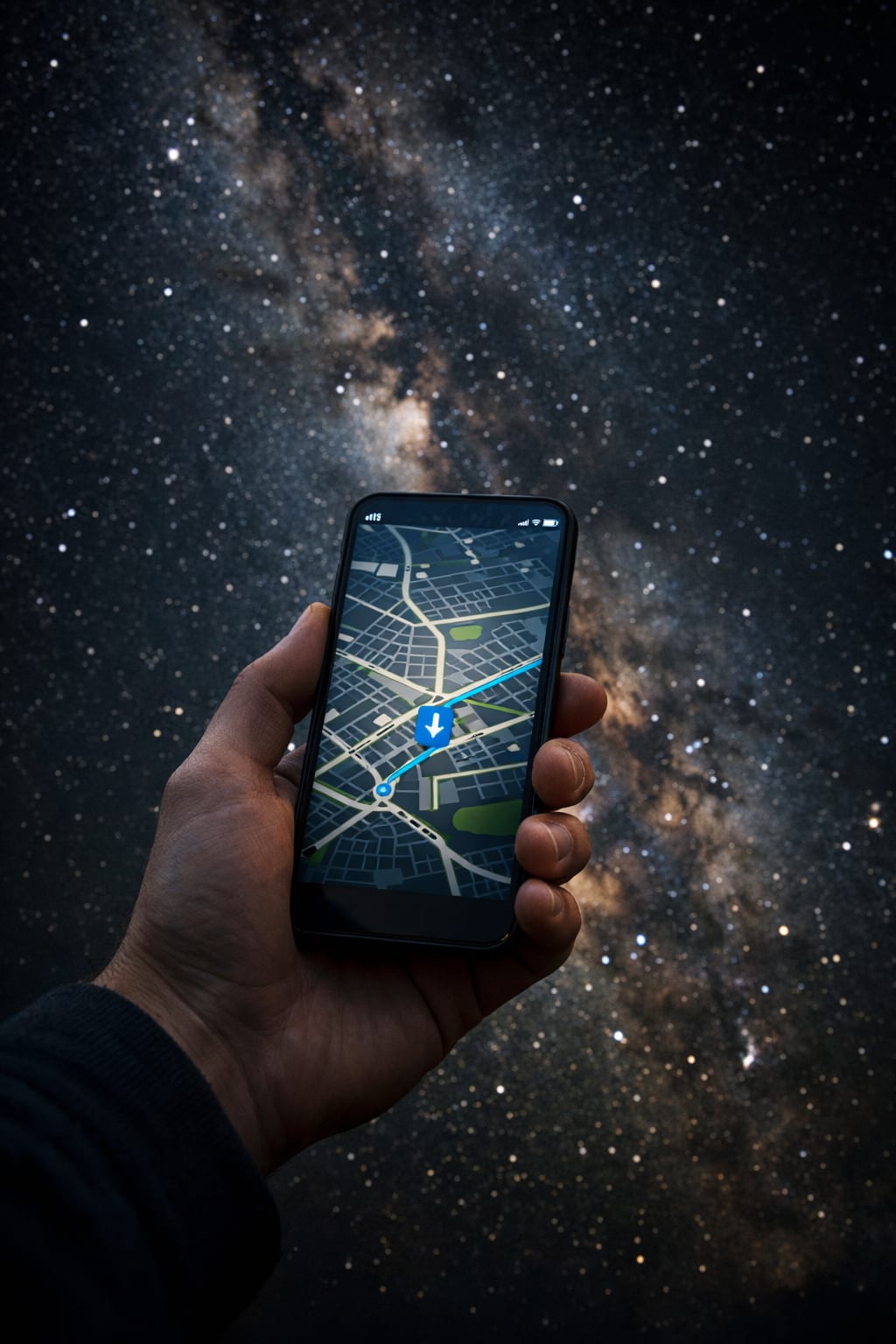
You wake up to your smartphone alarm, check the weather forecast, brew your morning coffee, and head to work guided by GPS navigation. Sounds like an ordinary day, right? Actually, you've just used at least five technologies born from space exploration programs. And it's not even 9 AM yet.
Space has long ceased to be a distant dream confined to science fiction novels and observatory telescopes. It invisibly permeates our daily existence, from that first sip of filtered coffee to the evening video call with family across the globe. The technology that took humanity to the Moon and beyond has quietly revolutionized life on Earth in ways most people never realize. Let's explore how reaching for the stars transformed the mundane reality we often take for granted.
GPS: When Satellites Know Where You're Having Lunch
The most obvious space technology is navigation, yet few people pause to consider that the Global Positioning System was originally created by the military for missile guidance and troop coordination during the Cold War. Today, 31 satellites orbiting approximately 12,550 miles above Earth help you locate the nearest pizza place, track your morning jog, or summon a rideshare driver to your exact location.
Here's a fascinating detail that sounds like science fiction: GPS accuracy depends on Einstein's theory of relativity. The satellites move so fast and orbit so far from Earth that without accounting for relativistic effects—both special and general relativity—your navigation system would accumulate errors of about six miles per day. Space technology literally operates on quantum physics principles just so you won't be late for your dentist appointment. Engineers must account for the fact that time moves slightly faster for satellites in orbit than for people on Earth's surface. Without these corrections, the system would become useless within minutes.
The Camera in Your Phone: A View from the Cosmos
That camera you use to photograph your brunch for social media is a direct descendant of NASA technology. In the 1990s, engineers at the Jet Propulsion Laboratory developed CMOS sensors to miniaturize cameras for spacecraft. They needed to reduce both weight and power consumption for interplanetary missions where every ounce matters and solar power is limited.
The challenge was enormous: create imaging technology that could survive the harsh radiation of space, operate in extreme temperatures, consume minimal power, and still capture detailed images of distant planets. The solution revolutionized photography on Earth. Today, this same technology powers every smartphone camera, surveillance system, medical endoscope, and even the sensors in modern cars that detect lane departures. That selfie at the Eiffel Tower is technically possible because of Mars rovers and space telescopes. When you snap a photo, you're using technology that has viewed the surface of Mars, captured images of Jupiter's moons, and helped scientists discover distant exoplanets.
Cordless Power Tools: Drilling Without the Hassle
Your cordless vacuum cleaner, electric screwdriver, or hair trimmer—all are byproducts of the Apollo program. NASA needed lightweight, powerful, and autonomous tools for astronauts collecting lunar soil samples. Traditional batteries of that era were too heavy and unreliable for the demanding conditions of space exploration.
Black & Decker engineers, contracted by NASA, created revolutionary battery-powered motor technology that could function in the Moon's extreme environment. The challenge wasn't just creating a cordless drill; it was creating one that would work reliably in temperatures ranging from minus 280 to plus 260 degrees Fahrenheit, in a complete vacuum, with no possibility of repair or replacement. The computer-controlled motors and nickel-cadmium battery technology they developed became the standard for all portable electronics—from power drills to modern electric vehicles like Tesla. Every time you vacuum your carpet without tripping over a cord, thank the engineers who needed to drill into Moon rocks.
Memory Foam: Cosmic Comfort for Earthlings
Orthopedic mattresses, pillows, shoe insoles, and even padding in football helmets—memory foam was originally developed by NASA for spacecraft seats. It needed to absorb the enormous G-forces during launch and landing, protecting astronauts from injuries that could occur during the violent shaking and acceleration.
This "smart" foam responds to body temperature and pressure, memorizing shapes and evenly distributing weight. During the intense vibrations of rocket launch, astronauts experience forces up to 3-4 times Earth's gravity. Standard foam would compress unevenly, creating pressure points that could cause injury during the multi-hour journey to orbit. The solution was a viscoelastic polyurethane foam that could absorb impact while slowly returning to its original shape. Today, this material relieves back pain for millions of people and is used in medicine to prevent bedsores in bedridden patients. It's also found in car seats, wheelchair cushions, and prosthetic limbs, making life more comfortable for people who never expected to benefit from space technology.
Water Purification: ISS Technology in Your Kitchen
The water filters in your home use principles developed for the International Space Station. Up there, every drop is worth its weight in gold—delivering water to orbit costs approximately $10,000 per liter. Therefore, NASA created multi-stage purification systems that can transform even urine and sweat into drinking water that's cleaner than most tap water on Earth.
The ISS water recovery system is so efficient it reclaims about 93% of all water, including humidity from astronauts' breath. This isn't just filtering; it's molecular-level purification involving multiple stages: filtration, chemical treatment, catalytic oxidation, and ion exchange. Adapted versions of these technologies now purify water in remote regions, disaster areas, and urban apartments worldwide. Carbon and ion-exchange filters, reverse osmosis membranes—all have cosmic origins. The next time you fill your water bottle from a filter, remember that the same basic technology is keeping astronauts alive 250 miles above your head.
Conclusion: Space Is Closer Than It Appears
We live in an era where the boundary between terrestrial and cosmic is blurring. Technologies created for survival in the utterly hostile environment of space are making our everyday Earth lives more comfortable, safer, and more efficient. The invisible hand of space innovation touches nearly every aspect of modern existence.
Economists estimate that every dollar invested in space research returns sevenfold to society through spin-off technologies and innovations. This return on investment manifests in saved lives through medical advances, improved quality of life through consumer products, and economic growth through new industries that didn't exist before the space age.
So next time you check your GPS, drink filtered water, take a smartphone photo, or sleep on your memory foam mattress, remember: you're using technology born among the stars. Space exploration isn't just about the romance of distant galaxies and the dream of walking on Mars. It's an investment in a future that has already arrived and is sitting comfortably in your pocket, making your daily life easier in ways that would have seemed like magic just a generation ago.
The cosmos isn't out there—it's right here, woven into the fabric of modern life.
About the Creator
Keep reading
More stories from Holianyk Ihor and writers in Futurism and other communities.
Exoplanet Atmospheres: Unexpected Discoveries That Are Changing Astronomy
For most of human history, planets beyond our Solar System were the stuff of speculation. Even after the first exoplanets were confirmed in the 1990s, they remained distant abstractions—numbers in databases, shadows in starlight, or subtle gravitational wobbles. Today, however, astronomers are doing something that once seemed impossible: directly probing the atmospheres of worlds orbiting other stars. And what they are finding is far stranger and more diverse than anyone expected.
By Holianyk Ihor3 days ago in Futurism
About Binding Prometheus
I want to start actively advocating on behalf of my own work, and the most valuable part of my canon is, without a doubt, Binding Prometheus, the play I have been working on since 2019 and only finished in 2023 as part of my MA. The play itself is an amalgamation of a million different inspirations. On one end, it evokes the Ancient Greek myth-play, deriving its own title from the earliest extant work of Western drama we have, Aeschylus’s Prometheus Bound. On the other end, it borrows significantly from the sci-fi bulwarks from over the years, namely Mary Shelley’s Frankenstein and Karel Capek’s Rossum’s Universal Robots. The play could be an episode of Black Mirror, I fear. I don’t know. I’ve only ever seen one episode of Black Mirror.
By Steven Christopher McKnightabout a month ago in Futurism
Bus Market: Public Transportation Investments, Fleet Modernization & Growth Ahead
According to IMARC Group's latest research publication, The global bus market size was valued at USD 53.42 Billion in 2025. Looking forward, IMARC Group estimates the market to reach USD 91.26 Billion by 2034, exhibiting a CAGR of 5.82% from 2026-2034.
By James Whitmana day ago in Futurism


Comments
There are no comments for this story
Be the first to respond and start the conversation.