


Kepler-452b has ignited a wave of curiosity about humanity’s future among the stars. Discovered by NASA’s Kepler mission in 2015, this exoplanet orbits in the "habitable zone" of a Sun-like star, sparking hope that it could be a potential refuge for life beyond Earth. With Earth's resources increasingly strained by climate change, overpopulation, and ecological degradation, the idea of finding another habitable world has shifted from science fiction to an urgent scientific quest. Could Kepler-452b, orbiting its star 1,400 light-years away, offer humanity a second chance at survival?
This question resonates deeply in a world where the fragility of Earth’s ecosystems becomes more apparent with each passing year. As we confront the possibility of our planet becoming less hospitable, the allure of Kepler-452b grows. With conditions that might allow liquid water to exist and a size and orbit reminiscent of our own planet, it presents a tantalizing "what if" scenario. What if, in the future, Earth's inhabitants needed to relocate? Could we look to distant exoplanets like Kepler-452b for salvation? This paper will explore not only the characteristics that make Kepler-452b fascinating to scientists, but also its implications for the future of humanity, inviting us to imagine whether a far-off world could one day become our home.
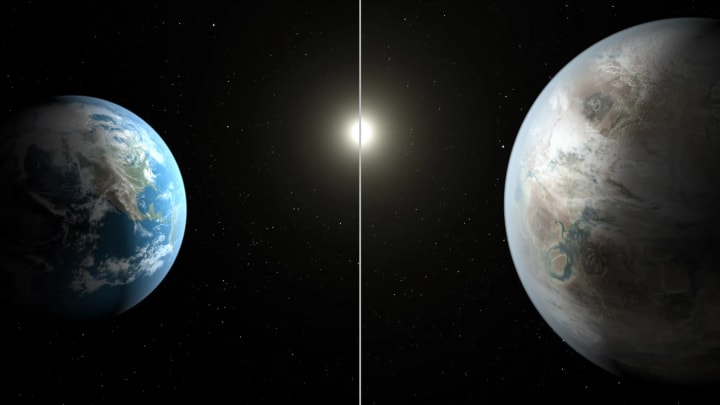
The discovery of Kepler-452b marked a significant milestone in our ongoing search for Earth-like exoplanets. It was identified in July 2015 by NASA’s Kepler Space Telescope, which was launched in 2009 with the mission to find potentially habitable planets orbiting distant stars. Kepler-452b was found using the transit method, where the telescope detects slight dips in a star’s brightness as a planet crosses in front of it. This method allows scientists to infer the size, orbit, and sometimes the composition of exoplanets, and in the case of Kepler-452b, it revealed a planet with striking similarities to Earth.
Kepler-452b orbits its star, Kepler-452, in the same habitable zone where Earth orbits the Sun—at a distance that could allow for liquid water, a key ingredient for life. This discovery was hailed as monumental because it offered the most Earth-like conditions found beyond our solar system at the time. Kepler-452b's orbital period of 385 days is remarkably close to Earth’s 365 days, further fueling speculation that this planet might harbor the conditions necessary for life. The Kepler mission was instrumental in identifying this and thousands of other exoplanets, revolutionizing our understanding of planetary systems and their potential to support life. However, with Kepler-452b located 1,400 light-years away, direct observation remains out of reach for now, but its discovery still serves as a symbol of hope for humanity’s quest to find new worlds in the face of an uncertain future on Earth.
Kepler-452b exhibits several characteristics that make it a prime candidate for further study in the search for habitable worlds. With a diameter approximately 60% larger than Earth, it is classified as a “super-Earth,” a category of exoplanets that are rocky and have a greater mass than Earth but less than that of Uranus or Neptune. This larger size suggests that Kepler-452b could possess a substantial atmosphere, though its composition remains unknown. Scientists theorize that it could be rocky, like Earth, or potentially have a thicker atmosphere composed of gases that might create different climate dynamics.
The planet's orbit around its host star, Kepler-452, takes about 385 days, making it a compelling parallel to Earth's yearly cycle. This similarity places it firmly within the habitable zone—the region around a star where conditions may be right for liquid water to exist. Additionally, Kepler-452 is a G-type star, akin to our Sun, albeit slightly older at around 6 billion years. This age presents intriguing implications for the evolutionary processes that might have occurred on Kepler-452b. The planet’s position in relation to its star, combined with its size and potential atmosphere, ignites excitement about its capability to support life as we know it. The prospect of exploring such a world not only captivates scientists but also stirs the imagination of those contemplating humanity’s future in the cosmos.

Kepler-452b's placement within the habitable zone of its host star ignites profound questions about the potential for life beyond Earth. The habitable zone is defined as the region around a star where temperatures could allow for liquid water to exist, a crucial requirement for life as we understand it. Given that Kepler-452b orbits in this zone, it raises exciting possibilities about the planet's climate and surface conditions. The presence of liquid water is fundamental because it serves as a solvent for biochemical reactions essential for life.
However, while Kepler-452b's location suggests it may have the right conditions for habitability, several factors complicate the picture. The planet's larger size compared to Earth could indicate a thicker atmosphere, which might lead to a different set of climate dynamics and weather patterns. Furthermore, the age of its host star, Kepler-452, which is 1.5 billion years older than the Sun, prompts discussions about the evolutionary timeline of any potential life forms. An older star may have different stellar activity levels, impacting the radiation environment that Kepler-452b experiences. These factors make the quest for understanding whether Kepler-452b can support life a tantalizing puzzle for scientists, as they seek to unravel the complexities of this distant world and its potential to host ecosystems akin to those on Earth.
As scientists delve into the potential of Kepler-452b as a new home for humanity, the comparison between this exoplanet and Earth invites both hope and caution. Often described as "Earth’s older cousin," Kepler-452b shares several characteristics with our planet, including its size, orbit, and position in the habitable zone. This resemblance evokes a sense of optimism, especially in light of the challenges facing Earth today, such as climate change, resource depletion, and the looming threat of overpopulation. The notion that Kepler-452b could serve as a possible refuge prompts vital questions about humanity's future and whether relocation to another planet might one day be feasible.
However, the idea of colonizing Kepler-452b is still firmly in the realm of speculation, primarily due to the current limitations in technology and our understanding of exoplanetary conditions. The vast distance of 1,400 light-years makes it impossible to reach with current spacecraft, and even the most advanced theoretical propulsion systems would require centuries to make the journey. Additionally, while the planet's Earth-like qualities are compelling, there are uncertainties regarding its atmosphere, surface conditions, and the presence of essential resources. These factors highlight the challenges of establishing a human presence on Kepler-452b and reinforce the importance of addressing Earth's pressing issues before looking to the stars. Ultimately, the allure of Kepler-452b as a potential second home captures the imagination, compelling us to consider what the future might hold for humanity as we seek new horizons in the cosmos.
The discovery of Kepler-452b has not only advanced our understanding of exoplanets but also sparked significant scientific debate and highlighted the limitations inherent in current astronomical observations. While its Earth-like characteristics are intriguing, the uncertainty surrounding many of its properties creates a rich landscape for discussion among researchers. The great distance of 1,400 light-years poses challenges for directly studying Kepler-452b, as detailed measurements of its atmosphere and surface conditions remain beyond our reach. As a result, many of the conclusions drawn about the planet rely on models and indirect evidence, which can vary in accuracy.
Moreover, the excitement surrounding Kepler-452b also invites skepticism within the scientific community. Some researchers caution against prematurely labeling it as a second Earth without more concrete data. They argue that while its similarities to our planet are compelling, other factors, such as the potential for a thick atmosphere or unique geological features, could significantly affect its habitability. This highlights the need for further exploration and research, particularly as new technologies develop that may allow for more detailed observations of distant worlds.
The advent of missions like the James Webb Space Telescope promises to enhance our understanding of exoplanets by examining their atmospheres and identifying potential biosignatures—chemical indicators of life. As scientists eagerly anticipate the data that future missions will provide, the conversation around Kepler-452b serves as a microcosm of the broader challenges and triumphs faced in the field of exoplanetary science. This ongoing dialogue not only enriches our understanding of Kepler-452b but also fuels the quest for discovering other potentially habitable worlds throughout the universe, reminding us of the limitless possibilities that lie beyond our home planet.
The broader impact of exoplanet research extends far beyond the confines of individual discoveries like Kepler-452b, reflecting humanity’s relentless curiosity and desire to understand our place in the universe. Each new finding contributes to an ever-expanding catalog of planets, enhancing our knowledge of the diversity of planetary systems and the conditions that may support life. Kepler-452b, with its tantalizing similarities to Earth, has invigorated discussions about the potential for life beyond our home planet and has reignited interest in astrobiology—the study of life in the universe. This search for extraterrestrial life is not just a scientific endeavor; it resonates deeply with our existential questions about whether we are alone in the cosmos.
Moreover, the discoveries made by the Kepler mission, including Kepler-452b, have influenced public interest in space exploration and the funding of scientific research. The media coverage surrounding exoplanet discoveries has the power to inspire future generations of scientists and astronomers, sparking enthusiasm for STEM fields and space exploration. Public interest in planets like Kepler-452b encourages a cultural narrative that embraces the unknown and invites a collective exploration of possibilities beyond Earth.
Ultimately, the quest to understand planets like Kepler-452b transcends the boundaries of science; it embodies humanity’s enduring aspiration to seek out new worlds and reflect on the future of our species. As we continue to explore the cosmos and develop new technologies for interstellar exploration, the journey toward understanding Kepler-452b serves as both a scientific challenge and a source of inspiration, reminding us of the interconnectedness of life, the fragility of our planet, and the infinite possibilities that await us among the stars.
About the Creator
Christen
Think logically. I know you can do it!
Public Relations (PR) Tools Market Outlook: Digital Media Monitoring and Brand Reputation Growth Opportunities
According to IMARC Group's latest research publication, The global public relations (PR) tools market size was valued at USD 13.8 Billion in 2025. Looking forward, IMARC Group estimates the market to reach USD 30.1 Billion by 2034, exhibiting a CAGR of 8.76% during 2026-2034.
By James Whitman6 days ago in Futurism
Australia Medicated Skincare Market: Consumer Health Focus, Product Innovation & Clinical Demand
According to IMARC Group, the Australia medicated skincare market reached USD 1,011.7 Million in 2025 and is projected to grow to USD 2,080.6 Million by 2034, exhibiting a compound annual growth rate (CAGR) of 8.34% during 2026–2034. The expansion reflects a structural shift in consumer behavior across Australia, where skincare is increasingly viewed through a medical and preventative health lens rather than purely cosmetic. Rising awareness of dermatological conditions such as acne, eczema and psoriasis, coupled with a preference for clinically tested formulations, is accelerating demand for specialized and scientifically validated skincare solutions.
By Kevin Cooper4 days ago in Futurism




Comments (1)
Thank you for sharing. Looking forward to discovering more.