
Japan Smart Home Market Trends & Summary
How Technology, Aging Demographics, and Energy Efficiency Are Fueling Japan’s Smart Home Revolution


The Japan smart home market, valued at US$ 7.61 billion in 2024, is accelerating toward a transformative decade. According to Renub Research, the sector is set to achieve a remarkable US$ 21.23 billion by 2033, expanding at a healthy CAGR of 12.08% from 2025 to 2033. This surge reflects Japan’s increasing appetite for connected living, energy-efficient solutions, and digitally enabled home environments that blend comfort, safety, and convenience.
With the rise of IoT-enabled appliances, voice assistants, artificial intelligence, and an aging demographic seeking assisted living solutions, Japan is emerging as a global hotspot for next-generation home automation.
This comprehensive editorial explores the trends shaping this market, the key growth drivers, challenges, segment insights, and what lies ahead for smart homes across the country.
Japan Smart Home Market Outlook
A smart home integrates internet-connected devices that enable homeowners to remotely monitor, control, and automate functions such as lighting, security, temperature, entertainment, and household appliances. In Japan, these solutions are becoming mainstream due to their potential to make daily life more efficient, safe, and personalized.
From voice-controlled lights to AI-enabled thermostats and advanced security cameras, smart homes elevate comfort and transform everyday tasks. As consumers increasingly embrace digital lifestyles, the demand for integrated home ecosystems continues to climb.
A major factor behind the boom is the seamless integration of smart home devices with popular virtual assistants like:
Amazon Alexa
Google Assistant
Apple Siri
These platforms work as centralized hubs that simplify the management of home devices through voice commands or smartphone apps—making smart home adoption frictionless.
Combined with Japan’s tech-savvy population, growing urbanization, and increasing affordability of smart technologies, the nation is positioning itself as a powerful market in the global smart home landscape.
Key Growth Drivers in the Japan Smart Home Market
1. Technological Advancements & IoT Integration
The rapid advancement of IoT (Internet of Things) is one of the strongest forces accelerating Japan’s smart home growth. IoT-powered devices—from smart thermostats to app-controlled ovens—enable seamless interaction, automation, and real-time control.
Breakthroughs in AI, machine learning, and automation are enhancing the intelligence of smart devices, allowing them to learn user habits and optimize energy usage. As the technology becomes more accessible and cost-effective, consumer adoption continues to skyrocket.
Industry Highlight:
In February 2024, Fibocom partnered with STMicroelectronics to launch a Matter-compatible smart home solution built on STM32WB55 and FG370. This technology aims to unify smart devices across various protocols, making interoperability smoother and user experiences more cohesive.
2. Rising Demand for Energy Efficiency & Sustainability
Japan’s commitment to environmental sustainability and stricter national energy policies are pushing consumers toward smart home devices that optimize energy consumption. Smart thermostats, energy-monitoring systems, lighting controls, and efficient appliances help reduce electricity usage and lower household costs.
Consumers appreciate the ability to receive real-time feedback on their energy patterns, enabling more conscious and cost-effective adjustments.
Industry Highlight:
In August 2024, Huawei Digital Power unveiled its Smart Home Energy solution in the Philippines, reflecting a wider regional movement toward sustainable energy management technologies.
3. Aging Population & Demand for Assisted Living Technologies
Japan’s demographic profile—marked by a large and growing elderly population—is driving the need for intelligent home systems that support independent living. Smart devices designed for senior care include:
Fall detection sensors
Remote medical monitoring
Automated lighting systems
Emergency alert devices
These solutions empower elderly citizens to live independently while offering caregivers real-time visibility and peace of mind.
Industry Highlight:
In February 2025, CEDIA announced expanded categories for its Smart Home Awards, celebrating innovations that often address key market segments such as assisted living and aging-in-place technologies.
Challenges Hindering Market Expansion
Despite its rapid growth, the Japan smart home industry faces obstacles that need addressing for mass adoption.
1. High Upfront Costs
Premium smart security systems, automated lighting setups, and comprehensive home automation solutions require significant initial investment. While long-term energy savings are appealing, cost remains a major deterrent for many households in Japan.
Affordability will play a critical role in accelerating market penetration over the next decade.
2. Interoperability & Compatibility Issues
With multiple manufacturers offering devices that operate on different communication protocols—such as Wi-Fi, Zigbee, Z-Wave, and proprietary systems—consumers often face integration challenges.
This lack of standardization complicates creating fully streamlined home ecosystems and can reduce the perceived value of smart home investments.
Japan Smart Home Market by Key Segments
Below is a summary of how major segments are evolving and contributing to broader market growth.
Japan New Construction Smart Home Market
Developers across Japan are increasingly embedding smart home technology into new housing projects. Today’s buyers expect new homes to include built-in smart features such as:
Automated lighting
Voice-controlled assistants
Smart thermostats
Centralized security systems
This proactive adoption at the construction level accelerates market growth, ensuring that smart home capability becomes a default expectation rather than a luxury add-on. As more households gravitate toward connected lifestyles, smart-ready homes are quickly becoming a competitive selling point.
Japan Smart Home Speaker Market
Smart speakers remain a cornerstone of home automation. Devices powered by:
Amazon Alexa
Google Assistant
Apple Siri
act as command centers that connect and control other smart products. Japanese consumers increasingly prefer hands-free operation for tasks such as playing music, adjusting lighting, checking the weather, and accessing entertainment.
As the AI behind these assistants improves, smart speakers are solidifying their position as the gateway into full smart home ecosystems.
Japan Smart Home Video Doorbell Market
Security-conscious homeowners are rapidly adopting smart video doorbells due to their ease of use and enhanced protective features. These devices offer real-time monitoring through smartphone apps, enabling users to:
View live HD video
Communicate via two-way audio
Receive instant motion alerts
Integration with broader security ecosystems—like surveillance cameras and alarm systems—has strengthened their appeal across Japanese households.
Japan Smart Home Motion Sensor Market
Motion sensors play a dual role in both security and convenience. They are widely used for:
Automated lighting activation
Intrusion detection
Smart camera triggers
Energy-saving systems
As Japanese consumers seek efficiency and enhanced home control, motion sensors are becoming foundational components of intelligent home networks.
Japan Smart Home Door Lock Market
Smart locks represent the future of home entry systems in Japan. Their rising adoption stems from benefits like:
Keyless entry via mobile apps
Biometric unlocking
Remote access control
Integration with security cylinders and smart ecosystems
These locks allow homeowners to track entry/exit logs and provide temporary digital keys to guests or service workers—revolutionizing how homes are accessed and secured.
Japan Smart Home Wireless Communication Market
Wireless technologies form the backbone of modern smart homes. Japan’s demand continues to surge for systems using:
Wi-Fi
Bluetooth
Zigbee
Z-Wave
As more devices populate Japanese households, robust and secure wireless networks are essential to ensuring seamless communication and dependable operation.
Japan Smart Home Protocols and Standards Market
With so many smart devices on the market, developing standardized protocols is essential. Japan is seeing increased activity in creating and adopting frameworks that guarantee reliability, security, and cross-device compatibility.
Protocols like Matter are expected to play a leading role in shaping the next phase of Japan’s smart home evolution.
Market Segmentation Overview
Application
New Construction
Retrofit
Product Categories
Smart Speaker
Interactive Security System
Smart Thermostat
Monitoring Camera
Video Doorbell
Smart Light Bulb
Motion Sensor
Smart Light Switch
Door/Video Sensor
Smart Door Lock
Smart Plug
Smart Smoke Detector
Garage Door Opener
Smart Electrical Socket
Smart Oven
Smart Window Shade/Blind
Leak/Moisture Detector
Irrigation Control System
Water Shutoff System
Technology
Wireless Communication Technologies
Cellular Network Technologies
Protocols and Standards
Key Players Covered (5 Viewpoints Each)
1. Panasonic Corporation
2. Sony Corporation
3. Samsung
4. Apple Inc.
5. Schneider Electric
6. Amazon.com Inc.
7. Honeywell International Inc.
Each profile typically includes:
Company Overview
Key Management
Recent Developments
Product Portfolio
Revenue Insights
Final Thoughts
Japan’s smart home market is on a strong upward trajectory driven by digital adoption, sustainability priorities, and demographic imperatives. As AI, IoT, and automation technologies mature, Japanese homes are becoming smarter, safer, and more efficient.
However, overcoming interoperability bottlenecks and reducing initial costs will be critical to unlocking mass adoption. With industry leaders making aggressive moves and government sustainability goals aligning with consumer interests, Japan is poised to become one of Asia’s most progressive markets for smart home innovation.
The shift toward connected living is not merely a trend—it’s a fundamental transformation of how Japanese consumers interact with their homes. And with the market projected to surpass US$ 21.23 billion by 2033, the next decade promises unprecedented growth, innovation, and lifestyle evolution.
About the Creator
Marthan Sir
Educator with 30+ years of teaching experience | Passionate about sharing knowledge, life lessons & insights | Writing to inspire, inform, and empower readers.
Keep reading
More stories from Marthan Sir and writers in Futurism and other communities.
United States Kitchen Appliance Market Size and Forecast (2025–2033)
The United States kitchen appliance market is undergoing a significant transformation, fueled by evolving consumer lifestyles, rapid technological adoption, and a deep-rooted cultural emphasis on convenience and home comfort. According to Renub Research, the U.S. Kitchen Appliance Market is projected to reach US$115.15 billion by 2033, rising from US$74.35 billion in 2024, reflecting a steady CAGR of 4.98% during the forecast period 2025–2033. This growth is supported by trends favoring energy efficiency, smart functionality, healthier food habits, and widespread home renovation projects across the country.
By Marthan Sirabout a month ago in Futurism
About Binding Prometheus
I want to start actively advocating on behalf of my own work, and the most valuable part of my canon is, without a doubt, Binding Prometheus, the play I have been working on since 2019 and only finished in 2023 as part of my MA. The play itself is an amalgamation of a million different inspirations. On one end, it evokes the Ancient Greek myth-play, deriving its own title from the earliest extant work of Western drama we have, Aeschylus’s Prometheus Bound. On the other end, it borrows significantly from the sci-fi bulwarks from over the years, namely Mary Shelley’s Frankenstein and Karel Capek’s Rossum’s Universal Robots. The play could be an episode of Black Mirror, I fear. I don’t know. I’ve only ever seen one episode of Black Mirror.
By Steven Christopher McKnight15 days ago in Futurism
France Convenience Store Market Size and Forecast 2026–2034
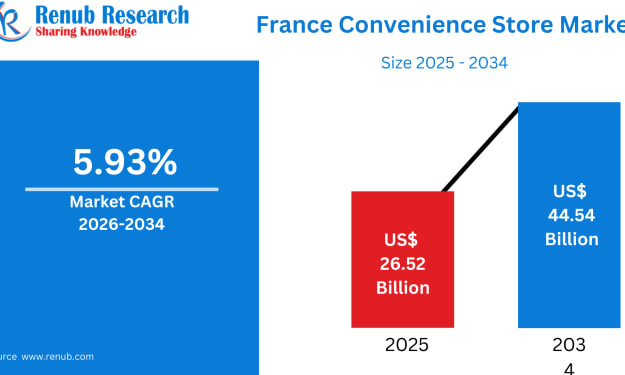
Introduction The France Convenience Store Market is poised for strong expansion over the coming decade, reflecting the country’s changing consumer habits, growing urban density, and rising preference for speed, accessibility, and ready-to-consume products. According to Renub Research, the market is expected to grow from US$ 26.52 billion in 2025 to US$ 44.54 billion by 2034, registering a healthy compound annual growth rate (CAGR) of 5.93% from 2026 to 2034.
By jaiklin Fanandish7 days ago in Futurism



Comments
There are no comments for this story
Be the first to respond and start the conversation.