
Japan Building Automation Systems Market Size and Forecast 2025–2033
Smart Infrastructure Powering Japan’s Next-Generation Buildings

Japan Building Automation Systems Market Outlook
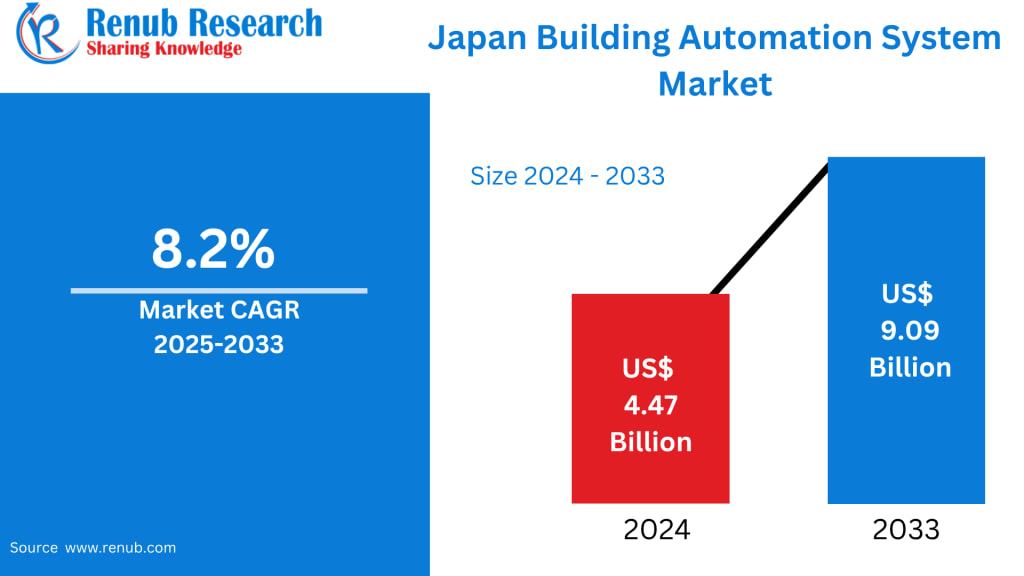
The Japan Building Automation Systems (BAS) Market is anticipated to grow to US$ 9.09 billion by 2033, rising from US$ 4.47 billion in 2024, registering a robust CAGR of 8.2% from 2025 to 2033, according to Renub Research. This strong growth trajectory reflects Japan’s accelerating push toward energy-efficient infrastructure, rapid adoption of smart technologies, and firm government backing for sustainable urban development.
Advanced integration of IoT, artificial intelligence (AI), cloud computing, and remote monitoring is redefining how commercial, industrial, and residential buildings are designed and managed across the country. From smart skyscrapers in Tokyo to digitally optimized factories in Aichi, building automation systems are becoming a cornerstone of Japan’s future-ready infrastructure.
Japan Building Automation Systems Market Overview
A Building Automation System (BAS) is a centralized, intelligent platform designed to monitor, control, and optimize a building’s mechanical and electrical systems. These include HVAC (heating, ventilation, and air conditioning), lighting, security, access control, fire safety, and energy management systems. BAS improves operational efficiency, occupant comfort, safety, and energy conservation by leveraging sensors, controllers, communication networks, and software analytics.
In Japan, BAS adoption has gained strong momentum due to the country’s technological leadership, aging building stock, high energy costs, and commitment to carbon neutrality. Urban densification, coupled with strict energy-efficiency standards, has made intelligent automation a strategic necessity rather than a luxury.
Government-backed smart city initiatives, green building certifications, and retrofitting mandates have further accelerated the deployment of BAS across both new developments and existing infrastructure. As a result, the market continues to experience consistent demand across commercial, industrial, and residential segments.
Growth Drivers in the Japan Building Automation Systems Market
Government Support for Smart Cities and Energy Efficiency
Japan’s government plays a pivotal role in BAS market expansion through policies promoting energy conservation and digital infrastructure. Programs such as Smart City initiatives, Zero Energy Building (ZEB) targets, and the Green Transformation (GX) Promotion Strategy actively encourage the adoption of intelligent building technologies.
In February 2023, Japan announced plans to mobilize nearly US$ 999.5 billion (150 trillion JPY) in public and private green investments over the next decade, including approximately US$ 133.2 billion (20 trillion JPY) in government support. A significant portion of this investment is directed toward energy-efficient buildings, automation, and digital monitoring systems, creating long-term growth opportunities for BAS providers.
Tax incentives, subsidies, and energy-efficiency regulations continue to stimulate BAS adoption across commercial offices, public buildings, and residential complexes.
Rising Demand for Green Buildings and Sustainability
Environmental responsibility is now central to Japan’s construction and real estate sectors. Developers increasingly prioritize low-carbon, energy-efficient, and environmentally certified buildings to meet regulatory requirements and investor expectations.
The widespread adoption of green certification frameworks such as CASBEE (Comprehensive Assessment System for Built Environment Efficiency) has strengthened demand for building automation. BAS enables precise control of lighting, HVAC, water usage, and energy consumption—critical for meeting sustainability benchmarks.
By late 2023, Japan emerged as a global leader in green architecture and sustainable urban design, driven by policy support, corporate innovation, and advanced automation technologies. BAS has become an essential enabler of this transformation.
Technological Advancements and IoT Integration
Japan’s leadership in electronics, robotics, and IoT significantly enhances BAS capabilities. Modern systems integrate real-time sensors, AI-driven analytics, cloud platforms, and predictive maintenance tools, allowing buildings to respond dynamically to occupancy patterns, weather conditions, and energy demand.
The Top-Runner Program, revised by Japan’s Ministry of Economy, Trade and Industry, mandates that new commercial buildings reduce energy consumption by 35% compared to 2005 levels by 2025. This regulation has fueled innovation in smart HVAC systems, LED lighting, and building energy management software, making advanced BAS solutions indispensable.
Challenges in the Japan Building Automation Systems Market
High Installation and Maintenance Costs
Despite long-term savings, BAS implementation often involves high upfront capital expenditure. Costs associated with specialized hardware, advanced software, system integration, and skilled technicians can be a barrier—particularly for small and medium-sized enterprises or owners of older buildings.
Japan’s extensive inventory of aging infrastructure frequently requires significant retrofitting, which further increases initial investment and limits adoption among budget-conscious stakeholders.
Integration Issues with Legacy Systems
Many Japanese buildings were constructed decades before smart infrastructure became standard. Integrating modern BAS into legacy electrical and mechanical systems presents challenges related to compatibility, outdated wiring, and limited digital connectivity.
These integration complexities can increase implementation time, raise costs, and discourage rapid adoption, particularly in older commercial and residential properties.
Japan Building Automation Systems Market Segmentation Insights
Japan Hardware Building Automation Systems Market
Hardware forms the backbone of BAS, encompassing sensors, controllers, actuators, meters, and communication devices. Demand for durable, precision-engineered components remains strong in Japan, reflecting the country’s emphasis on quality and long-term infrastructure reliability.
Manufacturers increasingly focus on compact, energy-efficient, and modular hardware designs to accommodate space constraints in dense urban environments while ensuring seamless system communication.
Japan Activated Carbon Building Automation Systems Market
Activated carbon-based air filtration systems are gaining prominence within BAS deployments, especially in urban and industrial regions. These systems help remove volatile organic compounds (VOCs), odors, and airborne pollutants, significantly improving indoor air quality.
Post-pandemic health awareness has further accelerated adoption, with BAS-enabled sensors automatically activating filtration systems based on real-time air quality data, ensuring compliance with health and environmental standards.
Japan Commercial Building Automation Systems Market
Commercial buildings—including offices, retail centers, hotels, and mixed-use complexes—represent a major share of BAS demand in Japan. Rising energy costs, ESG reporting requirements, and tenant expectations for comfort and safety drive heavy investment in automation.
Centralized control of lighting, HVAC, security, and fire systems improves operational efficiency, regulatory compliance, and asset value, making BAS essential for modern commercial real estate.
Japan Industrial Building Automation Systems Market
Japan’s globally renowned manufacturing sector relies heavily on BAS to maintain precision-controlled environments. Industries such as electronics, pharmaceuticals, and food processing depend on stable temperature, humidity, and air quality.
BAS supports predictive maintenance, energy optimization, and safety monitoring, reducing downtime and improving productivity. As Industry 4.0 adoption grows, BAS increasingly integrates with factory automation and digital twin technologies.
Japan Online Building Automation Systems Market
Cloud-based and online BAS platforms are gaining popularity due to their scalability, lower upfront costs, and remote accessibility. Facility managers can monitor multiple buildings from centralized dashboards, enabling faster decision-making and proactive maintenance.
This model is especially attractive to large property developers and commercial real estate operators managing assets across multiple locations.
Regional Insights: Key City Markets
Tokyo Building Automation Systems Market
Tokyo leads Japan’s BAS market due to its dense concentration of corporate offices, high-rise buildings, and smart city initiatives. Strong carbon-neutrality targets and energy-efficiency regulations drive widespread BAS adoption across public and private infrastructure.
Aichi Building Automation Systems Market
Home to major industrial players, including automotive manufacturing hubs, Aichi is a stronghold for industrial BAS solutions. Smart factories, predictive maintenance, and energy optimization are key growth drivers in the region.
Chiba Building Automation Systems Market
Chiba benefits from rapid residential and commercial development, logistics hubs, and proximity to Tokyo. Sustainability-focused housing projects and energy-efficient commercial complexes are expanding BAS demand.
Shizuoka Building Automation Systems Market
Shizuoka’s mix of mid-sized commercial facilities, manufacturing sites, and public institutions creates steady BAS demand. Investments in infrastructure modernization and healthcare facilities further support market growth.
Market Segmentation Overview
By Component:
Hardware
Software
Services
By Technology:
Activated Carbon
Electrostatic Precipitators
High Efficiency Particulate Air (HEPA)
Ion & Ozone Generators
Others
By Application:
Commercial
Industrial
Residential
By End User:
Offline
Online
Top Cities Covered:
Tokyo, Kansai, Aichi, Kanagawa, Saitama, Hyogo, Chiba, Hokkaido, Fukuoka, Shizuoka
Key Players Analysis
The Japanese BAS market is highly competitive, with global and domestic leaders focusing on innovation, partnerships, and sustainability-driven solutions. Each company is evaluated across five viewpoints: overview, key personnel, recent developments, SWOT analysis, and revenue performance.
Major Players Include:
Cisco Systems Inc.
Hitachi Ltd
Mitsubishi Electric Corporation
Honeywell International Inc.
Emerson Electric Co.
United Technologies Corporation
Trane Technologies
Huawei Technologies Corporation
Hubbell Inc.
Final Thoughts
The Japan Building Automation Systems Market is on a strong upward trajectory, driven by government-backed sustainability initiatives, rapid technological innovation, and growing demand for intelligent, energy-efficient buildings. Despite challenges related to cost and legacy integration, continuous advancements in IoT, AI, and cloud platforms are making BAS more accessible and scalable.
As Japan advances toward carbon neutrality and smart urban development, building automation systems will play a critical role in shaping resilient, efficient, and future-ready infrastructure. For investors, technology providers, and policymakers, the BAS market represents a compelling opportunity aligned with Japan’s long-term economic and environmental goals.
About the Creator
Diya Dey
Market Analyst
About Binding Prometheus
I want to start actively advocating on behalf of my own work, and the most valuable part of my canon is, without a doubt, Binding Prometheus, the play I have been working on since 2019 and only finished in 2023 as part of my MA. The play itself is an amalgamation of a million different inspirations. On one end, it evokes the Ancient Greek myth-play, deriving its own title from the earliest extant work of Western drama we have, Aeschylus’s Prometheus Bound. On the other end, it borrows significantly from the sci-fi bulwarks from over the years, namely Mary Shelley’s Frankenstein and Karel Capek’s Rossum’s Universal Robots. The play could be an episode of Black Mirror, I fear. I don’t know. I’ve only ever seen one episode of Black Mirror.
By Steven Christopher McKnight10 days ago in Futurism
Biodegradable Cutlery Market: Eco-Friendly Utensils, Sustainable Materials & Zero-Waste Trends
According to IMARC Group's latest research publication, global biodegradable cutlery market size reached USD 46.9 Million in 2024. Looking forward, IMARC Group expects the market to reach USD 69.3 Million by 2033, exhibiting a growth rate (CAGR) of 3.98% during 2025-2033.
By sujeet. imarcgroup3 days ago in Futurism
Standing While Falling
Quotation from Friedrich Nietzsche "He who wrestles long with monsters should beware lest he himself become a monster. And if you gaze long into an abyss, the abyss also gazes into you. Man is not destroyed by suffering, but by the meaning he makes of it."
By LUCCIAN LAYTH4 days ago in Critique




Comments
There are no comments for this story
Be the first to respond and start the conversation.