
India Taxi Market Size and Forecast 2025–2033
Digital Mobility, Urban Expansion, and App-Based Ride Services Drive a New Era of Transportation

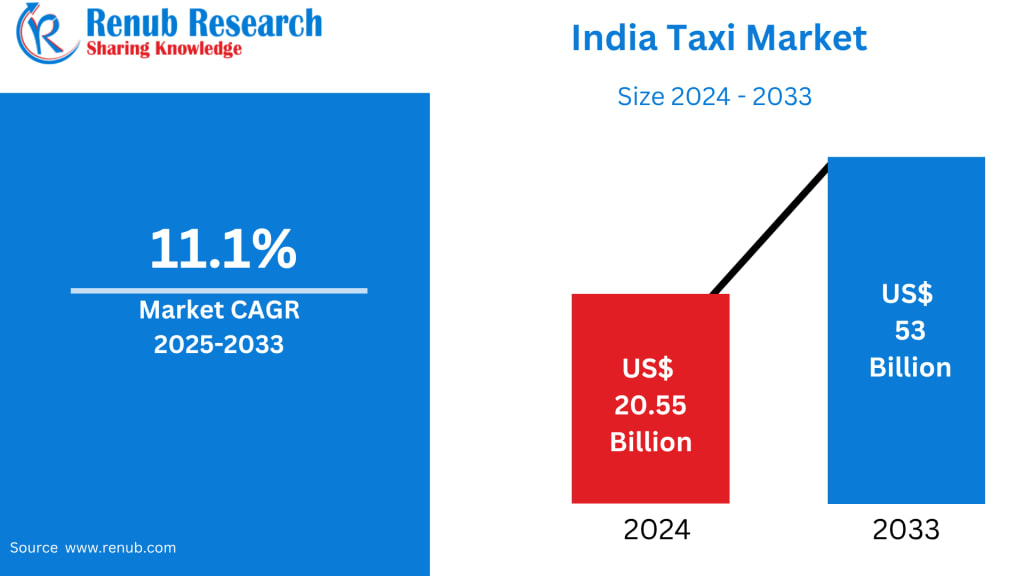
India Taxi Market at a Glance
The India Taxi Market was valued at USD 20.55 billion in 2024 and is projected to reach USD 53.0 billion by 2033, expanding at a CAGR of 11.1% during the forecast period. This strong growth trajectory reflects India’s accelerating urbanization, rising smartphone and internet penetration, and a decisive shift toward app-based mobility platforms. Ride-hailing giants such as Ola and Uber have transformed daily commuting across Tier-1, Tier-2, and increasingly Tier-3 cities, reshaping how millions of Indians move every day.
A taxi is a commercial vehicle offering passenger transport for hire, typically charged by time or distance. In India, taxi services span a wide spectrum—from traditional black-and-yellow cabs and auto-rickshaws to modern, app-based ride-hailing and ride-sharing platforms.
Taxis play a vital role in urban and semi-urban mobility, supporting daily commutes, airport transfers, corporate travel, tourism, and intercity journeys. Their point-to-point convenience, affordability, and flexibility make them indispensable, especially in cities where public transport is overcrowded or lacks last-mile connectivity.
As India modernizes, digital platforms, regulatory reforms, and consumer preference for on-demand personal mobility are accelerating market expansion. The taxi industry has evolved from a fragmented, cash-based system into a technology-driven ecosystem emphasizing safety, transparency, and efficiency.
Key Growth Drivers Shaping the India Taxi Market
Urbanization and Rising Mobility Demand
India’s rapid urban expansion is a primary catalyst for taxi market growth. Millions migrate to cities annually for employment, education, and better living standards. As metropolitan regions expand both vertically and horizontally, the demand for reliable, flexible transportation continues to rise.
Taxis fill critical mobility gaps where mass transit systems remain insufficient. By 2050, an estimated 70% of India’s population is expected to live in urban areas, intensifying the need for scalable transport solutions. While congestion and pollution remain challenges, taxis—particularly shared and electric variants—are increasingly positioned as part of the solution.
Smartphone and Internet Penetration
India’s digital revolution has fundamentally changed commuting behavior. Affordable smartphones and low-cost mobile data have enabled seamless taxi booking through apps. Platforms like Ola and Uber offer real-time tracking, fare transparency, digital payments, and driver ratings, significantly enhancing user experience.
According to DataReportal, India had over 806 million internet users in early 2025, with penetration exceeding 55%. As digital adoption spreads deeper into Tier-2 and Tier-3 cities, app-based taxi services are scaling rapidly beyond major metros.
Government Policies and Regulatory Support
Government initiatives indirectly but strongly support taxi market growth. Programs such as FAME (Faster Adoption and Manufacturing of Hybrid and Electric Vehicles) encourage electric taxi adoption, while Smart City Missions promote technology-enabled urban mobility.
The introduction of GST simplified taxation for taxi operators, improving compliance and transparency. Safety-focused regulations—mandatory GPS tracking, panic buttons, and driver background verification—have strengthened passenger confidence and professionalized the sector.
Challenges Facing the India Taxi Industry
Regulatory Fragmentation and Policy Uncertainty
Despite growth, India’s taxi market faces regulatory complexity due to state-level policy variations. Differences in fare caps, licensing norms, and vehicle eligibility often disrupt operations. Sudden policy changes or enforcement actions can lead to service suspensions, impacting both operators and consumers.
This fragmented regulatory environment complicates long-term planning and deters sustained investment, especially for platforms operating across multiple states.
Driver Shortages and Labor Issues
Driver dissatisfaction remains a persistent issue. Concerns over declining net earnings, high platform commissions, fuel costs, and lack of social security have led to strikes in major cities like Delhi and Mumbai.
Inconsistent training standards also affect service quality and safety. Addressing driver welfare, income stability, and skill development will be critical for sustaining growth.
India Online Taxi Market
Digital platforms dominate India’s taxi ecosystem. App-based services provide instant booking, route optimization, fare estimates, and cashless payments. Companies like Ola, Uber, and Rapido have expanded offerings to include electric vehicles, subscriptions, and micro-mobility options.
As smartphone usage grows nationwide, the online taxi market is expected to expand steadily across urban and semi-urban regions.
India Ride-Hailing Taxi Market
Ride-hailing has revolutionized daily commuting by offering door-to-door convenience, dynamic pricing, and comfort. These services are now preferred over traditional taxis and public transport by many urban consumers.
Beyond passenger mobility, ride-hailing platforms generate significant employment and flexible income opportunities. Post-pandemic, consumer preference for on-demand, private transport has further reinforced this segment’s long-term growth outlook.
India Ride-Sharing Taxi Market
Ride-sharing and carpooling are gaining traction among cost-conscious and environmentally aware consumers. Shared rides reduce travel expenses, traffic congestion, and carbon emissions—aligning well with India’s sustainable mobility goals.
While COVID-19 initially slowed adoption, enhanced safety measures have revived demand, particularly among office commuters and students in large cities.
India Motorcycle Taxi Market
Motorcycle taxis are emerging as a fast, affordable alternative in congested cities. Led by players like Rapido and UberMoto, bike taxis excel in last-mile connectivity and narrow urban roads.
Lower fares, quicker travel times, and rising fuel prices make this segment especially attractive to students and young professionals. The two-wheeler taxi market is expected to witness aggressive growth in coming years.
India Cars Taxi Market
Car taxis remain the backbone of India’s taxi industry. Hatchbacks, sedans, and compact SUVs dominate due to comfort and maneuverability. Corporate travel, airport transfers, and intercity journeys continue to drive demand.
The segment is also witnessing premiumization, with electric and luxury taxis gaining popularity among business travelers and high-income consumers.
Regional Market Highlights
Delhi Taxi Market
Delhi is one of India’s largest taxi markets, driven by dense population, tourism, and corporate activity. Environmental concerns have accelerated adoption of CNG and electric taxis. Government support for shared and app-based mobility continues to shape the market.
In November 2024, the Delhi Metro Rail Corporation launched a bike taxi service through its Momentum app, enhancing last-mile connectivity from metro stations.
Maharashtra Taxi Market
Maharashtra, home to Mumbai and Pune, features a diverse taxi ecosystem where traditional black-and-yellow cabs coexist with app-based services. Strong competition, high tourism, and intercity travel fuel market vibrancy. EV-friendly policies are expected to accelerate growth further.
Uttar Pradesh Taxi Market
With rapidly developing cities like Noida and Lucknow, Uttar Pradesh presents immense growth potential. Smartphone adoption and infrastructure development are enabling deeper penetration of online taxi services.
In December 2024, Noida International Airport partnered with Mahindra Logistics Mobility to launch 24/7 all-electric taxi services, signaling future-ready mobility.
Andhra Pradesh Taxi Market
Cities such as Visakhapatnam and Vijayawada are witnessing rising taxi demand due to infrastructure development, tourism, and IT expansion. Government support for digital and electric mobility strengthens long-term prospects.
Market Segmentation Overview
By Booking Type
Online Booking
Offline Booking
By Service Type
Ride-Hailing
Ride-Sharing
By Vehicle Type
Motorcycles
Cars
Other Vehicles (Vans)
Top States Covered
Maharashtra, Tamil Nadu, Uttar Pradesh, Karnataka, Gujarat, West Bengal, Rajasthan, Telangana, Andhra Pradesh, Madhya Pradesh, Kerala, Delhi
Key Players Analysis
Major companies operating in the India Taxi Market include:
Carzonrent India Pvt. Ltd.
ANI Technologies Pvt. Ltd. (Ola Cabs)
Spice Cabs
Uber Technologies Inc.
Meru Cabs
Savaari Car Rentals
FastTrack Taxi
Mega Cabs
My Taxi India
BlaBlaCar
Each company is evaluated across overview, leadership, recent developments, SWOT analysis, and revenue performance.
Final Thoughts
India’s taxi market is entering a transformational decade. Digital platforms, electric mobility, and evolving consumer preferences are redefining transportation across cities of all sizes. While regulatory complexity and labor challenges persist, supportive government initiatives and technological innovation continue to unlock new growth avenues.
With a projected market size of USD 53 billion by 2033, the India Taxi Market stands as a compelling example of how technology-driven mobility solutions can reshape urban life, improve accessibility, and support sustainable economic growth.
About the Creator
Diya Dey
Market Analyst
About Binding Prometheus
I want to start actively advocating on behalf of my own work, and the most valuable part of my canon is, without a doubt, Binding Prometheus, the play I have been working on since 2019 and only finished in 2023 as part of my MA. The play itself is an amalgamation of a million different inspirations. On one end, it evokes the Ancient Greek myth-play, deriving its own title from the earliest extant work of Western drama we have, Aeschylus’s Prometheus Bound. On the other end, it borrows significantly from the sci-fi bulwarks from over the years, namely Mary Shelley’s Frankenstein and Karel Capek’s Rossum’s Universal Robots. The play could be an episode of Black Mirror, I fear. I don’t know. I’ve only ever seen one episode of Black Mirror.
By Steven Christopher McKnight10 days ago in Futurism
Australia Foundry Equipment Market: Metal Casting Technology, Industrial Modernization & Productivity Growth
According to IMARC Group, the Australia foundry equipment market was valued at USD 143.59 Million in 2025 and is projected to reach USD 259.08 Million by 2034, growing at a compound annual growth rate (CAGR) of 6.78% during 2026–2034. This sustained growth reflects the increasing modernisation of Australia’s metal casting industry as manufacturers invest in advanced, efficient and automation-ready foundry systems. Foundry equipment plays a foundational role in producing metal components used across infrastructure, automotive, mining, defence, construction machinery and heavy engineering sectors. As Australia upgrades its industrial base and prioritises domestic manufacturing capability, foundry equipment is becoming a strategic enabler of productivity, quality and long-term industrial resilience.
By Shrestha Roy2 days ago in Futurism


Comments
There are no comments for this story
Be the first to respond and start the conversation.