
Is Reality Just a Computer Program? Scientists Suggest There's a 50% Chance We're Living in a Simulation
Bostrom’s argument hinges on the idea that future civilizations, with immense computing power, could simulate entire worlds, including conscious beings, for purposes ranging from research to entertainment.

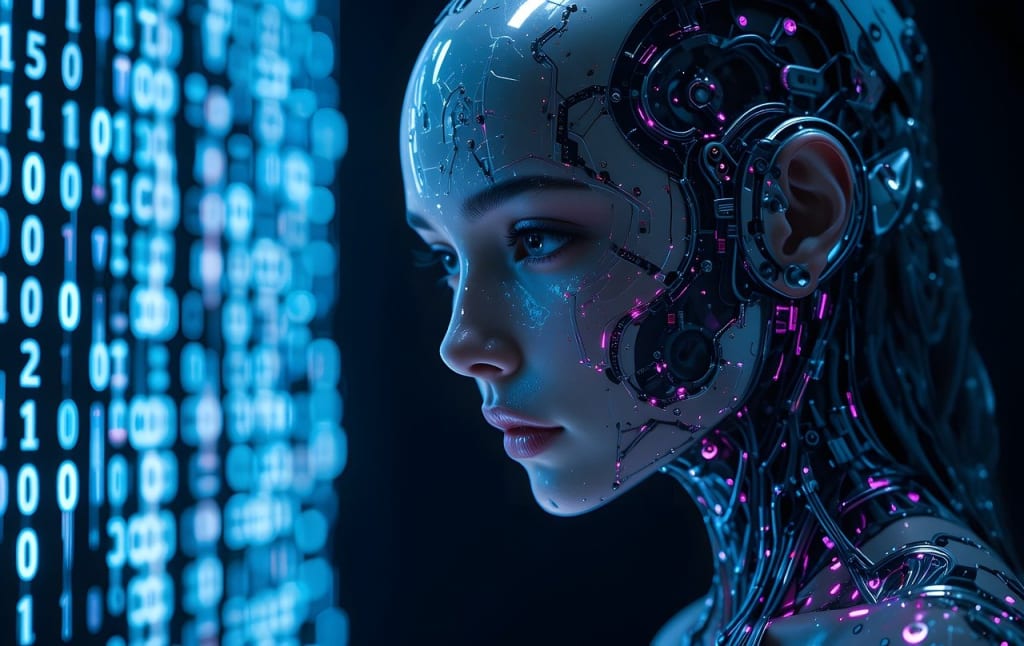
The idea that we might be living in a simulation is no longer just the stuff of science fiction. It’s a concept that has gained significant attention in both philosophical and scientific circles. From the Matrix movies to discussions among leading scientists and thinkers, the simulation hypothesis posits that our entire existence could be a highly advanced computer program. But what’s the real evidence behind this idea? Is there a real possibility that we’re not living in the "real" world at all?
Recently, a growing body of research and expert opinions has raised the possibility that there’s a 50% chance we’re all living in a simulation. Some of the world’s top minds, including physicists, technologists, and philosophers, are now taking this hypothesis more seriously. This post will dive deep into the concept, the arguments for and against it, and what it means for our understanding of reality itself.
The Origins of the Simulation Hypothesis The roots of the simulation theory can be traced back to the 2003 paper by philosopher Nick Bostrom titled “Are You Living in a Computer Simulation?”. In this groundbreaking work, Bostrom proposed that one of the following three scenarios must be true: Human civilization will go extinct before reaching a “post-human” stage capable of running highly realistic simulations. Advanced civilizations will choose not to run simulations of their ancestors.
We are almost certainly living in a simulation.
Bostrom’s argument hinges on the idea that future civilizations, with immense computing power, could simulate entire worlds, including conscious beings, for purposes ranging from research to entertainment. If these simulations are indistinguishable from reality, it stands to reason that the inhabitants of these simulated worlds (like us) would never be able to distinguish between the real world and the simulated one.
The Latest Findings
A 50% Chance We’re in a Simulation. This year, several notable scientists have echoed Bostrom’s original ideas and even put forward calculations suggesting that there’s a high likelihood we’re living in a simulation. While this doesn’t mean they believe we’re trapped in a “Matrix-like” world, it raises significant questions about the nature of reality.
The most recent figures to discuss this idea are physicists and computer scientists from prestigious institutions. According to their calculations, if future civilizations have the ability and desire to run ancestor simulations, the probability that we are part of one is disturbingly high, at least 50%. This means that, when considering all the factors involved, we may be living in a simulated environment as real as the one we perceive every day.
Why is this a plausible theory? For one, technological progress has reached a point where creating simulations of our reality might be possible. We already have artificial intelligence and machine learning models capable of simulating human-like behavior, and the exponential growth of computing power could eventually allow us to create simulations indistinguishable from the real world. With this in mind, future civilizations might be very capable of running simulations of their ancestors or entirely new forms of life.
Evidence for the Simulation Hypothesis. Although the idea of living in a simulation may seem outlandish at first, some of the supporting evidence is more compelling than you might think. Here are some of the key arguments.
Advances in Technology
As mentioned earlier, the rapid development of artificial intelligence, virtual reality, and computational power suggests that the ability to create complex simulations could be within reach. If we can create virtual worlds with immersive experiences today, it’s not far-fetched to imagine that future civilizations could build entire universes from scratch.
Quantum Mechanics and the Nature of Reality
Some physicists have pointed out that quantum mechanics, which governs the behavior of particles at a subatomic level, might be a telltale sign that we are living in a simulation. The strange phenomenon of particles existing in multiple states until they are observed, known as the “observer effect”, has led some to speculate that our reality might be rendered only when we observe it, like objects in a video game only appearing when we look at them. Cosmological Constants: Another fascinating argument comes from the fine-tuning of the constants of physics.
If the physical constants of the universe, such as the strength of gravity and the speed of light, were even slightly different, life as we know it wouldn’t be possible. Some have suggested that the precise nature of these constants could be indicative of a designed simulation, where variables are intentionally set to allow for the existence of conscious beings.
Mathematical Nature of Reality: Mathematics is the language of the universe. The fact that the laws of physics can be described using mathematical equations is something that many proponents of the simulation hypothesis point to. If the universe is essentially built on mathematical principles, could it be that it’s simply a very complex code running in a computer system?
The Counterarguments
While the simulation hypothesis is gaining traction, it’s far from universally accepted. Several significant objections challenge the idea that we’re living in a simulation. The Lack of Direct Evidence: The most glaring issue with the simulation theory is the lack of empirical evidence. So far, there’s no concrete proof that we’re living in a simulation, and the argument for it is largely based on logical reasoning and hypothetical scenarios. Without direct evidence, some argue that the hypothesis remains speculative at best.
Technological Limitations: Even with our ever-advancing technology, the computational power required to simulate an entire universe, let alone billions of conscious beings, might be far beyond what is realistically achievable. Some scientists argue that the resources needed for such a simulation would be astronomical, making it unlikely that future civilizations would attempt such an endeavor.
Philosophical Objections: Philosophers have long debated the nature of reality, and many reject the simulation hypothesis based on philosophical grounds. One argument is that the very concept of “simulated consciousness” might be incoherent. If consciousness can only exist within a biological system, then creating a conscious being within a simulation might be impossible.
The Fermi Paradox
The Fermi Paradox, which asks why we haven’t encountered extraterrestrial civilizations, also casts doubt on the simulation hypothesis. If advanced civilizations are capable of running simulations, some suggest, we should have already encountered signs of them. The fact that we haven’t could imply that simulations are not as widespread as the hypothesis suggests.
What It Means for Us So, what would it mean for us if we were living in a simulation? For many, the idea is a mind-boggling revelation, but it also opens up some intriguing possibilities. If we were to accept that our reality is simulated, it would raise questions about free will, the nature of consciousness, and the purpose of existence. Are we simply characters in a highly advanced video game? Do we have the ability to break free from the simulation? These are deep philosophical and existential questions that would fundamentally change how we view ourselves and our place in the universe.
Moreover, the simulation hypothesis also challenges our concept of reality itself. If our perception of the world is entirely virtual, it calls into question what’s “real.” Are the things we experience, the colors, sounds, and sensations, merely projections of a vast computer program? Or is there something more to reality than what meets the eye? While the idea that we might be living in a simulation is still speculative, it’s a concept that’s gaining more traction among scientists and thinkers alike. Whether or not we can ever prove it remains uncertain, but the philosophical implications are profound. It forces us to confront the nature of reality itself and challenges our assumptions about the world around us.
In the end, the simulation hypothesis offers an exciting and thought-provoking lens through which to examine our universe. Whether it’s a 50% chance or much lower, it invites us to question everything we think we know about existence, making us realize that the more we know, the more we might not know at all.
About the Creator
The Secret History Of The World
I have spent the last twenty years studying and learning about ancient history, religion, and mythology. I have a huge interest in this field and the paranormal. I do run a YouTube channel
Keep reading
More stories from The Secret History Of The World and writers in Futurism and other communities.
Were the Ancient Gods Extraterrestrials? The Hidden Truth Behind Our Origins
There’s something magnetic about ancient history, especially when you start asking the questions no one dares to answer. I’ve always been drawn to the forbidden corners of the past, the dusty layers that mainstream historians sweep under the rug. And one theory in particular continues to rise from those layers like a buried secret refusing to stay quiet: the idea that the ancient gods were not myths, but extraterrestrials.
By The Secret History Of The WorldExclusive • 10 months ago
Why Flutter and Firebase Are the Best Tech Stack for Startup App Development
Building a startup app today is very different from what it was even five years ago. Speed matters. Budget matters. Scalability matters even more. Most startups cannot afford a year-long development cycle or separate teams for Android, iOS, backend, and web. They need a tech stack that delivers a working product fast and scales when the business grows.
By Emily Cartera day ago in Futurism
Apple’s "Ultra" Gamble: 4 Surprising Ways the Mac Lineup is Changing Forever
1. Introduction: The End of the "One Size Fits All" Era For years, Apple executives dismissed the idea of a touchscreen Mac as an ergonomic disaster, famously insisting that "vertical surfaces don't want to be touched." That long-standing refusal is finally crumbling as the company prepares for its most significant hardware pivot in a decade. The catalyst is the rumored "MacBook Ultra," a device that signals a fundamental shift in how Apple categorizes its computers. We are moving away from the streamlined "Air and Pro" simplicity and entering a new era defined by a vast spectrum of models designed to capture every possible consumer—from the budget-conscious student to the high-end creative.
By Tech Horizons4 days ago in Futurism
From ad men to mad men
It's after 2am in the morning when a local police patrol vehicle in Northern New Jersey spots a figure costumed as Quasimodo, The Hunchback of Notre Dame, proceeding southbound on the sidewalk along Lydecker Street. Though the hunchback’s costume stuffing offers added insulation, it's January, and friggin’ freezing. Carefully, the officers slow down, gently question the subject, and offer him a ride home.
By David W. Maury7 days ago in Humor




Comments
There are no comments for this story
Be the first to respond and start the conversation.