
Inside Xiaomi's, Amazon's, BMW's Dark Factories: How Robots Are Quietly Taking Over the Modern Workplace
What Happens When Machines Run the Show--24/7?

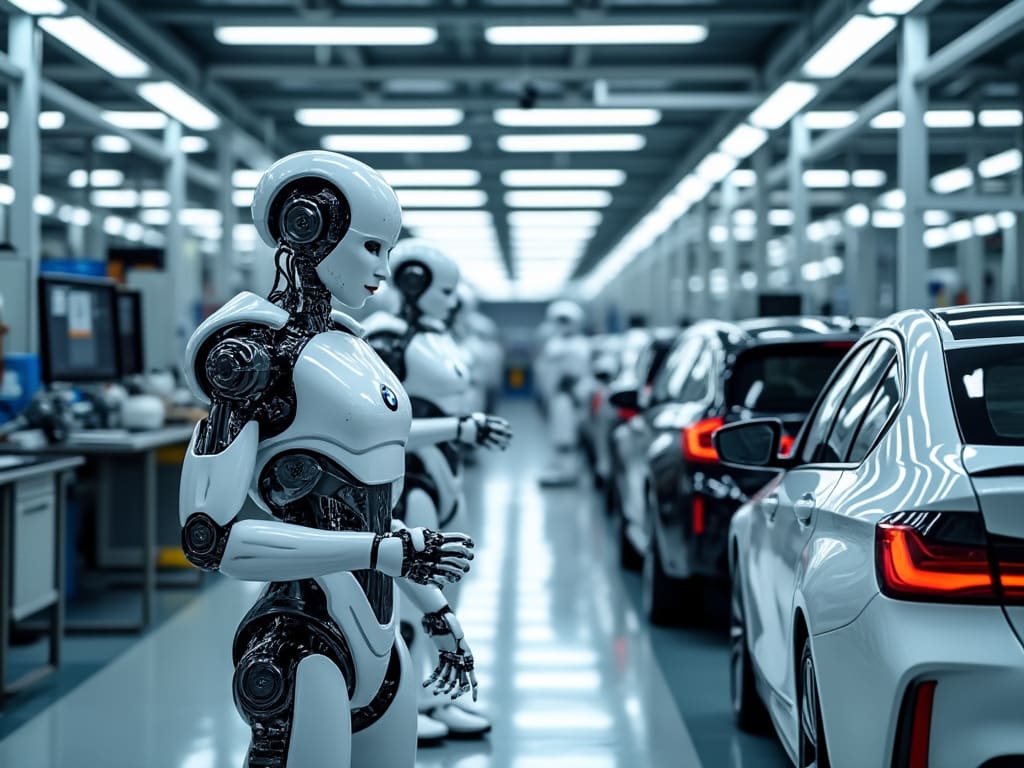
In a world rapidly evolving with technological advancements, a recent viral talk at Stanford University has sparked intense debate about the future of labor and artificial intelligence. The discussion, featuring insights from prominent technology expert Eric Brian Jolson, has shed light on a surprising truth: the era of fully automated factories is not just a distant possibility, but a present reality.
Jolson, who directs the Stanford Digital Economy Lab, revealed a startling fact about modern chip manufacturing facilities. Contrary to the belief that such advanced production would create a resurgence in blue-collar jobs, these facilities operate with virtually zero human workers. The reason? Humans are simply too "clumsy and dirty" for the ultra-precise environment required for chip production.
This revelation is not an isolated case. Across various industries, we're witnessing a dramatic shift towards automation. Take, for instance, Xiaomi's groundbreaking factory in Beijing's Changping district. This facility, often described as a "dark factory" or "lights-out factory," operates 24/7 without human intervention. Using Xiaomi's self-developed PPAI intelligent manufacturing platform, the factory manages everything from raw material procurement to product delivery, producing one smartphone every three seconds.
The automotive industry is not far behind in this automation race. BMW's plant in Spartanburg has been testing the Figure 2 robot, an autonomous machine capable of placing metal sheets with precision and even correcting its own mistakes. Similarly, Tesla has been demonstrating its Tesla Bot, showcasing its ability to perform various tasks in a factory setting.
But it's not just about humanoid robots. Amazon, the e-commerce giant, has taken a different approach. With approximately 750,000 robots working alongside human staff in its warehouses, Amazon has created a hybrid model of automation. These robots, like the Hercules, which can lift up to 3,000 pounds and travel the distance of 10 football fields, are revolutionizing the logistics industry.
However, this rapid advancement in automation raises critical questions about the future of human labor. While companies like Amazon claim that automation has created new job categories, unions and labor advocates express concerns about potential job losses. The debate intensifies as we consider whether humanoid robots are truly necessary or if non-humanoid machines could be more efficient for specific tasks.
China's aggressive push into robotics adds another layer to this complex picture. At the recent World AI Conference, China showcased an impressive lineup of 12 humanoid robot platforms, with many more in development. This massive investment in robotics technology signals China's intention to lead the global automation revolution.
As we grapple with these changes, it's crucial to consider the long-term implications for the workforce. Bill Gates, the tech mogul turned philanthropist, offers some insights into careers that might thrive in this AI-driven future. He suggests that AI specialists will be in high demand, as businesses across all sectors seek to integrate AI into their operations. For instance, an AI specialist in healthcare might develop algorithms to assist in early disease detection, while one in finance could create models for more accurate risk assessment.
Gates also points to the energy sector as a potential growth area. As the world shifts towards sustainable power sources, jobs in solar, wind, and nuclear energy production and management are likely to surge. Imagine engineers developing more efficient solar panels or technicians maintaining vast offshore wind farms – these roles will be crucial in our transition to a greener future.
Healthcare is another field that Gates believes will remain resilient to automation. While AI can assist in diagnosis and treatment planning, the human touch in patient care remains irreplaceable. Picture a future where AI helps a nurse quickly identify potential drug interactions, allowing them to spend more quality time comforting and caring for patients.
However, it's important to note that the transition to an automated workforce won't be smooth or uniform across all industries. Some sectors may see rapid changes, while others evolve more slowly. For example, while a car manufacturing plant might become fully automated in the near future, a local artisanal bakery might still rely heavily on human skills and creativity.
As we stand on the brink of this new era, the key to thriving in the job market of tomorrow lies in adaptability, innovation, and focusing on uniquely human skills. Emotional intelligence, creative problem-solving, and the ability to work in complex social environments are likely to become even more valuable.
In conclusion, while the rise of AI and robotics presents challenges to traditional employment models, it also offers exciting opportunities for those willing to adapt and innovate. As we navigate this brave new world of work, one thing is clear: the future belongs to those who can harness the power of technology while retaining the essential human touch. The question is not whether machines will replace humans, but how humans and machines can work together to create a more productive, efficient, and fulfilling work environment for all.
About the Creator
Keep reading
More stories from Next Koding and writers in Futurism and other communities.
The Silicon Valley's Dark Secrets Exposed: Eric Schmidt's AI Warfare Video Blocked by YouTube, Unveiling Terrivying Plans for Future Military Tecnology
In a shocking development that has sent ripples through the technology and defense worlds, former Google CEO Eric Schmidt has made a series of controversial statements in a video that has reportedly been blocked by YouTube. These statements lift the veil on plans to use AI in modern warfare and raise alarming concerns about the future of global conflicts.
By Next Kodingabout a year ago in Futurism
About Binding Prometheus
I want to start actively advocating on behalf of my own work, and the most valuable part of my canon is, without a doubt, Binding Prometheus, the play I have been working on since 2019 and only finished in 2023 as part of my MA. The play itself is an amalgamation of a million different inspirations. On one end, it evokes the Ancient Greek myth-play, deriving its own title from the earliest extant work of Western drama we have, Aeschylus’s Prometheus Bound. On the other end, it borrows significantly from the sci-fi bulwarks from over the years, namely Mary Shelley’s Frankenstein and Karel Capek’s Rossum’s Universal Robots. The play could be an episode of Black Mirror, I fear. I don’t know. I’ve only ever seen one episode of Black Mirror.
By Steven Christopher McKnight17 days ago in Futurism
Saudi Arabia Fuel Station Market: Retail Network Expansion, Mobility Demand & Market Growth
According to IMARC Group's latest research publication, Saudi Arabia fuel station market size was valued at USD 871.8 Million in 2025. The market is projected to reach USD 1,122.7 Million by 2034, exhibiting a growth rate of 2.85% during 2026-2034.
By Suhaira Yusuf5 days ago in Futurism


Comments (2)
Very informative article!
OMG, I so much enjoyed it and yes , I literally learnt stuff . Fantastic content , I subscribed to you and you can check out my articles and reciprocate also . Looking forward to more of ya stuff