
Saudi Arabia Fuel Station Market: Retail Network Expansion, Mobility Demand & Market Growth
How rising vehicle ownership, highway infrastructure expansion, and growing demand for convenience services are transforming the Saudi Arabia fuel station market, driven by network modernization, retail integration, and evolving consumer mobility needs across the Kingdom.

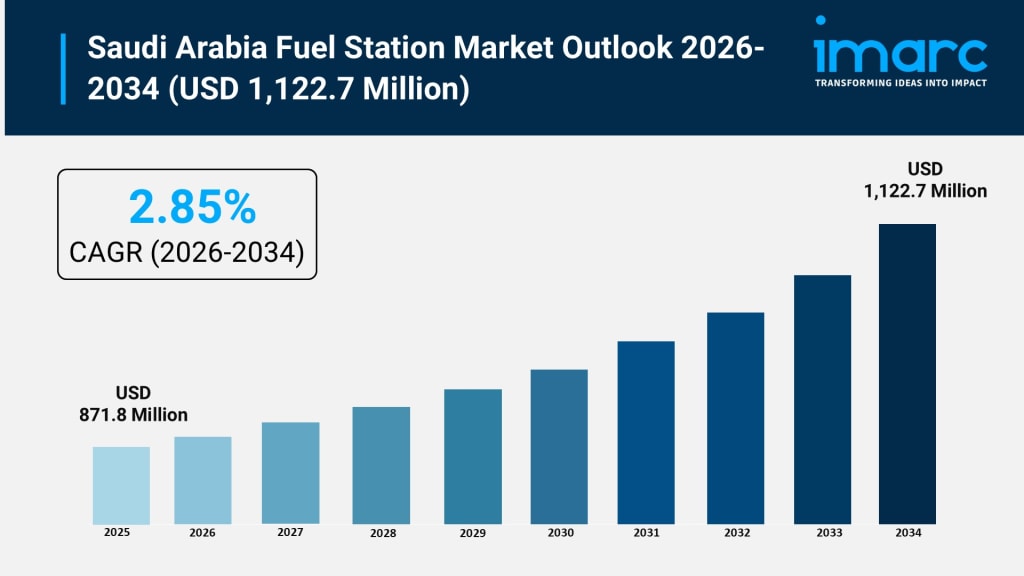
According to IMARC Group's latest research publication, Saudi Arabia fuel station market size was valued at USD 871.8 Million in 2025. The market is projected to reach USD 1,122.7 Million by 2034, exhibiting a growth rate of 2.85% during 2026-2034.
How AI is Reshaping the Future of Saudi Arabia Fuel Station Market
- Smart POS and Inventory Systems: AI-enabled terminals provide predictive inventory management and faster checkout. ENOC deployed AI-powered POS at 60 stations in Jeddah and Dammam, enabling real-time tracking and automated billing.
- Fleet Management Optimization: PetroApp closed USD 50 million funding in July 2025, managing over 500,000 vehicles across 5,000 stations using AI for predictive maintenance, expanding services including washes and oil changes.
- IoT-Enabled Monitoring: Real-time fuel level tracking, flow rate monitoring, and leakage detection through connected dispensers reduce losses and improve safety standards across automated forecourt operations in urban and semi-urban areas.
- Digital Payment Integration: Electronic payments reached 70% of retail transactions in 2023, up from 62% in 2022, streamlining customer experience with contactless systems and mobile payment platforms at modern stations.
- Compliance and Automation: ZATCA e-invoicing integration and Ministry of Energy standards compliance through automated forecourt controllers supporting over 120 pump brands eliminate manual errors and ensure regulatory adherence across operations.
How Vision 2030 is Revolutionizing Saudi Arabia Fuel Station Industry
Vision 2030 is reshaping Saudi Arabia's fuel station landscape through massive infrastructure investments and energy sector diversification. The government plans to invest SR 10 billion (USD 2.67 billion) in 18 new logistics zones, significantly boosting traffic and freight activity requiring expanded fueling infrastructure. With over SR 266 billion (USD 71 billion) allocated for downstream projects and SR 150 billion (USD 40 billion) for road infrastructure and tourism development, fuel station networks are rapidly modernizing across urban and semi-urban regions. Privatization and liberalization of fuel distribution attract substantial private sector capital, while public-private partnerships accelerate retail network expansion and EV charging infrastructure development. Major players like Saudi Aramco, Aldrees, and Petromin are renovating stations with automated payment systems, convenience stores, and alternative fuel options. The Kingdom's target to reach 100 million tourists annually by 2030 and accommodate 86.16 million visitors in 2024 drives continuous demand for strategically positioned, technologically advanced fuel stations throughout the Kingdom.
Saudi Arabia Fuel Station Market Trends & Drivers:
Rising vehicle ownership continues as the primary market driver, with approximately 60% of Saudi Arabia's population under 30 contributing to expanding demand for personal mobility. The expanding middle class and vehicle ownership projected to reach 14.6 million by 2025 represents 17.7% growth from 2022 levels. The automotive sector received SAR 58 billion (USD 15.5 billion) in investments in 2022 according to Saudi Arabian Monetary Authority, fueling consistent gasoline consumption growth. Saudi Arabia's population growing at 1.78% annually, with 92.12% urban residents totaling 31.8 million people, concentrates demand in cities experiencing increased traffic congestion requiring accessible, well-equipped fuel stations. Private car financing accessibility and international automotive brand expansion broaden consumer vehicle access. The over 60,000 kilometers of highway networks sustain heavy fuel consumption from passenger cars, commercial fleets, and logistics vehicles supporting the Kingdom's growing economy and trade activities.
Rapid urbanization and infrastructure modernization under national development programs transform fuel retail landscapes. New transport corridors and road networks encourage fuel station development in previously underserved areas, supporting longer commutes and mixed-use developments integrating convenience stores, food outlets, and rest zones. Riyadh metropolitan area with 7.6 million projected population represents substantial fuel infrastructure demand driven by urbanization and economic diversification. King Salman International Airport expected to accommodate 120 million travelers by 2030 and reaching 185 million by 2050 exemplifies infrastructure scale creating sustained fuel demand. Tourism sector growth from 49 million visitors in 2022 targeting 100 million by 2030 generates transportation fuel needs, particularly in gateway cities like Jeddah. During Hajj and Umrah, approximately 86.16 million tourists in 2024 including 0.22 million Hajj pilgrims and 4.32 million Ziarah Madinah visitors peak traffic demands, driving service expansion and infrastructure enhancement across pilgrimage routes.
Regulatory compliance modernization drives technological adoption throughout the sector, with 440 out of 1,219 petrol stations along highways failing to meet operational and safety standards, highlighting urgent infrastructure upgrade needs. Electronic payment adoption, integrated digital systems, real-time price displays, and surveillance technologies improve service consistency and operational efficiency. SASCO unveiled 30,000-square-meter station on Makkah-Taif road with SAR 12.4 million (USD 3.31 million) investment, featuring convenience stores, branded restaurants, coffee shops, and ATMs demonstrating integrated service node concept. Alternative fuel infrastructure development accelerates with ENOWA opening Saudi Arabia's first heavy-duty hydrogen refueling station at Petromin Corporation, distributing approximately 500 kg hydrogen in 12 weeks supporting green hydrogen goals. EVIQ partnered with Petromin in July 2025 launching EV charging stations marking significant EV infrastructure expansion. Air Products Qudra and Saudi Arabia Railways signed November 2023 MoU for hydrogen fueling stations for trains, positioning Kingdom for multi-energy fuel station transition supporting electrification and hydrogen adoption alongside traditional fuels.
Saudi Arabia Fuel Station Market Industry Segmentation:
The report has segmented the market into the following categories:
Fuel Type Insights:
- Petrol
- Diesel
- Gas
End Use Insights:
- Road Transport Vehicle
- Air Transport Vehicle
- Water Transport Vehicle
Region Insights:
- Northern and Central Region
- Western Region
- Eastern Region
- Southern Region
Competitive Landscape:
The competitive landscape of the industry has also been examined along with the profiles of the key players.
Recent News and Developments in Saudi Arabia Fuel Station Market
- January 2025: ENOWA, energy and water subsidiary of NEOM, opened Saudi Arabia's first heavy-duty hydrogen refueling station at Petromin Corporation in collaboration with Hydrogen Refueling Solutions. The station distributed approximately 500 kg hydrogen in 12 weeks, marking significant milestone in NEOM region's green hydrogen goals.
- July 2025: PetroApp, Saudi-based independent platform for fuel payments and fleet management, closed USD 50 million funding round led by Jadwa Investment. Established in 2018, PetroApp manages over 500,000 vehicles across 5,000 stations, integrating AI for predictive maintenance and planning Tadawul IPO.
- July 2025: EVIQ announced opening of new EV charging station in partnership with Petromin, one of Kingdom's most trusted fuel and e-mobility services providers, marking significant step forward in EV infrastructure growth across Saudi Arabia.
- April 2024: Zain KSA introduced pioneering fleet management system entirely developed, designed, and assembled in Saudi Arabia, becoming first telecommunications operator to align with Made in Saudi Program, demonstrating locally developed advanced fleet solutions supporting logistics efficiency.
Note: If you require specific details, data, or insights that are not currently included in the scope of this report, we are happy to accommodate your request. As part of our customization service, we will gather and provide the additional information you need, tailored to your specific requirements. Please let us know your exact needs, and we will ensure the report is updated accordingly to meet your expectations.
About the Creator
Suhaira Yusuf
I specialize in Consumer Insights, focusing on transforming detailed market data into strategic business solutions that accelerate growth and improve customer engagement.
Keep reading
More stories from Suhaira Yusuf and writers in Futurism and other communities.
Saudi Arabia Event Management Market: Mega Events, Tourism Push & Demand Growth
According to IMARC Group's latest research publication, the Saudi Arabia event management market size reached USD 9,450.2 Million in 2024. The market is projected to reach USD 19,561.3 Million by 2033, exhibiting a growth rate (CAGR) of 8.42% during 2025-2033.
By Suhaira Yusuf8 days ago in Futurism
About Binding Prometheus
I want to start actively advocating on behalf of my own work, and the most valuable part of my canon is, without a doubt, Binding Prometheus, the play I have been working on since 2019 and only finished in 2023 as part of my MA. The play itself is an amalgamation of a million different inspirations. On one end, it evokes the Ancient Greek myth-play, deriving its own title from the earliest extant work of Western drama we have, Aeschylus’s Prometheus Bound. On the other end, it borrows significantly from the sci-fi bulwarks from over the years, namely Mary Shelley’s Frankenstein and Karel Capek’s Rossum’s Universal Robots. The play could be an episode of Black Mirror, I fear. I don’t know. I’ve only ever seen one episode of Black Mirror.
By Steven Christopher McKnight18 days ago in Futurism
United States Automotive Lighting Market Size and Forecast 2025–2033
Market Snapshot The United States Automotive Lighting Market is projected to grow from US$ 10.41 billion in 2024 to US$ 17.24 billion by 2033, registering a compound annual growth rate (CAGR) of 5.76% during the forecast period 2025–2033. This growth is being driven by rising vehicle production, rapid advancements in LED and adaptive lighting technologies, increasing demand for energy-efficient systems, and a strong regulatory focus on road safety.
By Aaina Oberoi4 days ago in Futurism



Comments (1)
When I was in Saudi...I was like looook out. A lot of growth happening there.