
The Silicon Valley's Dark Secrets Exposed: Eric Schmidt's AI Warfare Video Blocked by YouTube, Unveiling Terrivying Plans for Future Military Tecnology
Is the tech giant's ex-CEO paving the way for robot armies and AI-driven global conflicts?

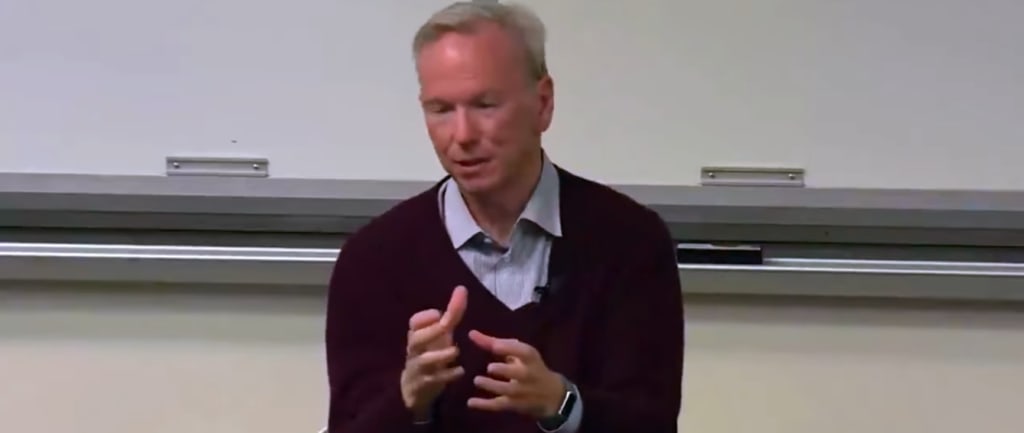
In a shocking development that has sent ripples through the technology and defense worlds, former Google CEO Eric Schmidt has made a series of controversial statements in a video that has reportedly been blocked by YouTube. These statements lift the veil on plans to use AI in modern warfare and raise alarming concerns about the future of global conflicts.
1. Offensive Strategy in Modern Warfare
Schmidt began his discussion with a startling statement about war strategy. "One of the things to know about war is that the offense always has the advantage," he said. "You can always overwhelm the defensive systems, so you're better off as a strategy of National Defense to have a very strong offense that you can use if you need to."
Imagine a world where nations are in a race to develop increasingly sophisticated offensive systems, with AI as their backbone. This could create a highly unstable international environment where the threat of war is constantly looming.
2. Definition of Military Offense in the AI Era
Schmidt then explained what "offense" means in the context of modern military operations. This includes the ability to occupy or recapture territory, achieve certain objectives, or realize larger strategic goals.
In the AI era, military offense might look very different. Picture a swarm of autonomous drones capable of carrying out reconnaissance missions or even attacks without direct human intervention. Or AI systems that can cripple an enemy's digital infrastructure in a matter of seconds.
3. AI and Robotics in Warfare
"The idea basically is to do two things," Schmidt explained, "use AI in complicated powerful ways for these essentially robotic wars, and the second one is to lower the cost of the robots."
This conjures images of future battlefields populated by autonomous combat robots. Imagine a scenario where thousands of small drones, each equipped with advanced AI, can be deployed to overwhelm traditional defense systems at a fraction of the cost of using human soldiers.
4. Revolution in War Strategy
Schmidt proposed a radical change in how we think about warfare. "The whole theory of armies is tanks, artillery, and mortar, and we can eliminate all of them," he said. "We can make the penalty for invading a country, at least by land, essentially impossible."
Envision a world where traditional land invasions become obsolete. Instead of tanks and troops, battles might be dominated by drone swarms and automated defense systems capable of detecting and destroying intruders with incredible precision.
5. Schmidt as an Arms Dealer
In a shocking admission, Schmidt stated, "I am now a licensed arms dealer." He explained his involvement in shipping weapons to Ukraine, saying, "Because of the way the laws work, we're doing this privately... it's all legal with the support of the governments."
This raises serious questions about the role of tech executives in global conflicts. Do we want people who have spent their careers in Silicon Valley suddenly pivoting to the defense industry? How will this affect the direction of military technology development?
6. Grim Predictions about Ukraine
Schmidt made a worrying prediction about the conflict in Ukraine. "If in May or June, if the Russians build up as they are expecting to, Ukraine will lose a whole chunk of its territory and will begin the process of losing the whole country," he said.
This statement underscores the seriousness of the situation in Ukraine and how crucial modern military technology is in determining the outcome of conflicts. It also raises questions about the ethics of tech companies' involvement in such conflicts.
7. Influence on AI Policy
Schmidt revealed that he leads an "informal ad hoc non-legal group" that has influenced US government AI policy. "The group includes all the usual suspects," he said, "and over the last year came up with the basis of the reasoning that became the B administration's AI act."
This raises serious questions about who is really shaping national AI policy. Should we be concerned that a small group of tech executives has such a large influence on policies that will affect entire societies?
8. Experience at the Department of Defense
Schmidt spoke about his experience working with the US Department of Defense. "I worked for the Secretary of Defense for seven years and tried to change the way we run our military," he said. "I'm not a particularly big fan of the military, but it's very expensive and I wanted to see if I could be helpful."
This illustrates the increasingly close relationship between Silicon Valley and the military-industrial complex. Is this a positive development that will bring efficiency and innovation? Or is it a sign that technology is becoming increasingly militarized?
9. Ethical Questions
Throughout the video, disturbing ethical questions arise. Is the development of AI warfare technology ethical? How can we ensure that this technology doesn't fall into the wrong hands? And what about the potential for errors or malfunctions that could trigger unintended conflicts?
10. Context and Implications of the Video
The video appears to have been recorded around April, with Schmidt making projections for May and June. The fact that the video has reportedly been blocked by YouTube adds another layer of mystery and controversy. Is this an attempt to silence discussion about AI warfare technology? Or perhaps it's a precautionary measure to avoid the spread of sensitive information?
Conclusion
Eric Schmidt's statements open a worrying window into the future of warfare and the role of technology in it. They reveal the extent to which AI and robotics could change the landscape of global conflicts, and how close the relationship between tech giants and the military-industrial complex has become.
As a society, we need to critically question the direction of these developments. Do we want to live in a world where warfare is increasingly automated? How can we ensure that the development of military technology remains within ethical boundaries?
We also need to consider the broader implications of tech companies' involvement in military affairs. Will this change the way these companies operate? How will it affect our privacy and civil liberties?
Regardless of the answers to these questions, one thing is clear: we are on the brink of a new era in technology and warfare. We must remain vigilant, critical, and engaged in discussions about how this technology is developed and used. The future of our global security may depend on it.
About the Creator
Keep reading
More stories from Next Koding and writers in Futurism and other communities.
The Twilight of Smartphones: A New Dawn in Personal Technology
In a world where smartphones have become an extension of our hands, a startling revelation is shaking the foundations of personal technology. The smartphone, a device that has dominated our lives for over a decade, may be approaching its twilight years. This isn't just speculation; it's a possibility backed by industry trends and technological advancements that are reshaping how we interact with the digital world.
By Next Kodingabout a year ago in Futurism
About Binding Prometheus
I want to start actively advocating on behalf of my own work, and the most valuable part of my canon is, without a doubt, Binding Prometheus, the play I have been working on since 2019 and only finished in 2023 as part of my MA. The play itself is an amalgamation of a million different inspirations. On one end, it evokes the Ancient Greek myth-play, deriving its own title from the earliest extant work of Western drama we have, Aeschylus’s Prometheus Bound. On the other end, it borrows significantly from the sci-fi bulwarks from over the years, namely Mary Shelley’s Frankenstein and Karel Capek’s Rossum’s Universal Robots. The play could be an episode of Black Mirror, I fear. I don’t know. I’ve only ever seen one episode of Black Mirror.
By Steven Christopher McKnight11 days ago in Futurism
Saudi Arabia Office Furniture Market: Smart Workspaces, Ergonomic Demand, Commercial Expansion & Vision 2030
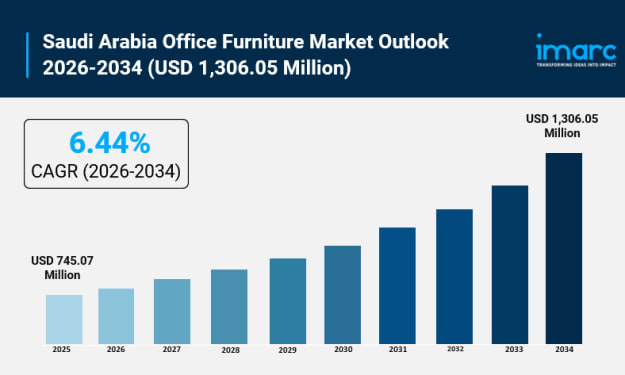
According to IMARC Group's latest research publication, Saudi Arabia office furniture market size was valued at USD 745.07 Million in 2025. The market is projected to reach USD 1,306.05 Million by 2034, exhibiting a growth rate (CAGR) of 6.44% during 2026-2034.
By Jeffrey Wilsonabout 6 hours ago in Futurism



Comments (3)
Very nice article! It illustrates the changes in military technology. With a button, we will be out of this reality like animals.(In a case a drone killed its operator.)
Very interesting and timely article. Regarding Ukraine, an initial agreement is coming, but then the big banking issue in Kyiv.
Pretty nice... Whatever techs for good purpose is nice to defeat evil spirit authorotarian regimes & it's related affiliates... Evil spirit authorotarian regimes & it's related affiliates are great trouble & trouble givers for this entire planet in current situations & also in future... [ just from my perspective... ]