
How Humans Will Get Oxygen on Mars
NASA's Plan: Oxygen on Mars – How Will Humans Survive?

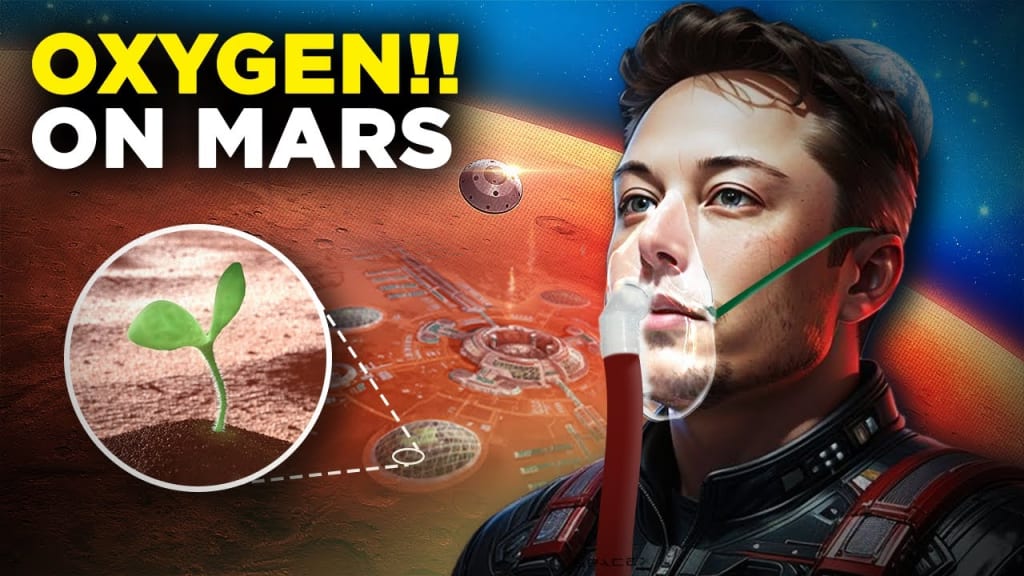
NASA plans to build a base on the Moon before sending humans to Mars — a step meant to shorten the journey to the Red Planet.
Elon Musk, founder of SpaceX, wants to win the race to Mars. Meanwhile, European and Russian space agencies have also expressed interest in sending humans to Mars.
But here's the real question: how will humans survive on Mars after landing there? Unlike Earth, Mars lacks the most essential element for life — oxygen.
NASA has been working on ways to produce oxygen on Mars. But the oxygen production method used on the International Space Station (ISS) won't work the same way there. Why? Let’s explore.
Why Mars? Why Now?
There are many reasons why humans dream of living on Mars: scientific exploration, curiosity, and... fear. Yes, fear — fear that one day, a disaster may wipe out humanity from Earth, just like the dinosaurs 65 million years ago. And it's not just a fantasy — climate change is a real threat we’re witnessing today.
That’s why one day, someone will become the Neil Armstrong of Mars.
The Race to Mars
Elon Musk initially aimed to colonize Mars by 2026, but now predicts the first human mission may occur in 2029.
NASA, too, is targeting a manned Mars mission by 2030.
But again, the real question isn’t who gets there first, but:
How will humans survive on Mars?
Mars vs. Earth – What’s Similar?
Mars shares some features with Earth:
- A day on Mars (called a Sol) is just 39 minutes longer than an Earth day
- There are seasons
- Both have ice caps at the poles
- Both have atmospheres (though Mars’ is much thinner)
But the one thing that’s critically missing on Mars is: oxygen.
Can ISS Tech Work on Mars?
To understand why ISS methods won’t work, let’s look at how oxygen and water are created in space.
On the ISS (orbiting 400 km above Earth), there are two main systems:
1. Water Reclamation System (WRS)
- Collects urine, sweat, and humidity
- Purifies it for reuse (yes, yesterday’s coffee becomes tomorrow’s)
- Saves 98% of water
2. Oxygen Generation System (OGS)
- Uses electrolysis: electrical current splits water into oxygen and hydrogen
- Oxygen is used for breathing
- Hydrogen (highly flammable) is dangerous, so it’s mixed with carbon dioxide from astronaut exhalation via the Sabatier System
- This creates water, methane, and heat
However, these systems rely on regular resupply missions from Earth. Despite 98% efficiency, there are always losses and leaks.
Refueling costs are extremely high — just sending 1 liter of water to ISS costs hundreds of dollars.
So imagine doing the same for Mars, which is 225 million km away. It’s not cost-effective at all.
NASA’s Solution: MOXIE – Making Oxygen on Mars
In 2021, NASA’s Perseverance Rover carried an experiment called MOXIE (Mars Oxygen In-Situ Resource Utilization Experiment).
Mars has little water, so extracting oxygen from it isn't practical. Instead, MOXIE pulls carbon dioxide (CO₂) from Mars’ atmosphere (which is 95% CO₂), and:
- Pressurizes it
- Heats it to 800°C
- Runs it through a gold-plated solid oxide electrolysis cell
- Separates oxygen from carbon monoxide
The gold helps conduct heat efficiently and protects internal components. However, there's a risk: carbon buildup, like on the bottom of cooking pans, can damage the system. So this process must be done carefully.
How Much Oxygen Has MOXIE Produced?
So far, MOXIE has only produced 122 grams of oxygen — enough for a human to survive just 35 hours.
Scaling this up would require:
- A much larger MOXIE unit
- A powerful energy source, like a Martian power plant
The Energy Challenge
MOXIE’s biggest problem: it needs a lot of energy — both to compress CO₂ and to heat it.
Scientists are exploring future tech that could break down CO₂ using vibrational energy instead of heat, allowing the oxygen to be extracted at lower temperatures. It’s still in lab-testing and not viable under Earth’s conditions — but Mars' thin atmosphere is ideal for it.
Why Mars Oxygen Must Be Independent
Any oxygen-generation system on Mars must be self-sufficient.
- On ISS, if something breaks down, astronauts can survive in suits and await backup from Earth.
- On Mars, no such help will come quickly.
- A breakdown could be catastrophic, and there's no going back easily.
That’s why systems like MOXIE are just the beginning. Future Mars colonists will need:
- Autonomous oxygen generation
- Devices that use Martian resources only
- And no reliance on Earth-based resupply missions
Final Thoughts
Making Mars livable isn't just about reaching there — it's about surviving once we get there.
And oxygen, the most basic human need, might be the biggest hurdle.
About the Creator
Keep reading
More stories from Jehanzeb Khan and writers in Futurism and other communities.
Impossible Rescue of Space Station After Power Failure | Salyut 7
During one of its orbits, a Soviet space station suffered an electrical failure, and all contact with the ground station was lost. Fortunately, at the time of this incident, no crew was onboard the space station known as Salyut 7. However, the power failure led to the station spinning out of control and drifting off its orbit.
By Jehanzeb Khan8 months ago in Futurism
IT Solutions Powering Modern Manufacturing Operations
Manufacturing has always been shaped by technology, from mechanized looms to assembly lines. Today, the transformation is less about physical machinery alone and more about the digital systems that connect, monitor, and optimize every step of production. Information Technology (IT) solutions now sit at the center of modern manufacturing operations, quietly enabling factories to work faster, smarter, and with greater resilience.
By Davin Convaya day ago in Futurism
Australia Luxury Fashion Market: Rising Affluent Demand, Digital & Retail Expansion & Sustainability Trends
According to IMARC Group, the Australia luxury fashion market reached USD 5.2 Billion in 2025 and is projected to grow to USD 6.8 Billion by 2034, exhibiting a compound annual growth rate (CAGR) of 2.95% during 2026–2034. The steady expansion of the market reflects rising disposable incomes, growing affluent consumer segments, and evolving lifestyle aspirations across Australia. Luxury apparel, footwear, handbags, and accessories are increasingly viewed as lifestyle investments rather than occasional indulgences. As digital retail channels expand and sustainability becomes central to brand positioning, Australia luxury fashion market share continues to evolve within a competitive global landscape.
By Kevin Cooperabout 19 hours ago in Futurism




Comments (3)
amazing bro
Nice bro good information especially for those people who want to go there
This was eye-opening. I always wondered how we’d breathe on Mars, and MOXIE sounds like both a scientific miracle and a massive challenge. You made the complexities feel clear and urgent—surviving on Mars is going to take far more than just getting there.