
Helicity Space and a New Generation of Plasma Engines: How the Journey to Mars Could Be Cut by Several Times
Space

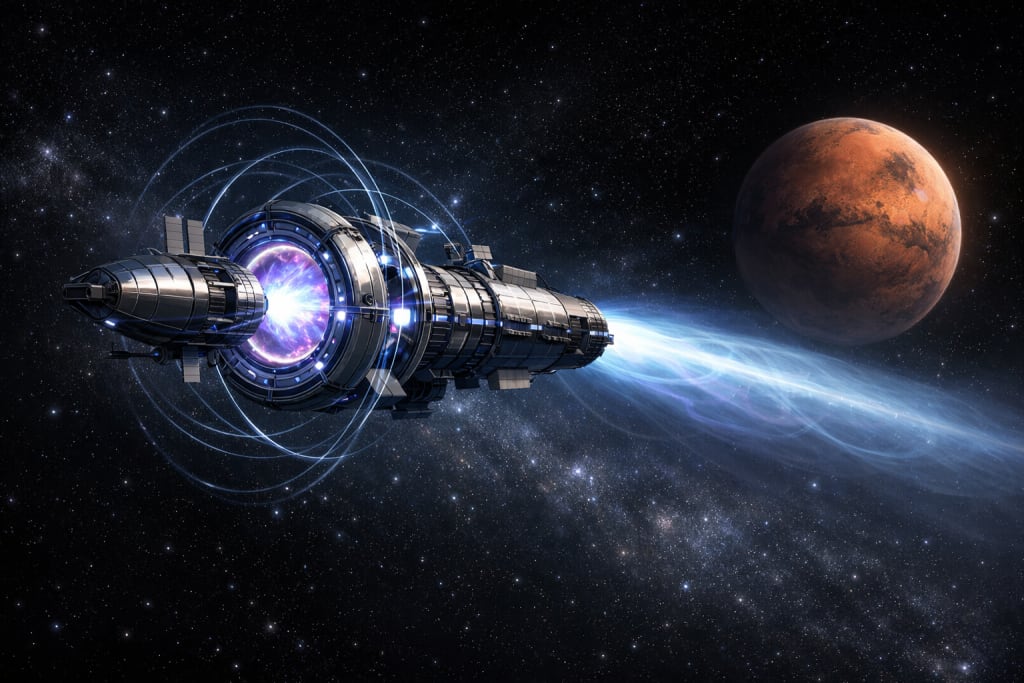
For decades, Mars has been humanity’s most realistic dream beyond the Moon. It is close enough to reach with existing technology, yet distant enough to expose the fundamental limits of modern spaceflight. Even with today’s best rockets, a crewed mission to the Red Planet typically takes six to nine months one way. That long transit time is not just inconvenient—it is dangerous, expensive, and physically exhausting for astronauts.
But what if the trip to Mars could be reduced not by weeks, but by several times? What if interplanetary travel began to resemble a fast, controlled journey rather than a slow orbital drift? This is the promise behind Helicity Space, a startup developing a radically new type of plasma propulsion that could redefine how humans move through the Solar System.
Why Current Engines Are the Bottleneck
The core problem with interplanetary travel is propulsion. Nearly all rockets in use today rely on chemical engines, a technology that has changed surprisingly little since the mid-20th century. These engines are extremely powerful—but only for a few minutes. Almost all the fuel is burned during launch and initial acceleration, after which the spacecraft simply coasts along its trajectory.
This approach works for reaching orbit or the Moon, but it becomes highly inefficient for deep-space missions. Once a spacecraft is on its way to Mars, it cannot meaningfully accelerate or decelerate. The result is a long, passive journey governed by orbital mechanics rather than active control.
Electric propulsion systems—such as ion or Hall-effect thrusters—are a step forward. They are far more fuel-efficient and can operate for months or years. However, their thrust is extremely low, making them unsuitable for transporting humans quickly. They excel at slowly moving robotic probes, not crewed spacecraft on tight timelines.
Helicity Space’s Different Approach
Helicity Space aims to bridge the gap between high-efficiency electric propulsion and the high thrust required for human missions. Their concept is based on advanced plasma physics and a fusion-adjacent approach known as field-reversed configuration (FRC).
In simple terms, Helicity Space’s engine creates a compact, self-contained ring of superheated plasma. This plasma is confined and compressed using powerful magnetic fields rather than physical walls. As the plasma is manipulated, it releases enormous amounts of energy. Crucially, much of this energy can be directly converted into thrust, without the multiple conversion steps seen in conventional reactors.
This is a major departure from traditional propulsion design. Instead of burning fuel violently and inefficiently, the engine uses controlled plasma dynamics to generate sustained, high-performance thrust over long periods.
Continuous Acceleration Changes Everything
The real breakthrough lies in what continuous thrust enables. With a Helicity-style plasma engine, a spacecraft could accelerate for half the journey to Mars, then flip and decelerate for the second half. This is fundamentally different from today’s “boost and coast” missions.
The implications are dramatic:
- Transit times could drop to 30–45 days, according to early projections.
- Future iterations might reduce travel time to just a few weeks.
- Mission planners gain flexibility instead of waiting for narrow orbital launch windows.
- This is not just faster—it is safer.
- Radiation, Health, and Human Survival
One of the greatest dangers of long-duration spaceflight is cosmic radiation. Outside Earth’s magnetic field, astronauts are exposed to high-energy particles that increase cancer risk, damage the nervous system, and degrade cognitive performance over time.
By shortening the journey to Mars, Helicity Space’s propulsion concept directly reduces radiation exposure. A one-month transit instead of nine months could mean the difference between a manageable medical risk and a mission-ending health crisis.
Shorter trips also ease psychological strain. Living in a confined spacecraft for months on end is one of the least studied—but most serious—challenges of crewed Mars missions. Faster travel makes human factors far more manageable.
Why This Technology Is Still Experimental
Despite its promise, Helicity Space’s engine is not ready to fly tomorrow. Significant challenges remain:
- Plasma stability must be maintained under extreme conditions.
- Materials must survive intense magnetic fields and particle fluxes.
- The system must be scaled from laboratory prototypes to spacecraft-sized reactors.
However, the most important point is this: no known laws of physics are violated. The underlying principles are well-established, and key components have already been demonstrated experimentally. What remains is engineering, optimization, and time.
What This Means for the Future of Mars Exploration
If Helicity Space—or similar companies—successfully brings this technology to operational readiness, the impact will extend far beyond a single mission to Mars.
Fast, efficient plasma propulsion could enable:
- Regular cargo and crew rotations between Earth and Mars
- Emergency return capabilities for astronauts
- More ambitious missions to the outer planets
- A transition from exploration to permanent settlement
In effect, Mars would stop being a once-in-a-generation expedition and start becoming a reachable destination within a broader space infrastructure.
A New Era of Interplanetary Travel
Chemical rockets launched humanity into space, but they were never meant to carry us across the Solar System efficiently. Just as aviation evolved beyond propellers, spaceflight must evolve beyond combustion.
Helicity Space represents one of the clearest signals that this transition has begun. If their plasma engine succeeds, the journey to Mars will no longer be defined by endurance and risk—but by speed, control, and sustainability.
Mars will still be far away. But for the first time, it may truly feel within reach.
About the Creator
Keep reading
More stories from Holianyk Ihor and writers in Futurism and other communities.
Is Digital Immortality Possible for Space Colonists?
As humanity prepares to expand beyond Earth, questions once reserved for philosophy are rapidly becoming matters of engineering and survival. Among the most provocative of these questions is the idea of immortality. Not in a mythical or religious sense, but in a technological one. When interstellar journeys may last centuries, and off-world colonies must survive in extreme and hostile environments, the limitations of the human body become a serious obstacle. In this context, the concept of digital immortality—the continuation of a human mind in a non-biological form—no longer sounds like science fiction. It begins to resemble a practical solution.
By Holianyk Ihor2 months ago in Futurism
Animal Wound Care Market Growth: Bioactive Dressings, Veterinary Clinics Expansion & Forecast to 2033
Rising pet humanization, increasing veterinary surgical procedures, and advancements in advanced wound care technologies are driving animal wound care demand, supported by favorable government animal welfare policies, a surge in pet insurance adoption, and the expanding global livestock industry. According to IMARC Group’s latest data, the global animal wound care market size reached USD 1.3 Billion in 2024. Looking forward, IMARC Group expects the market to reach USD 2.1 Billion by 2033, exhibiting a growth rate (CAGR) of 5.16% during 2025-2033.
By Andrew Sullivan5 days ago in Futurism
According to neuroscientists, this typical nightly ritual significantly enhances sleep.
It has been demonstrated that reading a book in bed improves sleep quality more than immediately turning out the lights. That straightforward practice simultaneously activates the systems of memory, language, and emotion, and that consistent concentration can facilitate the transition to sleep.
By Francis Dami6 days ago in Futurism




Comments
There are no comments for this story
Be the first to respond and start the conversation.