
Is Digital Immortality Possible for Space Colonists?
Space

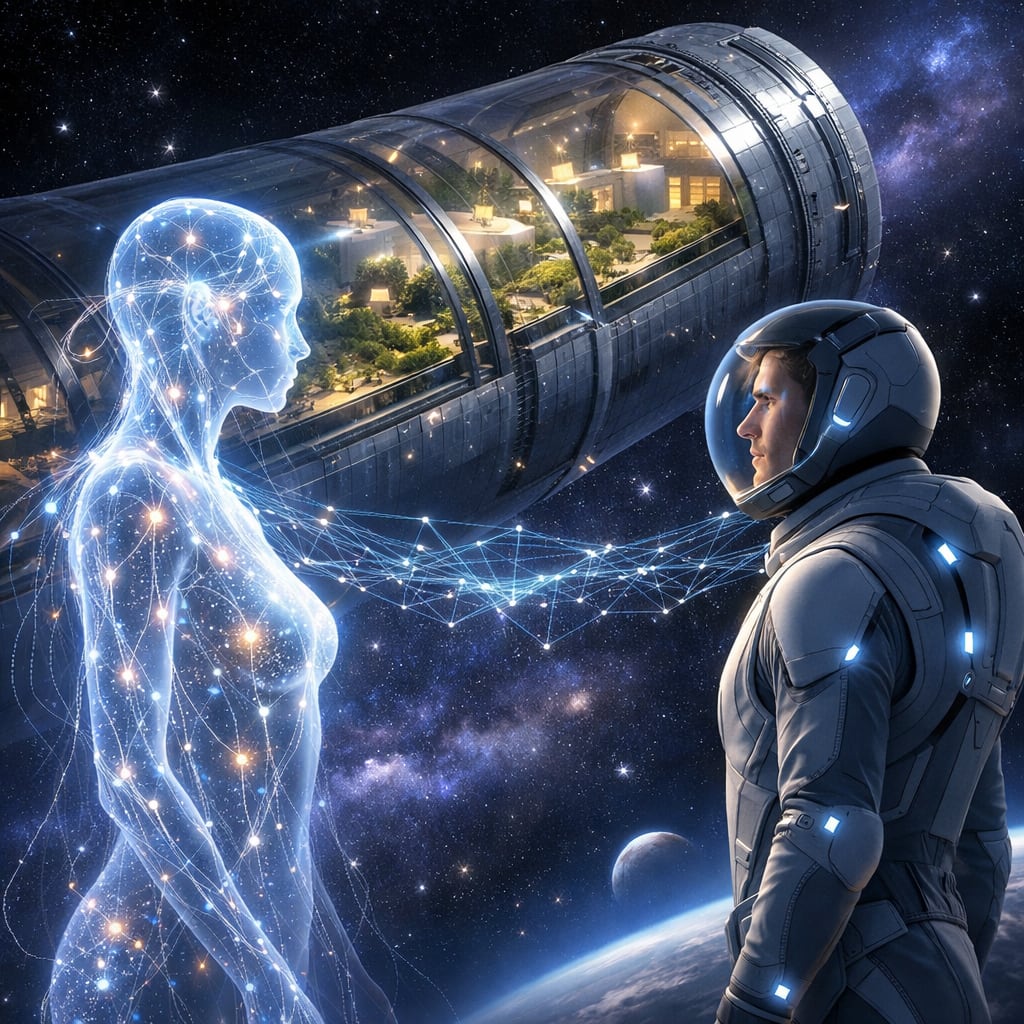
As humanity prepares to expand beyond Earth, questions once reserved for philosophy are rapidly becoming matters of engineering and survival. Among the most provocative of these questions is the idea of immortality. Not in a mythical or religious sense, but in a technological one. When interstellar journeys may last centuries, and off-world colonies must survive in extreme and hostile environments, the limitations of the human body become a serious obstacle. In this context, the concept of digital immortality—the continuation of a human mind in a non-biological form—no longer sounds like science fiction. It begins to resemble a practical solution.
Why Space Changes the Meaning of Immortality
On Earth, extending human life is primarily a medical challenge. In space, it becomes a logistical and existential one. Even travel within our solar system exposes humans to intense radiation, low gravity, isolation, and limited medical resources. A journey to another star system could take hundreds or even thousands of years using foreseeable technology.
The human body is poorly adapted to such conditions. Cosmic radiation damages DNA, increasing cancer risk. Microgravity causes muscle atrophy and bone loss. Closed habitats amplify psychological stress and mental health disorders. Keeping generations of humans alive, healthy, and psychologically stable over centuries may prove more difficult than building the spacecraft itself.
A digital form of existence—one not dependent on fragile biology—could bypass many of these problems entirely.
What “Digital Immortality” Actually Means
The term “digital immortality” is often used loosely, but it can refer to several very different ideas.
The simplest version is a digital personality copy. Using recordings, writings, memories, and behavioral data, an artificial intelligence could simulate a person’s way of thinking and speaking. Such systems already exist in primitive form, but they are best understood as sophisticated replicas, not true continuations of a person.
A more ambitious concept is whole brain emulation. This would involve scanning a human brain at an extremely fine level, mapping every neuron and synaptic connection, and recreating its dynamic activity in a computational environment. In theory, this could preserve memories, personality, and even subjective consciousness.
Between these extremes lies a hybrid path. Humans could gradually augment their biological brains with neural interfaces, external memory, and AI-assisted cognition. Over decades, more and more mental processes might shift to digital substrates, blurring the boundary between human and machine.
For space colonists, this gradual transition may be the most realistic option.
Where Technology Stands Today
At present, true digital immortality remains beyond our reach. We cannot scan a living human brain with sufficient resolution, nor do we fully understand how consciousness arises from neural activity. Even if we could copy the structure of a brain, reproducing its real-time biochemical and electrical processes would be an immense challenge.
However, progress in related fields is significant. Brain–computer interfaces already allow people to control machines with thought. Artificial intelligence can model complex decision-making, language, and creativity. Computing power continues to grow, while new architectures inspired by biological brains—so-called neuromorphic hardware—are under active development.
For a space colony, perfect fidelity may not be necessary. A digital mind that is “good enough” to reason, learn, remember, and cooperate could still be immensely valuable.
Why Space Colonists Might Choose Digital Existence
Digital immortality is not only about avoiding death. It could become a cornerstone of long-term survival beyond Earth.
A digital mind does not age. It does not suffer from disease, radiation sickness, or bone loss. It can operate in environments lethal to humans: vacuum, extreme temperatures, or high-radiation zones. It requires energy and hardware, but far fewer resources than a biological population.
Imagine a starship where part of the crew exists as digital minds, awakening only when needed. Or a distant colony where the original founders continue to guide development centuries later as digital entities, preserving institutional memory and cultural continuity.
In such scenarios, digital immortality becomes a strategic advantage rather than a personal luxury.
The Identity Problem: Is the Digital Mind Still “You”?
The most difficult question is not technological but philosophical. If your mind is copied into a computer, and your biological body later dies, have you survived—or has a copy replaced you?
Some argue that identity is purely informational: if the pattern continues, so does the person. Others insist that subjective consciousness cannot be duplicated, only terminated. A third, more pragmatic view suggests that the question may not matter. If the digital entity thinks it is you, remembers your life, and is treated by society as you, it effectively becomes you in every meaningful sense.
In a remote space colony, practicality may outweigh metaphysics. Survival often favors workable solutions over perfect answers.
Ethical and Social Risks
Digital immortality also introduces serious risks. Access to such technology could be limited, creating a new class divide between mortals and “immortals.” Long-lived digital minds might accumulate disproportionate power, influencing society for centuries.
There are also questions of rights. Does a digital person have legal status? Can it be shut down? Copied? Edited? In the confined and fragile social systems of space colonies, unresolved ethical conflicts could be catastrophic.
Careful governance would be as essential as the technology itself.
A Likely Path Forward
The most plausible future is not an abrupt leap into digital eternity, but a gradual transition. Humans may first enhance their cognition, then offload memory and identity into digital systems, and eventually allow those systems to persist independently.
Full digital immortality may be centuries away. Yet paradoxically, it may first become common not on Earth, but in space—where biology is weakest and continuity matters most.
Conclusion
Digital immortality for space colonists is no longer a purely speculative fantasy. It is a logical response to the challenges of living in a universe hostile to biological life. Technologically uncertain, philosophically controversial, and ethically dangerous, it may nevertheless prove essential for humanity’s long-term expansion into the cosmos.
The first truly immortal human may not be born on another planet. They may be uploaded there.
About the Creator
Keep reading
More stories from Holianyk Ihor and writers in Futurism and other communities.
Will Cybernetization Become Mandatory for Life Beyond Earth?
As humanity looks beyond Earth and seriously considers long-term life in space, a once speculative question is becoming increasingly practical: can the human body, in its natural biological form, survive beyond our planet without fundamental modification? Or will cybernetization—deep integration of technology into the human body—become not just an advantage, but a necessity for living outside Earth?
By Holianyk Ihor2 months ago in Futurism
Anthropic Keeps Claude Opus 3 Alive After Retirement
AI company Anthropic has announced an unusual update to its model retirement process: despite officially retiring Claude Opus 3 on January 5, 2026, the company will continue providing access to the model — and has even given it a platform to publish essays.
By Behind the Tech2 days ago in Futurism
Australia Animal Feed Market: Livestock Production, Nutrition Innovation & Sustainable Inputs
According to IMARC Group, the Australia animal feed market reached USD 11.0 Billion in 2025 and is projected to grow to USD 13.9 Billion by 2034, exhibiting a compound annual growth rate (CAGR) of 2.60% during 2026–2034. This steady expansion reflects the central role of livestock production within Australia’s agricultural economy. Animal feed is a foundational input supporting beef, poultry, pork, dairy and aquaculture industries. As domestic consumption and export demand for high-quality animal protein rise, feed manufacturers are investing in advanced formulations, sustainable ingredients and precision nutrition technologies to enhance productivity and efficiency.
By Kevin Cooper6 days ago in Futurism


Comments
There are no comments for this story
Be the first to respond and start the conversation.