
Global Game-based Learning Market Size & Forecast 2026–2034
Interactive Education Goes Mainstream as Gamification, AI, and Cloud Platforms Reshape Learning Worldwide

Introduction: Learning Enters the Age of Play
The way the world learns is undergoing a profound transformation. Classrooms, training rooms, and even living rooms are no longer limited to textbooks, slides, and lectures. Instead, learning is becoming interactive, immersive, and increasingly driven by game mechanics. From students solving math problems through story-driven adventures to employees mastering leadership skills via simulations, game-based learning is redefining how knowledge is delivered and absorbed.
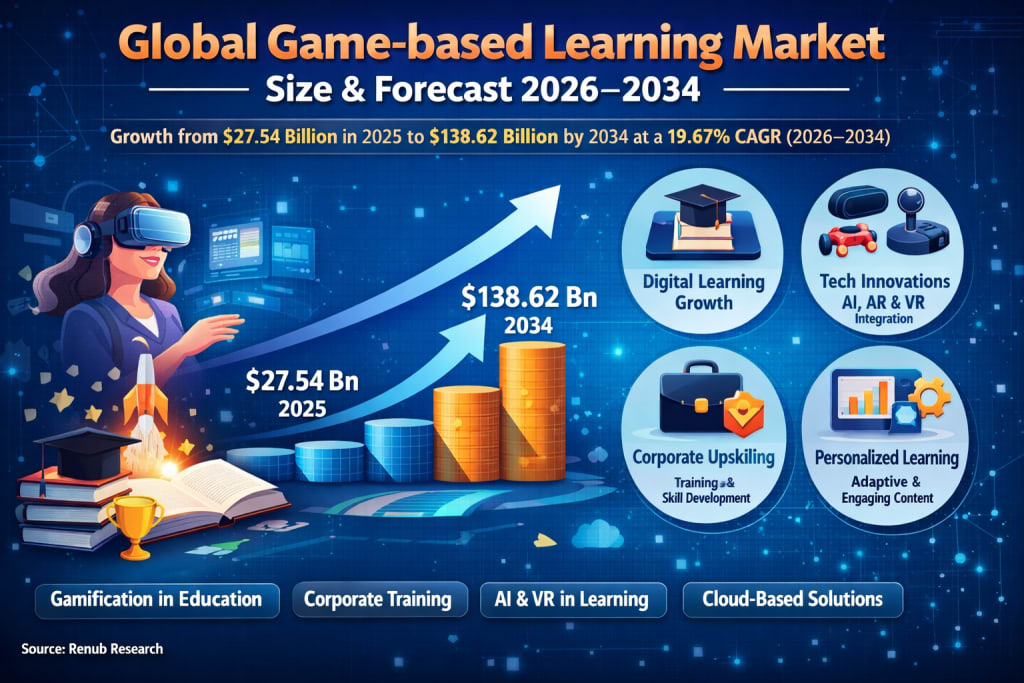
According to Renub Research, the Global Game-based Learning Market is expected to expand dramatically, growing from US$ 27.54 billion in 2025 to US$ 138.62 billion by 2034, registering a strong compound annual growth rate (CAGR) of 19.67% during 2026–2034. This remarkable growth reflects a global shift toward digital education, the rising importance of learner engagement, and the increasing need for continuous skill development in a fast-changing world.
Game-based learning is more than just adding points or badges to lessons. It represents a structured educational approach that integrates challenges, rewards, storytelling, feedback loops, and competition into learning environments. Delivered through digital platforms, mobile apps, simulations, and even hybrid physical-digital formats, it encourages active participation rather than passive consumption of information. The result is higher motivation, better knowledge retention, and improved problem-solving skills across academic and professional settings.
As education systems modernize and organizations invest more in workforce upskilling, game-based learning is moving from a niche innovation to a mainstream learning strategy worldwide.
Global Game-based Learning Market Outlook
Game-based learning uses the mechanics of games—such as levels, quests, scores, instant feedback, and narrative progression—to support educational objectives. Instead of memorizing information, learners interact with content, make decisions, experiment with outcomes, and learn from both success and failure. This approach aligns well with modern learning theories that emphasize experiential learning, engagement, and personalized progress.
Globally, the adoption of game-based learning is accelerating due to several converging trends. The rapid digitalization of education, the widespread availability of smartphones and high-speed internet, and the normalization of remote and hybrid learning models have all created fertile ground for interactive digital learning tools. At the same time, employers are facing unprecedented pressure to reskill and upskill their workforces as technology reshapes industries. Game-based learning offers a practical and engaging solution to these challenges.
From K–12 classrooms and universities to corporate training programs and consumer learning apps, game-based learning is increasingly viewed as a powerful way to improve outcomes while keeping learners motivated. With continuous innovation in mobile technology, cloud computing, artificial intelligence, and immersive technologies such as AR and VR, the market is set for sustained and transformative growth over the next decade.
Key Growth Drivers of the Market
Rapid Digitalization of Education and Training
One of the strongest drivers of the game-based learning market is the ongoing digital transformation of education and corporate training. Schools, universities, and enterprises across the world are shifting away from traditional, lecture-based models toward digital platforms that support interactive and learner-centered experiences.
Game-based learning fits naturally into this transformation. Cloud-based learning management systems, mobile learning platforms, and enterprise training tools increasingly integrate simulations, quizzes, scenario-based challenges, and gamified assessments. These tools make learning more engaging while also enabling organizations to deliver standardized content at scale.
Governments and institutions are also investing heavily in digital infrastructure and e-learning initiatives, further supporting adoption. In May 2025, for example, the Congolese government launched an online learning platform designed to train young people in IT and communication skills, highlighting how digital learning strategies are expanding even in emerging markets. As digital education ecosystems grow, game-based learning continues to benefit from improved accessibility, scalability, and cost efficiency.
Growing Demand for Engaging and Personalized Learning
Today’s learners—whether students or professionals—expect education to be interactive, relevant, and tailored to their individual needs. Traditional one-size-fits-all teaching methods struggle to meet these expectations, especially in an era of shorter attention spans and constant digital stimulation.
Game-based learning addresses this challenge by offering personalized pathways, adaptive difficulty levels, and real-time feedback. With the help of data analytics and artificial intelligence, modern platforms can track learner performance, identify skill gaps, and adjust content dynamically. This makes learning not only more engaging but also more effective.
The industry is already moving in this direction. In July 2025, D2L launched new AI-powered experiences under its D2L Lumi platform to advance hyper-personalized learning, using machine learning to improve adaptability, content recommendations, and learner engagement. Such innovations are strengthening the case for game-based learning as a core component of modern education and training strategies.
Expansion of Corporate Training and Workforce Upskilling
The global workforce is under constant pressure to adapt to new technologies, business models, and regulatory requirements. As automation and digital transformation reshape job roles, organizations must invest continuously in reskilling and upskilling their employees.
Game-based learning is particularly well suited to corporate environments because it supports scenario-based simulations, role-playing exercises, and practical decision-making challenges. These methods allow employees to apply knowledge in realistic contexts, improving both confidence and performance. Gamification elements such as rewards, progress tracking, and friendly competition also increase participation in training programs that might otherwise feel mandatory or monotonous.
In November 2025, LinkedIn Learning introduced AI-driven corporate training modules that personalize skill development paths across technology, leadership, and compliance areas, reinforcing the growing importance of intelligent, engaging digital training solutions. As enterprises continue to prioritize human capital development, game-based learning is increasingly seen as a high-impact, cost-effective training strategy.
Challenges Facing the Market
High Development Costs and Content Complexity
Despite its benefits, game-based learning is not without challenges. Developing high-quality educational games requires collaboration between subject matter experts, instructional designers, game developers, and user experience specialists. Creating content that is both pedagogically sound and technically robust can be expensive and time-consuming, especially for advanced simulations or immersive AR/VR experiences.
Smaller institutions and organizations may find these costs prohibitive, limiting adoption in price-sensitive markets. In addition, content often needs regular updates to stay aligned with curricula, industry standards, or regulatory requirements, increasing long-term costs and operational complexity.
Resistance to Adoption and Learning Curve Issues
Another challenge is resistance to change. Some educators, trainers, and decision-makers remain skeptical about the effectiveness of game-based learning compared to traditional methods. Concerns about screen time, lack of familiarity with digital tools, and doubts about academic rigor can slow adoption.
In corporate environments, employees from non-digital-native generations may struggle with game-based platforms, reducing engagement. Poorly designed games can also backfire, being perceived as entertainment rather than serious learning tools. Overcoming these barriers requires proper training, change management, and clear evidence of measurable learning outcomes.
Market by Key Segments
Game-based Learning Services Market
The services segment plays a crucial role in the ecosystem, covering consulting, design, development, integration, and ongoing support. Many organizations lack in-house expertise to build effective learning games, creating strong demand for specialized service providers. These services ensure that solutions align with educational goals, business objectives, and measurable performance outcomes. As implementations become more complex, professional services are increasingly essential for long-term success.
Online Game-based Learning Market
Online delivery is one of the fastest-growing deployment models. It enables learners to access content from anywhere, supporting remote education, hybrid classrooms, and distributed workforces. Scalability, centralized performance tracking, and social features such as multiplayer challenges and leaderboards make online platforms especially attractive for both education and enterprise use.
Cloud Game-based Learning Market
Cloud-based platforms are gaining strong traction due to their flexibility, lower upfront costs, and ease of updates. They allow global deployment, real-time analytics, and seamless integration with learning management systems and HR platforms. As organizations pursue digital transformation, cloud-based game-based learning continues to see robust adoption.
AI Game-based Learning Market
Artificial intelligence is transforming game-based learning by enabling adaptive content, intelligent tutoring systems, and predictive analytics. AI-driven platforms can personalize learning journeys, automate assessments, and simulate complex real-world scenarios, making this segment a key growth engine for the future.
Game-based Education Learning Market
In K–12 and higher education, game-based learning supports subjects such as mathematics, science, languages, and history through interactive simulations and problem-solving activities. The push toward student-centered and competency-based education models is further strengthening demand in this segment.
Game-based Consumer Learning Market
This segment targets individual users seeking self-improvement in areas such as language learning, coding, financial literacy, and brain training. Mobile apps dominate, supported by freemium and subscription models. Lifelong learning trends and smartphone penetration continue to drive strong growth.
Regional Market Insights
United States
The United States is one of the most advanced markets, supported by strong digital infrastructure, high education spending, and a mature corporate training ecosystem. Innovation is rapid, with widespread adoption of AI, analytics, and immersive technologies. In June 2025, Arizona State University partnered with Games for Change to advance educational innovation through game-based learning, research, and microcredentials, highlighting the country’s leadership in this space.
France
France is seeing steady growth as schools and enterprises modernize learning methods. Government support for digital education and a strong emphasis on pedagogical quality drive adoption, particularly for localized and curriculum-aligned content.
India
India is one of the fastest-growing markets, fueled by a large youth population, widespread smartphone usage, and strong demand for affordable education. Mobile-first platforms dominate, and government initiatives supporting digital learning further accelerate adoption. Several state governments, including Meghalaya, are introducing game-based learning for children, reinforcing the country’s momentum.
Saudi Arabia
Saudi Arabia’s market is gaining momentum as part of broader education and digital reforms. In November 2025, the King Salman Science Oasis introduced a play-based learning program to strengthen children’s cognitive and creative abilities, reflecting the country’s growing focus on innovative education.
Market Segmentation Overview
By Component: Solutions, Services
By Platform Type: Online, Offline
By Deployment Mode: Cloud, On-Premise
By Game Type: AR/VR Games, AI-Based Games, Location-Based Games, Knowledge and Skill-Based Games, Language-Learning Games, Others
By End User: Education, Enterprises, Government, Consumer, Others
By Geography:
North America (United States, Canada)
Europe (France, Germany, Italy, Spain, United Kingdom, Belgium, Netherlands, Turkey)
Asia Pacific (China, Japan, India, South Korea, Thailand, Malaysia, Indonesia, Australia, New Zealand)
Latin America (Brazil, Mexico, Argentina)
Middle East & Africa (Saudi Arabia, UAE, South Africa)
All major companies are analyzed across five viewpoints: overview, key person, recent developments, SWOT analysis, and revenue analysis.
Key Players Include:
Badgeville (CallidusCloud), Bunchball (BI WORLDWIDE), Classcraft Studios Inc., Six Waves Inc., Recurrence, Inc., Gametize Pte. Ltd., Kuato Studios, BreakAway Ltd., Inc., Filament Games, LearningWare, Inc.
Final Thoughts: A Market That Makes Learning Stick
The global game-based learning market is no longer just about making education more fun—it is about making learning more effective, measurable, and relevant in a rapidly changing world. With the market projected to surge from US$ 27.54 billion in 2025 to US$ 138.62 billion by 2034, the momentum is unmistakable.
Driven by digital transformation, the demand for personalized learning, and the urgent need for workforce upskilling, game-based learning is becoming a core pillar of modern education and training strategies. While challenges such as development costs and resistance to change remain, continuous innovation in AI, cloud computing, and immersive technologies is steadily addressing these barriers.
As institutions, enterprises, and individuals increasingly embrace interactive and outcome-focused learning, game-based learning is set to move from a powerful supplement to a central engine of global education and skill development in the years ahead.
About the Creator
Keep reading
More stories from shibansh kumar and writers in Futurism and other communities.
United Kingdom Diabetes Devices Market Size and Forecast 2026–2034
Introduction: A Market Shaped by Urgency and Innovation Diabetes has quietly become one of the most pressing long-term healthcare challenges in the United Kingdom. With millions of people already diagnosed and many more at risk, the need for accurate, reliable, and user-friendly diabetes management tools has never been greater. This growing clinical burden is now reshaping the medical device landscape, pushing innovation beyond traditional glucose meters into the era of continuous monitoring, smart insulin delivery, and digitally connected care.
By shibansh kumarabout 7 hours ago in Trader
Advances in Genetic Engineering Driving the Global Recombinant DNA Technology Market
Rising demand for advanced therapeutics, vaccines, and personalized medicine is driving growth in the recombinant DNA technology market. Expanding applications in biotechnology, pharmaceuticals, and agriculture support adoption. According to IMARC Group's latest research publication, The global recombinant DNA technology market size reached USD 796.2 Billion in 2024. Looking forward, IMARC Group expects the market to reach USD 1,143.4 Billion by 2033, exhibiting a growth rate (CAGR) of 3.9% during 2025-2033.
By Michael Richardabout 8 hours ago in Futurism
Robotics Solutions Market: Industrial AI, Automation & Efficiency Trends
Rising automation demand, labor shortages, and need for higher productivity are driving growth in the robotics technology market. Advancements in AI, machine vision, and sensor technologies expand applications across manufacturing, healthcare, and logistics. Increasing adoption of collaborative robots improves workplace flexibility and safety. According to IMARC Group's latest research publication, The global robotics technology market size reached USD 108.0 Billion in 2024. Looking forward, IMARC Group expects the market to reach USD 237.0 Billion by 2033, exhibiting a growth rate (CAGR) of 9.13% during 2025-2033
By James Whitman7 days ago in Futurism
Writing About Writing: The Rainbow Trap
The good thing about living in modern times is that LGBTQ representation in media is increasing. Not just in niche and Independant media, either, but also in mainstream media. Books, movies, TV shows, comics... they're finally catching on that LGBTQ+ people form a significant part of their audience, and deserve to see themselves on screen and in fiction, not just as victims in documentaries and true crime shows.
By Natasja Roseabout 3 hours ago in Writers




Comments
There are no comments for this story
Be the first to respond and start the conversation.