
United Kingdom Diabetes Devices Market Size and Forecast 2026–2034
How Smart Monitoring, Digital Health, and Preventive Care Are Transforming Diabetes Management Across the UK

Introduction: A Market Shaped by Urgency and Innovation
Diabetes has quietly become one of the most pressing long-term healthcare challenges in the United Kingdom. With millions of people already diagnosed and many more at risk, the need for accurate, reliable, and user-friendly diabetes management tools has never been greater. This growing clinical burden is now reshaping the medical device landscape, pushing innovation beyond traditional glucose meters into the era of continuous monitoring, smart insulin delivery, and digitally connected care.
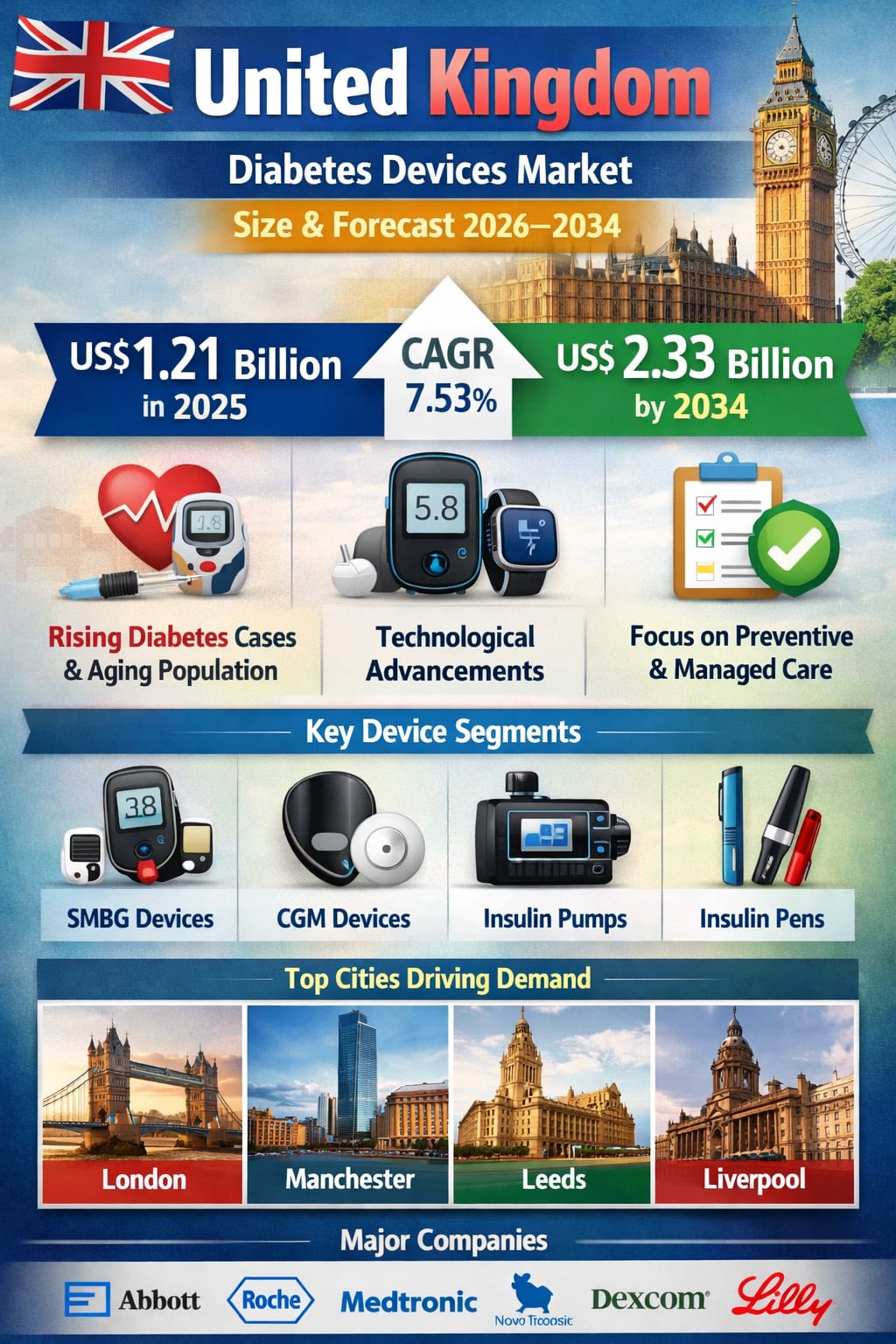
According to Renub Research, the United Kingdom diabetes devices market is expected to grow from US$ 1,214.80 million in 2025 to US$ 2,333.50 million by 2034, registering a compound annual growth rate (CAGR) of 7.53% from 2026 to 2034. This strong growth trajectory reflects not only the rising incidence of diabetes but also a structural shift in how the condition is diagnosed, monitored, and managed across the UK healthcare system.
From self-monitoring blood glucose (SMBG) meters and insulin pens to advanced continuous glucose monitoring (CGM) systems and automated insulin pumps, diabetes devices are becoming central to everyday disease management. The market’s evolution is being powered by three major forces: a growing and aging patient population, rapid technological advancement, and a healthcare policy environment that increasingly prioritizes prevention and self-management.
Understanding Diabetes Care Devices in the UK Context
Diabetes care devices are medical tools designed to help patients monitor blood glucose levels and administer insulin or other treatments accurately and consistently. These include SMBG meters, continuous glucose monitoring systems, insulin pens, insulin pumps, and a growing range of digital platforms that store, analyze, and share patient data.
In practical terms, these devices allow people with diabetes to make informed daily decisions about diet, exercise, and medication. More importantly, they reduce the risk of dangerous complications such as hypoglycemia, cardiovascular disease, kidney failure, and vision loss. In a healthcare system like the UK’s—where long-term cost control and quality-of-life outcomes are critical—these devices are not just tools, but strategic assets in chronic disease management.
The UK has seen rising acceptance of diabetes devices, particularly as awareness grows around early diagnosis and proactive disease control. The National Health Service (NHS) and associated clinical bodies continue to encourage structured self-management, which naturally increases demand for reliable monitoring and insulin delivery solutions. At the same time, digital connectivity and smartphone integration are changing patient expectations, making real-time data and remote monitoring a new standard rather than a luxury.
Key Growth Drivers in the UK Diabetes Devices Market
Rising Diabetes Prevalence and an Aging Population
One of the strongest drivers behind market expansion is the steady rise in diabetes cases across the UK. Both type 1 and type 2 diabetes are increasing due to lifestyle changes, higher obesity rates, and longer life expectancy. An aging population further intensifies this trend, as older adults are more likely to require continuous monitoring and insulin therapy.
The British Diabetic Association has highlighted a consistent year-on-year increase in diagnosed cases, with hundreds of thousands of new patients added in recent years. Millions more are considered at high risk of developing type 2 diabetes in the coming decade. This expanding patient base directly fuels demand for SMBG devices, CGM systems, insulin pens, and insulin pumps.
From a healthcare economics perspective, diabetes devices play a crucial role in preventing complications and reducing hospital admissions, making them an essential part of long-term care strategies. As a result, device adoption is no longer limited to specialist centers but is increasingly embedded in routine primary and community care.
Deployment of Advanced Monitoring and Digital Health Solutions
Technology is reshaping diabetes care at a rapid pace. Continuous glucose monitoring systems, smart insulin pens, and automated insulin pumps are transforming how patients and clinicians manage blood sugar control. These devices provide real-time data, trend analysis, and alerts, enabling faster and more accurate decision-making than traditional finger-prick methods.
A major milestone came in May 2023, when the National Institute for Health and Care Excellence (NICE) updated its recommendations to expand the use of CGM and flash glucose monitoring in children with type 2 diabetes. This move signaled a broader shift toward less invasive, more patient-friendly monitoring methods, especially for younger and more vulnerable patients.
Digital health integration also improves patient adherence. Connected devices that sync with smartphones or cloud platforms allow users to track patterns, share data with clinicians, and receive personalized feedback. Compared to manual record-keeping, these systems significantly enhance engagement and long-term disease control.
Emphasis on Preventive and Managed Care
The UK healthcare system places strong emphasis on prevention, early intervention, and self-management of chronic diseases. Diabetes devices align perfectly with this philosophy by empowering patients to take daily control of their condition.
Regular glucose monitoring, supported by educational initiatives and clinical guidance, helps patients make better lifestyle and medication decisions. This self-management model reduces the burden on hospitals and improves long-term outcomes, which in turn supports sustained demand for diabetes devices.
In November 2023, Medtronic launched a highly advanced hybrid closed-loop insulin pump system, highlighting how innovation continues to push the boundaries of automated and personalized diabetes care. Such developments reinforce the role of devices not just as tools, but as integral components of modern treatment pathways.
Challenges Facing the UK Diabetes Devices Market
Budget Constraints and Reimbursement Pressures
Despite their proven benefits, advanced diabetes devices such as CGM systems and insulin pumps come with higher upfront costs. In a publicly funded healthcare system, cost-effectiveness assessments and reimbursement decisions play a critical role in determining patient access.
While basic SMBG devices are widely доступible, more sophisticated technologies often face slower adoption due to budget limitations and strict evaluation criteria. This creates a tension between clinical innovation and financial sustainability, which remains one of the key challenges for market expansion.
Patient Adoption and Usability Barriers
Not all patients find it easy to adapt to new devices. Some users—particularly elderly patients or those with limited technical experience—may perceive devices as complex, uncomfortable, or intrusive. Issues such as sensor wearability, device calibration, and interface design can influence long-term adherence.
Overcoming these barriers requires not only better product design but also stronger patient education and support systems within the healthcare network.
Market by Device Type: A Closer Look
United Kingdom SMBG Devices Market
Self-monitoring blood glucose devices remain a cornerstone of diabetes management in the UK. Glucose meters and test strips are widely used by both type 1 and type 2 diabetes patients, especially those managing their condition through lifestyle changes, oral medication, or insulin therapy.
While growth in this segment is slower compared to newer technologies, SMBG devices continue to benefit from their simplicity, affordability, and reliability. They are particularly popular among elderly patients and in primary care settings, ensuring stable, long-term demand.
United Kingdom CGM Devices Market
The CGM segment is one of the fastest-growing areas of the market. Continuous glucose monitors provide real-time readings, trend data, and alerts, significantly reducing the need for finger-prick testing. These benefits are especially valuable for patients with type 1 diabetes or insulin-dependent type 2 diabetes.
Smartphone integration and cloud connectivity have further improved usability and patient engagement. As clinical guidelines increasingly recognize the long-term benefits of continuous monitoring, CGM systems are becoming a central pillar of modern diabetes management in the UK.
United Kingdom Insulin Pumps Market
Insulin pumps offer continuous subcutaneous insulin infusion, providing greater flexibility and more precise control compared to multiple daily injections. They are widely used by type 1 diabetes patients and those requiring intensive insulin therapy.
Recent innovations, including partially and fully automated systems, have improved both safety and treatment outcomes. Although cost remains a limiting factor, the clinical advantages ensure that this segment remains highly attractive within the broader market.
United Kingdom Insulin Pens Market
Insulin pens are valued for their convenience, portability, and dosing accuracy. Available in both disposable and reusable formats, they are commonly prescribed to both newly diagnosed and long-term insulin users.
The emergence of smart insulin pens with dose-tracking features has further enhanced their appeal. Strong physician preference and patient familiarity continue to support steady growth in this segment.
Distribution Channels: Reaching the Patient
Retail pharmacies play a critical role in the UK diabetes devices ecosystem, serving as the primary access point for glucose meters, test strips, insulin pens, CGM sensors, and accessories. Pharmacists also contribute to patient education, improving correct usage and adherence.
Hospital pharmacies, diabetes clinics, and online pharmacies complement this network, ensuring broad and consistent availability across urban and regional areas.
Regional Insights: Key UK Cities Driving Demand
London stands as the largest and most advanced diabetes devices market in the UK, supported by high population density, strong healthcare infrastructure, and rapid adoption of digital health technologies. The city leads in uptake of CGM systems, insulin pumps, and smart pens.
Manchester benefits from a growing patient base and expanding healthcare facilities, with strong demand for SMBG devices and rising interest in CGM solutions.
Leeds shows stable growth driven by preventive healthcare initiatives and integrated care models, while Liverpool relies on strong public healthcare services and chronic disease management programs to sustain device usage.
Other major cities—including Birmingham, Edinburgh, Glasgow, Bristol, and Tyneside—collectively contribute to a well-distributed and resilient national market.
Competitive Landscape: Key Players Shaping the Market
The UK diabetes devices market features strong participation from global and regional leaders, including:
Abbott Laboratories
Roche
Medtronic
Novo Nordisk A/S
Terumo Corporation
Eli Lilly
BD
Dexcom Inc
These companies compete across product innovation, digital integration, strategic partnerships, and portfolio expansion, continuously raising the standard of diabetes care technology.
Market Segmentation Snapshot
By Type:
Self-Monitoring Devices
Continuous Glucose Monitoring Devices
Insulin Pumps
Insulin Pens
By Distribution Channel:
Hospital Pharmacies
Retail Pharmacies
Diabetes Clinics/Centers
Online Pharmacies
By Region:
London, Manchester, Birmingham, Leeds, Liverpool, Edinburgh, Glasgow, Tyneside, Bristol, Rest of UK
Final Thoughts: A Market Moving Toward Smarter, Patient-Centered Care
The United Kingdom diabetes devices market is entering a decisive growth phase. With revenues projected to rise from US$ 1,214.80 million in 2025 to US$ 2,333.50 million by 2034, the sector reflects both the urgency of the diabetes epidemic and the promise of technological innovation.
While cost pressures and usability challenges remain, the long-term direction is clear: more connected, more automated, and more patient-centric diabetes care. As preventive healthcare, digital health integration, and self-management continue to gain momentum, diabetes devices will play an increasingly vital role in shaping the future of chronic disease management in the UK.
For patients, clinicians, and policymakers alike, this market is no longer just about devices—it is about building a smarter, more sustainable healthcare ecosystem for the years ahead.
About the Creator
Keep reading
More stories from shibansh kumar and writers in Trader and other communities.
Europe Retinal Surgery Devices Market Size & Forecast 2026–2034
Market Snapshot The Europe Retinal Surgery Devices Market is expected to witness steady and sustained growth over the forecast period, expanding from US$ 820.33 million in 2025 to US$ 1,668.76 million by 2034, registering a compound annual growth rate (CAGR) of 8.21% during 2026–2034.
By shibansh kumara day ago in Trader
Why the Home Decor Market Is More Than Just a Trend
Summary The Home Decor Market is no longer just about beautifying spaces—it’s about storytelling, comfort, and identity. As lifestyles evolve and homes double as workplaces, wellness zones, and social hubs, consumers are investing more thoughtfully in décor that reflects personality and purpose. From sustainable materials and handcrafted accents to smart décor and digital-first shopping, the market is witnessing a shift toward experience-driven design. With strong demand across residential and commercial spaces, the home decor industry is positioned for long-term, style-led growth.
By James Smith7 days ago in Trader
Dead and Wearing Green
She was wearing that green dress when I first saw her, five years ago to the day. Flowing meadow fabric draped over long legs, thick auburn hair flowing down her back. That smile. Of course, she is still beautiful now. But now she is no longer alive.
By Karen Cave7 days ago in Fiction


Comments
There are no comments for this story
Be the first to respond and start the conversation.