
Robotics Solutions Market: Industrial AI, Automation & Efficiency Trends
The robotics solutions market is expanding as industries adopt AI-powered robots and automation to improve efficiency, productivity, and safety. Smart factories and digital manufacturing systems help reduce errors, save costs, and speed up production.

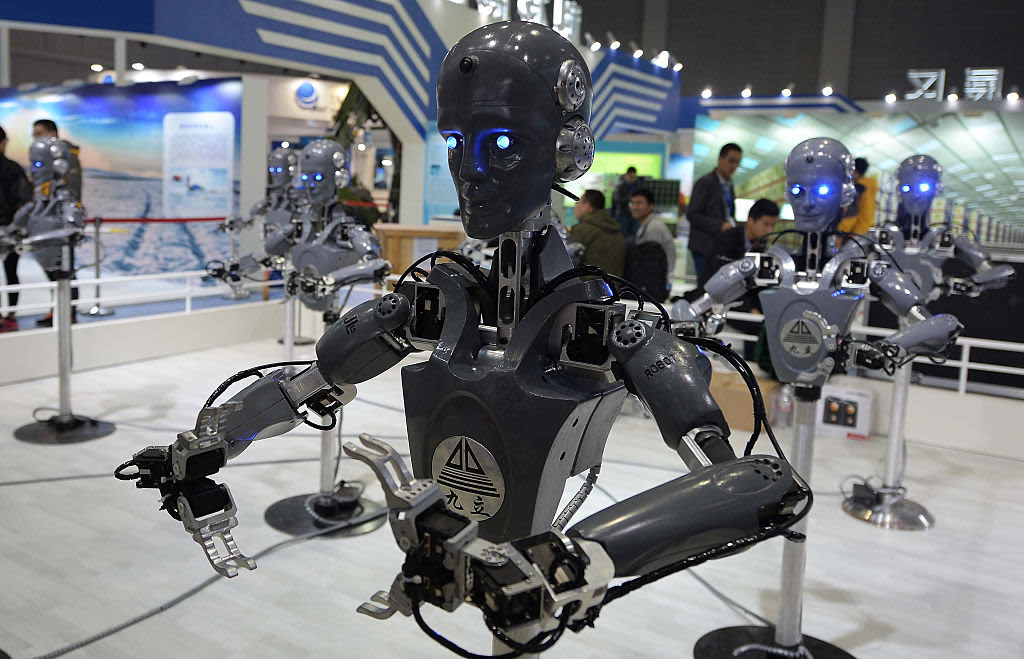
Rising automation demand, labor shortages, and need for higher productivity are driving growth in the robotics technology market. Advancements in AI, machine vision, and sensor technologies expand applications across manufacturing, healthcare, and logistics. Increasing adoption of collaborative robots improves workplace flexibility and safety. According to IMARC Group's latest research publication, The global robotics technology market size reached USD 108.0 Billion in 2024. Looking forward, IMARC Group expects the market to reach USD 237.0 Billion by 2033, exhibiting a growth rate (CAGR) of 9.13% during 2025-2033
How AI is Reshaping the Future of Robotics Technology Market
- Smart Vision for Quality: Robots with AI cameras can check products for defects with almost 100% accuracy. Companies like Tesla use these robots to inspect thousands of parts every hour, catching tiny problems that humans might miss, while reducing quality control costs by about 35%.
- Predicting Machine Problems: AI systems analyze sensor data to predict when machines might break down. Factories that use this predictive maintenance experience 25–30% less downtime and 20% lower repair costs, keeping production running smoothly and avoiding expensive repairs.
- Robots Working with Humans: AI allows robots to learn from human workers and do new tasks without extra programming. At BMW’s smart factories, robots work safely alongside humans, adjusting their speed and movements, which makes production safer and increases productivity by 40%.

Robotics Technology Industry Overview
The use of robots is growing fast around the world because governments are supporting new technology and automation. China plans to have 150 robots for every 10,000 workers. South Korea invested $450 million in its robot program. Japan wants humans and robots to work together with its Society 5.0 plan. The European Union is spending €2.1 billion on robotics research, and India is promoting robots in factories and hospitals. Robots are used in factories, hospitals, and other industries to make work faster, safer, and more accurate. They can do repetitive or dangerous tasks, letting humans focus on smarter jobs. With more investment and better technology, robots will be used more in the future, helping businesses become faster, safer, and more efficient.
Robotics Technology Market Trends & Drivers
More Robots Being Used: The use of robots is growing around the world as companies and governments invest in automation. Robots work in factories, hospitals, and warehouses to do repetitive or dangerous tasks. This makes work faster, safer, and more accurate and lets humans focus on smarter jobs. Countries like China, Japan, South Korea, India, and EU nations are supporting this growth.
Smart Robots and AI: Robots with AI and smart sensors help companies find problems, maintain machines, and improve quality. Factories can predict breakdowns, reduce downtime, and save on repairs. AI also helps robots learn from humans and do new tasks, making work more efficient and productive in factories, warehouses, and logistics.
Robots in Healthcare and Services: Robots are used more in hospitals, labs, and care centers. Surgical robots help doctors perform precise operations and reduce recovery time. Service robots deliver medicines and help patients. With an aging population and need for efficiency, healthcare robots are becoming important and driving the robotics market worldwide.
Leading Companies Operating in the Global Robotics Technology Industry
- ABB Ltd.
- DENSO Products and Services Americas, Inc.
- Epson America, Inc.
- FANUC Corporation
- Kawasaki Heavy Industries Ltd.
- KUKA AG
- Mitsubishi Electric Corporation
- Nachi Robotic Systems, Inc
- Omron Robotics
- Stäubli International AG
- Yaskawa America, Inc.
Robotics Technology Market Report Segmentation
By Component:
- Hardware
- Software
- Services
Hardware represents the largest segment, driven by demand for sensors, actuators, and control systems essential for precision manufacturing and automation.
By Robot Type:
- Traditional Industrial Robots
- Cobots
- Professional Service Robots
- Others
Traditional industrial robots dominate the market, widely used in automotive and electronics for welding, assembly, and material handling operations.
By Application:
- Manufacturing
- Healthcare
- Aerospace and Defence
- Media and Entertainment
- Logistics
- Others
Regional Insights:
North America (United States, Canada)
- Asia Pacific (China, Japan, India, South Korea, Australia, Indonesia, Others)
- Europe (Germany, France, United Kingdom, Italy, Spain, Russia, Others)
- Latin America (Brazil, Mexico, Others)
- Middle East and Africa
Asia Pacific dominates the robotics technology market due to strong manufacturing base, high automation demand, and robust government support across the region.
Recent News and Developments in Robotics Technology Market
- June 2025: Elon Musk announced Tesla's robotaxi service launching in Austin, Texas on June 22, with first autonomous delivery expected June 28. The delay from earlier timelines reflects heightened focus on safety protocols and regulatory compliance.
- June 2025: Wandercraft raised $75 million in Series D funding to accelerate AI-powered humanoid robots and personal exoskeletons. The funding supports Calvin-40 humanoid robot and Eve exoskeleton launches, partnering with Renault and using NVIDIA technology.
- June 2025: Beijing Academy of Artificial Intelligence launched RoboBrain 2.0, an open-source AI model for humanoid robots with 74% improved accuracy and 17% better performance, supporting China's leadership in embodied AI innovation.
- May 2025: Asamaka Industries launched Advanced Automation Technology & Robotics Training Program in Ontario. The 12-week hybrid program offers hands-on training in robotics, PLC programming, and electrical design for underserved communities.
- March 2025: Google launched Gemini Robotics and Gemini Robotics-ER on its Gemini 2.0 platform, enhancing robots' physical actions, spatial awareness, and reasoning across humanoids and warehouse bots, positioning Google in industrial AI robotics.
Note: If you require specific details, data, or insights not currently included in this report, we're happy to accommodate your request. As part of our customization service, we'll gather and provide additional information tailored to your specific requirements. Please let us know your exact needs, and we'll ensure the report meets your expectations.
About the Creator
James Whitman
With years of experience in analyzing global industries, I specialize in delivering actionable market insights that help businesses stay ahead in an ever-changing landscape.
Keep reading
More stories from James Whitman and writers in Futurism and other communities.
Energy Bar Market: Plant-Based Nutrition, Healthy Snacking & Global Growth Trends
People are eating more energy bars because they want to stay healthy, are busy, and need quick nutrition. More people are doing fitness, sports, and outdoor activities, which increases demand. New bars with natural ingredients, high protein, and extra health benefits are becoming popular with health-conscious consumers. According to IMARC Group's latest research publication, The global energy bar market size reached USD 3.9 Billion in 2024. Looking forward, IMARC Group expects the market to reach USD 6.5 Billion by 2033, exhibiting a growth rate (CAGR) of 5.68% during 2025-2033.
By James Whitmana day ago in Futurism
About Binding Prometheus
I want to start actively advocating on behalf of my own work, and the most valuable part of my canon is, without a doubt, Binding Prometheus, the play I have been working on since 2019 and only finished in 2023 as part of my MA. The play itself is an amalgamation of a million different inspirations. On one end, it evokes the Ancient Greek myth-play, deriving its own title from the earliest extant work of Western drama we have, Aeschylus’s Prometheus Bound. On the other end, it borrows significantly from the sci-fi bulwarks from over the years, namely Mary Shelley’s Frankenstein and Karel Capek’s Rossum’s Universal Robots. The play could be an episode of Black Mirror, I fear. I don’t know. I’ve only ever seen one episode of Black Mirror.
By Steven Christopher McKnight28 days ago in Futurism
U.S. Pen Needles Market on Track to Reach USD 1.53 Billion by 2031 as Home-Based Diabetes Care and Device Innovation Accelerate
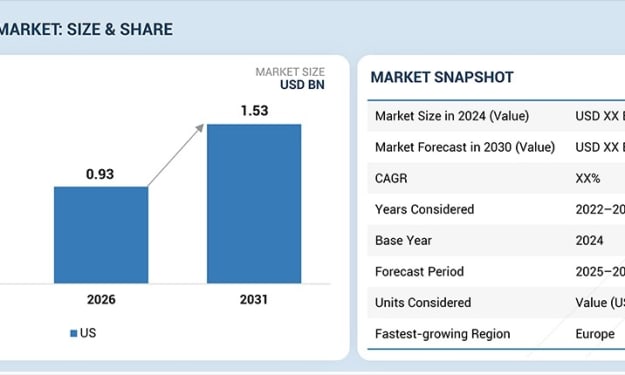
The U.S. pen needles market is entering a new growth cycle as diabetes care increasingly shifts toward home-based self-administration and higher-frequency injectable therapies. Valued at USD 0.85 billion in 2025 and USD 0.93 billion in 2026, the market is projected to expand at a CAGR of 10.4% from 2026 to 2031, reaching USD 1.53 billion by the end of the forecast period. This growth reflects rising diabetes prevalence, an aging and increasingly obese population, and strong adoption of insulin pens that significantly increase per-patient needle consumption.
By Juan Martinez2 days ago in Futurism
One Hard Thing
Stop me if you’ve heard this one before: You have the number, you know your schedule- you’ve even picked out the perfect day and time to make this appointment. Shoot, you’ve even picked out alternative days and times just in case their schedules can’t accommodate you!
By Taylor Rigsby4 days ago in Motivation



Comments
There are no comments for this story
Be the first to respond and start the conversation.