
Futuristic inventions that will change the world
16 Futuristic Inventions about to change the World.

The Future of Technology: 16 Groundbreaking Innovations
4D Printing: The Next Dimension
What is 4D Printing?
While you may be familiar with 2D and 3D printing, 4D printing introduces a new dimension—time. Unlike 3D printers that create static objects, 4D printers use advanced smart materials that allow objects to change shape in response to environmental stimuli like heat or moisture. This innovation means we can now create dynamic products such as self-healing roads or even functional human organs. We’re just scratching the surface of this technology's potential.
The Evolution of Display Technology
Samsung's Flex Hybrid Display
Samsung has recently showcased its Flex Hybrid display, a revolutionary piece of technology that combines both folding and rolling capabilities. This display allows a large tablet to fold and roll into a compact form, paving the way for future devices like TVs that can roll away when not in use or smartphones with adaptable screens that adjust to the content being displayed.
Displace’s Wireless TV
On the horizon is Displaces prototype of a completely wireless 55-inch 4K TV. This innovative screen operates on four large batteries and utilizes hand gestures for control, eliminating the need for a remote. It also features vacuum-sealing technology, allowing it to adhere to walls without mounting brackets. However, the vacuum system relies on the same batteries as the screen, which could be a drawback if the batteries deplete.
Li-Fi: Lighting Up the Future of Communication
Understanding Li-Fi
Li-Fi (Light Fidelity) is a technology that uses light to transmit data, potentially offering speeds up to 100 times faster than traditional Wi-Fi. Developed by German physicist Harald Haas, Li-Fi works by flickering LED lights to send binary signals. Although light cannot penetrate walls like radio waves, making Li-Fi ideal for secure communications in specific contexts like military use or in-flight internet.
Advances in Solar Technology
MIT’s Semiconducting Solar Cells
In 2022, MIT scientists created solar cells using semiconducting inks that are thinner than a human hair and weigh just one-hundredth of traditional solar panels. These cells are 18 times more efficient per pound than conventional panels. Their flexibility means they can be applied to various surfaces, such as drone propellers and backpacks, making them ideal for portable power and disaster relief.
The Breakthrough of Nuclear Fusion
Fusion Energy Milestone
Nuclear fusion, the process powering the sun, has long been a challenging field. Traditionally, fusion reactions required more energy to start than they produced. However, in December 2022, U.S. scientists achieved "Ignition," where the fusion reaction produced more energy than was used to initiate it. This breakthrough holds the promise of a nearly limitless, clean energy source using hydrogen, the most abundant element in the universe.
Innovations in Wearable Technology
Sweat-Powered Batteries
Researchers at Nanyang Technological University in Singapore have developed a tiny sweat-powered battery. This battery, which reacts with chloride ions in sweat to generate electricity, is integrated into a flexible fabric. While it can’t yet power high-demand devices like smartwatches fully, it extends the life of wearable technology and provides a new way to keep devices running longer.
The Evolution of Smart Tattoos
Smart Tattoo Technology
Smart tattoos are flexible circuits that adhere to the skin and can be powered by sweat. These tattoos can execute commands, such as playing music when touched. Currently, these tattoos last about two weeks due to skin shedding, but future advancements may lead to customizable, on-body interfaces that connect seamlessly with the digital world.
Microchip Implants: Enhancing Daily Life
Microchip Implant Applications
Microchip implants, including RFID and NFC tags, are becoming more common. These implants can store medical data or facilitate contactless transactions. While we’re not yet at the stage of fully integrated smartphone functionality beneath the skin, these implants offer practical benefits for improving convenience and safety.
Personalized Airport Information
Parallel Reality Display
Delta Airlines has introduced the Parallel Reality Display, a technology that shows personalized flight information based on the viewer’s angle. This system uses individually lit pixels and motion sensors to display relevant details to each passenger. This innovation could revolutionize public information displays, allowing for personalized content in various settings.
SpinLaunch: A New Approach to Satellite Launching
Reducing Launch Costs
SpinLaunch is set to transform satellite launching with a new system starting in 2025. It involves a large vacuum-sealed wheel that spins satellites at high speeds before releasing them into orbit. This method significantly reduces fuel consumption and costs, making satellite launches more efficient and environmentally friendly.
Tackling Environmental Challenges
Direct Air Capture Technology
Direct air capture is a technology aimed at removing excess carbon dioxide from the atmosphere. It involves drawing air into a chamber with a special filter that traps CO2. The captured CO2 is then purified and stored underground, while the cleaned air is released. This process can help mitigate greenhouse gas emissions and repurpose CO2 for useful applications like fuel or plastics.
De-Extinction: Bringing Back the Woolly Mammoth
The Quest for De-Extinction
Scientists are exploring the possibility of de-extincting the Woolly Mammoth by using genetic engineering. By modifying the DNA of modern elephants to resemble that of their ancient ancestors, researchers aim to bring these creatures back to life. This groundbreaking effort could restore biodiversity, though it raises questions about how such species would interact with current ecosystems.
The Arrival of Flying Cars
The Asker A5
The Asker A5 is a four-seater, mostly electric flying car with drone-like propellers and a top airspeed of 150 miles per hour. It offers a range of 250 miles per charge, significantly reducing travel time compared to traditional road vehicles. However, practical challenges such as infrastructure and cost—around $789,000—currently limit its widespread adoption.
Neural Interfaces: Connecting Minds and Machines
Neural Interface Technology
Neural interfaces are microchips connected directly to the brain, capable of reading brain signals and communicating wirelessly with technology. These interfaces are used in healthcare to treat conditions like Parkinson’s disease and paralysis. Companies like Elon Musk’s Neuralink aim to push the boundaries further, with ambitions like downloading data into the mind or enabling direct communication.
The Cetacean Translation Initiative
Understanding Whale Communication
The Cetacean Translation Initiative seeks to decode whale language, which is remarkably sophisticated and closely resembles human communication. By gathering extensive audio data and using AI to analyze it, researchers hope to understand and potentially communicate with whales. This project could represent the first step in inter-species communication.
Xenobots: Programmable Living Robots
The Future of Xenobots
Xenobots are tiny, self-healing living robots created from African frog stem cells. These programmable organisms can perform tasks like drug delivery or environmental cleanup. Their potential applications are vast, from medical treatments to addressing microplastic pollution in oceans.
About the Creator
Adebayo Mahmud
To go straight to the point i like diving into topics that interest me and make me begin to think. Promoting peoples work especially those have interest in, in my articles is an hobby of mine. (I GUESS :-p).
Reader insights
Nice work
Very well written. Keep up the good work!
Top insights
Easy to read and follow
Well-structured & engaging content
On-point and relevant
Writing reflected the title & theme
Keep reading
More stories from Adebayo Mahmud and writers in Futurism and other communities.
Elon Musk’s Brain Chip to Help Blind People See Gets Approval
Elon Musk’s Brain Chip to Help Blind People See Gets Approval: A New Frontier in Medical Technology In a groundbreaking move, Neuralink, the neurotechnology company founded by Elon Musk, has received regulatory approval to conduct human trials of its brain chip designed to help blind people regain their sight. The company's ambitious goal is to develop a direct brain-computer interface (BCI) capable of restoring lost vision, among other medical applications. This approval marks a major milestone in Musk's vision of merging humans with artificial intelligence to overcome the limitations of biology.
By Adebayo Mahmudabout a year ago in Futurism
Australia Energy Storage Market: Renewable Integration, Battery Deployment & Grid Stability
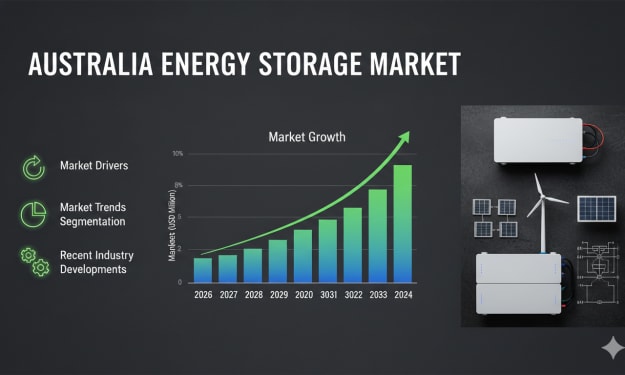
According to IMARC Group, the Australia energy storage market reached 4.72 GW in 2025 and is projected to expand significantly to 19.81 GW by 2034, exhibiting a compound annual growth rate (CAGR) of 17.28% during 2026–2034. The rapid growth of the sector reflects the country’s accelerating transition toward renewable energy and the increasing need for reliable electricity systems across Australia. As solar and wind power generation expands, energy storage technologies such as battery energy storage systems (BESS) are becoming essential for maintaining grid reliability and balancing electricity supply and demand. Government policies supporting clean energy adoption, declining battery costs, and investments in grid modernization are significantly strengthening Australia energy storage market share while enabling the integration of renewable power into the national electricity network.
By Shrestha Roy7 days ago in Futurism
The Last Fortress
The Final Frontier of Privacy For centuries, the human mind has been the only place where true freedom existed. No matter how oppressive a regime was, or how invasive a technology became, your thoughts were yours alone. They were the "Last Fortress"—a sanctuary of private dreams, silent rebellions, and unspoken loves.
By Alex Sterling 3 days ago in Futurism



Comments (3)
Well detailed
That's amazing
Liked it.