
From Alchemy to CERN: The 1,200-Year Quest to Turn Lead into Gold; A Tale in Pictures: From Alchemy’s Glow to Particle Science’s Roar
How an 8th-Century Alchemist’s Dream Echoed Through Time—and Was Realized Beneath the Alps
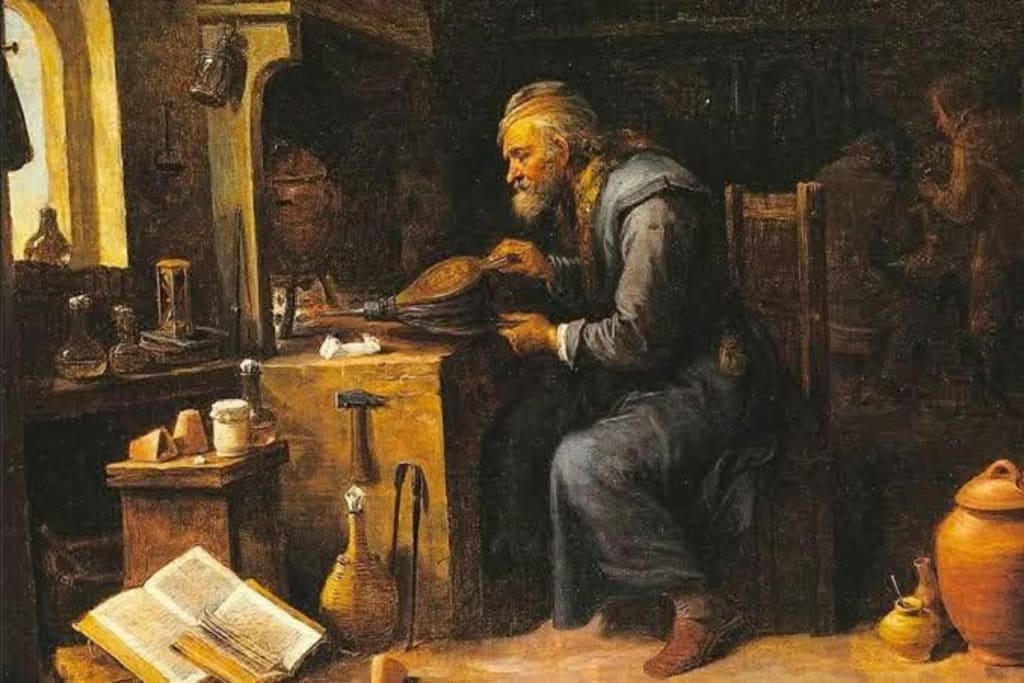
It is Baghdad in the 8th century. The night air carries a cool hush, but deep within one narrow alley, a small room glows under the flicker of oil lamps. Smoke swirls toward the ceiling where its tendrils twine with shadows that dance upon the walls.
In the center stands an elderly man, his wise, sharp eyes fixed on his work. His hands move deftly among slender glass vessels, matte brass flasks, and copper bowls. With precision born of long hours and countless repetitions, he drips liquids—sometimes a drop of golden-yellow solution, other times two drops of milky white fluid—into a crucible of curiosity. Mutters escape his lips in Arabic:
“قم بالتجارب لكي تكتسب المعرفة...”
“Try experiments so that you may attain knowledge...”
The night deepens. The lamp’s flame sputters. Smoke clings to the low ceiling, a stifling veil carrying the acrid scent of brimstone, burnt salt, and a hint of sour fruit. The old man’s face is etched with strain; sweat gleams across his forehead. His eyes, red-rimmed from sleepless nights and relentless focus, fix upon a long, curved glass tube—its lower end capped with a small flask.
Within that flask, a single ruby-red drop trembles, falls—with the soft plink echoing in the cramped silence. Each drop is an announcement to his racing heart.
This is Jābir ibn Ḥayyān, the legendary alchemist-scientist, consumed for the last decade by a singular obsession: the transformation of lead into gold. Jābir believed he could do so with the mythical Philosopher’s Stone or through a precise chemical process. Tonight, the dull, heavy chunk of lead before him remains stubbornly unchanged.
The truth is, Jābir never succeeded in turning lead into gold. But his relentless trials pushed him to innovate: he designed new apparatus for distillation—the alembic; improved vessels for evaporation, crystallization, and safe containment of acids and alkalis. He meticulously documented sublimation, dissolution, oxidation, and hundreds of other reactions. These experiments earned him the title “Father of Chemistry.”
For centuries, the flame of alchemy spread worldwide. By the 16th and 17th centuries, however, the dawn of empirical modern science dimmed alchemy’s enchantment. The dream of transmuting base metals into gold became recognized as nothing more than an alchemical myth.
---
🚀 And now—1,250 years later—May 7, 2025:
Under the Alps, straddling the border between Switzerland and France, lies CERN’s Large Hadron Collider (LHC)—a colossal scientific engine buried deep beneath the earth. The contrast with Jābir’s smoky workshop—and both could not be more profound.
Here, the air hums with the breath of supercomputers that analyze mountains of data, while physicists in spotless lab coats sit before console screens. They accelerate beams of protons nearly to the speed of light, steering them into ultra-high-energy collisions.
Data graphs bloom on the screens, complex and intricate as constellations. The researchers wait, breath held, until a distinctive signal emerges—a pattern they’ve been searching for all along. A hush descends, then slowly, one scientist’s eyes widen. A hand lifts in silent marvel. Others hurriedly scan their monitors.
They are witnessing it: by colliding lead nuclei with tremendous kinetic energy, they have changed the number of protons in atomic nuclei—transmuting lead into gold. In this moment, what Jābir pursued with crude tools in his humble room has finally been accomplished—with exquisite precision and staggering scale.
---
🌟 Continuum of Curiosity
In that dimly lit workshop of 1,200 years ago, Jābir whispered:
“قم بالتجارب لكي تكتسب المعرفة…”
“Try experiments so that you may attain knowledge...”
Tonight, deep beneath the earth, the echo of those words resonates once more—less a whisper, more a triumph.
From glass flasks to stainless steel accelerators; from copper heating coils to cryogenic superconductors; from a lone man’s intuition to massive international teams… science has evolved, but its heartbeat remains unchanged.
Jābir’s experiments laid the foundation. Early chemists refined his processes; medieval scholars classified substances, dedicated alchemical texts, and developed proto-laboratories. Over centuries, the blend of curiosity and precision gave birth to modern chemistry and physics—disciplines grounded in experimentation, measurement, and skepticism.
---
🔬 From Alchemy to Particle Collision
Jābir’s Legacy:
He invented the alembic, refined vessels for distilling and crystallizing, and formalized chemical terminology. He catalogued substances and reactions like oxidation and desiccation—planting the seeds of systematic chemical science.
Scientific Revolution:
As empirical methods took root in Europe, alchemy evolved into chemistry. Robert Boyle, Antoine Lavoisier, and others proposed rigorous standards: reproducibility, measurement, skepticism about hidden forces like “vital spirits.” The pursuit of transmutation faded, while focus shifted to atomic structures and molecular composition.
Nuclear Transmutation:
In the 20th century, Ernest Rutherford cracked the nucleus with alpha particles, discovering protons and pioneering artificial element transformation. Later, particle accelerators generated isotopes and exotic elements at scale.
Modern Alchemy—The LHC Way:
At CERN, researchers create fleeting new elements, test matter under extreme conditions, and sometimes observe transmutations—turning mercury, bismuth, or lead nuclei into higher elements like gold. Not economically viable, but monumental in human understanding.
---
🌌 A Lab of Dreams and Determination
Jābir’s smoky room was powered by nothing but oil lamps and hope. He had no theory of the atom, no periodic table—only observation, intuition, and meticulous documentation.
Modern science runs on gigawatts of electricity, millions of lines of code, and thousands of researchers, but it too is built on the same pillars: hypothesis, experiment, observation, and critical analysis.
What unites them is simple yet profound: the human spirit’s hunger to know.
One small drop falls in Jābir’s flask. One massive collision unfolds in the LHC. Both moments answer an enduring question: What happens when we push nature’s boundaries?
In Baghdad’s dusty alley, Jābir heard it slow and close:
> “قم بالتجارب لكي تكتسب المعرفة...”
In Geneva’s corridors, tens of thousands of equations later, we hear it again. A whisper becomes a roar.
---
✨ Because Curiosity Never Dies
Osama scientist or medieval alchemist—across time, cultures, and tools—the impulse to experiment remains the same. Whether mixing reagents or colliding nuclei, we challenge the unknown.
Jābir didn’t make gold. Yet his inventions, records, and courage paved a path intellect traveled for millennia. Modern science stands on that foundation, and tonight, under the Alps, human ingenuity has turned the impossible into history.
So the next time you hesitate—wondering whether a small experiment, a bold idea, or a simple question is worth the effort—remember: Curiosity is the spark, experimentation is the flame.
قم بالتجارب لكي تكتسب المعرفة …
“Try experiments so that you may attain knowledge.”
And maybe, in your own way, you are building the future—one question, one drop, one collision at a time.
About the Creator
Keep reading
More stories from Ikram Ullah and writers in Futurism and other communities.
Why are medical students trained using frogs for dissection and not other animals?
Why are medical students trained using frogs for dissection and not other animals? Answer: Frogs are commonly used for teaching medical and biological sciences because they are small, easily available, and their internal organ systems are quite similar to those of humans. Therefore, the physiology of frogs is employed to help medical students understand anatomical and physiological principles.
By Ikram Ullah7 months ago in Futurism
About Binding Prometheus
I want to start actively advocating on behalf of my own work, and the most valuable part of my canon is, without a doubt, Binding Prometheus, the play I have been working on since 2019 and only finished in 2023 as part of my MA. The play itself is an amalgamation of a million different inspirations. On one end, it evokes the Ancient Greek myth-play, deriving its own title from the earliest extant work of Western drama we have, Aeschylus’s Prometheus Bound. On the other end, it borrows significantly from the sci-fi bulwarks from over the years, namely Mary Shelley’s Frankenstein and Karel Capek’s Rossum’s Universal Robots. The play could be an episode of Black Mirror, I fear. I don’t know. I’ve only ever seen one episode of Black Mirror.
By Steven Christopher McKnight20 days ago in Futurism
Wood and Timber Products Market Size and Forecast 2025–2033: Sustainable Growth Shapes a Trillion-Dollar Industry
Global Wood and Timber Products Market Outlook The global Wood and Timber Products Market is undergoing a steady transformation as sustainability, urbanization, and infrastructure development reshape material choices worldwide. According to Renub Research, the market is expected to grow from US$ 981.33 billion in 2024 to US$ 1,463.38 billion by 2033, expanding at a CAGR of 4.54% from 2025 to 2033.
By Janine Root a day ago in Futurism



Comments
There are no comments for this story
Be the first to respond and start the conversation.