
Earth’s Light Tail: Why Our Planet Leaves a Trail in Space
Space

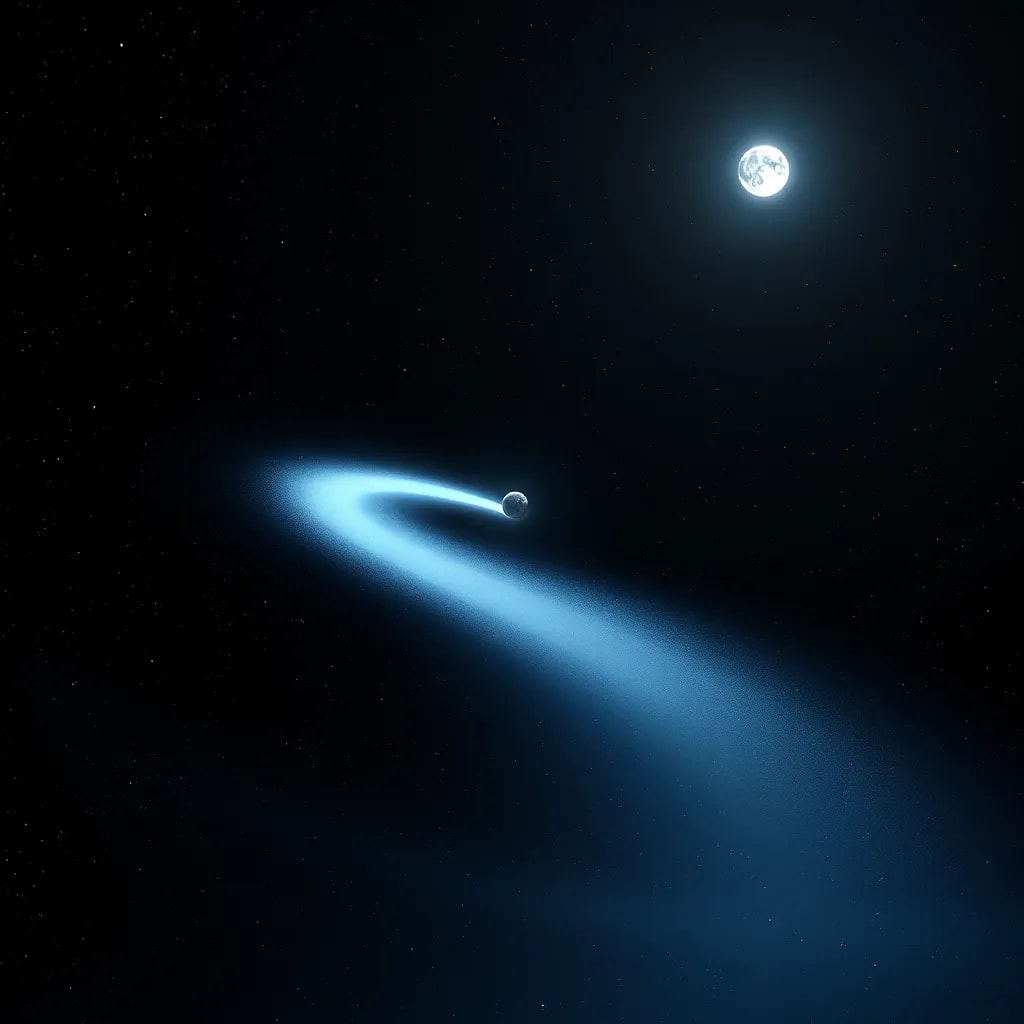
A ghostly ribbon of light that stretches beyond the Moon
From our everyday perspective, Earth appears as a solid sphere spinning quietly in the void of space. But take a step back several hundred thousand kilometers back and the picture changes. To the keen eyes of astronomers and space telescopes, Earth isn’t just floating silently through space; it’s leaving a shimmering trail behind. This isn’t science fiction or artistic metaphor it’s a real phenomenon known as Earth’s light tail, and it tells a surprising story about our planet.
What Is Earth’s Light Tail?
Earth’s light tail, also called the geocorona, is a faint, ghost-like glow that envelops the Earth and extends far into space up to 630,000 kilometers away, well beyond the Moon's orbit. It is caused by hydrogen atoms in the outermost layer of Earth’s atmosphere scattering sunlight, especially in the ultraviolet (UV) spectrum.
Though invisible to the human eye, this vast halo of hydrogen can be detected with UV-sensitive instruments. In fact, the European Space Agency's SOHO (Solar and Heliospheric Observatory) spacecraft first captured stunning images of it in the late 1990s. The discovery surprised even seasoned scientists no one expected Earth’s atmosphere to stretch so far into space.
How Does It Form?
To understand this phenomenon, we need to travel to the exosphere the uppermost region of Earth’s atmosphere. Unlike the dense layers below, the exosphere is incredibly thin. Gas molecules here are so far apart they rarely interact. However, many of these particles are hydrogen atoms, which are lightweight enough to escape gravity’s pull and drift outward.
When sunlight hits these atoms, they scatter ultraviolet radiation in all directions. This scattered light creates the geocorona a gigantic, faintly glowing shroud around our planet that trails off in the direction opposite the Sun, forming a tail-like structure. Think of it as a soft, ethereal comet’s tail, but made of light and invisible without the right tools.
Why Should We Care?
At first glance, a giant ultraviolet glow might not seem particularly significant. But Earth’s light tail offers critical insight and poses intriguing possibilities across several scientific fields.
1. Astronomical Observations
For astronomers, the geocorona can be both a clue and a complication. When observing distant galaxies or stars in ultraviolet light, this halo can distort or interfere with the data. Understanding and accounting for it ensures that measurements from telescopes especially space-based ones like Hubble or James Webb remain accurate.
2. Planetary Science and Atmospheric Studies
The geocorona helps researchers track how gases escape from Earth’s atmosphere. This is particularly useful for comparing Earth’s atmospheric loss to planets like Mars, which lost much of its atmosphere over time. Learning how our atmosphere behaves in its outermost edges can inform models of planetary evolution and climate stability.
3. The Hunt for Alien Worlds
Perhaps most intriguingly, if Earth has such a tail, could distant exoplanets have them too? If so, astronomers could one day detect faint ultraviolet glows around exoplanets and use them to infer atmospheric composition even habitability. A light tail might become a cosmic signature of life-supporting conditions.
A Technological Trail?
Beyond natural phenomena, Earth may also be leaving behind a technological fingerprint. Radio waves from our satellites, debris from decades of space exploration, and even the electromagnetic hum of our civilization contribute to a wider “halo” of human activity. Some futurists speculate that intelligent civilizations could be detected from afar not by their cities or ships but by the faint technological glow they emit into space. Could Earth already be shining like that in someone else’s sky?
What About Other Planets?
It’s not just Earth that might have a light tail. Any planet with an atmosphere and exposure to solar radiation could theoretically produce something similar. For instance, Venus with its dense, active atmosphere might create a dramatic, glowing trail if viewed in UV. Mars’ thinner atmosphere might produce only a faint trace, while gas giants like Jupiter could have vast, luminous coronas stretching far into their moons' orbits.
Imagining the solar system filled with glowing planetary halos gives space a whole new kind of beauty a dynamic interplay of light, chemistry, and motion.
In Conclusion
Earth’s light tail is a quiet but powerful reminder that our planet is never truly isolated. We interact with space in subtle, ongoing ways, leaving trails of atoms, light, and information in our wake. Though invisible to our eyes, this shimmering UV signature is real, and it stretches like a whisper across hundreds of thousands of kilometers.
Just like the breath you see on a cold morning, Earth’s light tail is a fleeting trace of something vital. It’s the breath of our atmosphere, the glow of our presence, and the soft echo of life, moving with us through the stars.
About the Creator
Keep reading
More stories from Holianyk Ihor and writers in Futurism and other communities.
How Much Does a Sunbeam Weigh?
The Physics of Light That Can Blow Your Mind Have you ever stood in the sun, feeling its warm rays touch your skin, and wondered: Does sunlight weigh anything? Can something so intangible as a beam of light have mass? At first glance, the idea seems poetic, even whimsical. But dig a little deeper, and you'll uncover a fascinating corner of physics that challenges our everyday understanding of the world.
By Holianyk Ihor6 months ago in Futurism
About Binding Prometheus
I want to start actively advocating on behalf of my own work, and the most valuable part of my canon is, without a doubt, Binding Prometheus, the play I have been working on since 2019 and only finished in 2023 as part of my MA. The play itself is an amalgamation of a million different inspirations. On one end, it evokes the Ancient Greek myth-play, deriving its own title from the earliest extant work of Western drama we have, Aeschylus’s Prometheus Bound. On the other end, it borrows significantly from the sci-fi bulwarks from over the years, namely Mary Shelley’s Frankenstein and Karel Capek’s Rossum’s Universal Robots. The play could be an episode of Black Mirror, I fear. I don’t know. I’ve only ever seen one episode of Black Mirror.
By Steven Christopher McKnight15 days ago in Futurism
Saudi Arabia Cloud Computing Market & Forecast 2025–2033
Introduction Saudi Arabia’s digital transformation is entering a decisive phase, with cloud computing at the core of the Kingdom’s technology roadmap. As enterprises, government agencies, and startups accelerate their shift toward digital platforms, cloud infrastructure is rapidly becoming the backbone of innovation, efficiency, and scalability across industries.
By jaiklin Fanandisha day ago in Futurism


Comments
There are no comments for this story
Be the first to respond and start the conversation.