


The Physics of Light That Can Blow Your Mind
Have you ever stood in the sun, feeling its warm rays touch your skin, and wondered: Does sunlight weigh anything? Can something so intangible as a beam of light have mass? At first glance, the idea seems poetic, even whimsical. But dig a little deeper, and you'll uncover a fascinating corner of physics that challenges our everyday understanding of the world.
Light: Mass Without Mass?
To understand how a sunbeam might "weigh" anything, we need to talk about photons the basic particles of light. A photon is unique in that it has no rest mass. That means, unlike an apple or a pebble, it doesn't weigh anything when considered at rest (although photons never really rest they're always moving at the speed of light).
Still, photons carry energy and momentum, and thanks to Einstein’s iconic equation,
E = mc²,
we know that energy and mass are two sides of the same cosmic coin. So, if a photon has energy, it has an equivalent mass even if it doesn’t have "mass" in the traditional, gravitational sense.
This opens up the door to a wonderfully weird question: if a beam of light carries energy, can we calculate how much it would weigh?
One Beam, in Grams?
Let’s crunch some cosmic numbers.
The Sun delivers about 1361 watts of power per square meter to Earth (above the atmosphere). This value is known as the solar constant. One watt equals one joule of energy per second. So, each square meter receives 1361 joules of sunlight every second.
Now, the energy of a single photon depends on its wavelength, but if we take an average photon from the Sun's broad light spectrum, its energy is roughly 3.2 × 10⁻¹⁹ joules.
So how many photons hit each square meter per second?
Divide total energy by the energy of one photon:
1361 ÷ 3.2 × 10⁻¹⁹ ≈ 4.25 × 10²¹ photons per second per square meter.
That's 4.25 sextillion photons bombarding every square meter, every second.
To find the mass equivalent of that energy, we use Einstein’s equation in reverse:
m = E / c²
Where c is the speed of light (~3 × 10⁸ m/s):
m = 1361 / (3 × 10⁸)² ≈ 1.51 × 10⁻¹⁴ kilograms
Or about 15 trillionths of a gram per second per square meter.
That’s incredibly tiny barely more than nothing. But here’s the fun twist: the Earth’s surface absorbs over 170 petawatts of solar energy (that’s 170 followed by 15 zeros). If you sum up the total energy from sunlight reaching Earth, it adds up to roughly 2 kilograms of photons hitting Earth every second.
The Weight of Sunshine
Even though a photon’s mass is nearly nonexistent, light can exert pressure a force known as radiation pressure. In space, this phenomenon is powerful enough to push spacecraft with ultra-light, reflective “solar sails.” These sails don’t need fuel; they ride on beams of sunlight like cosmic surfers. Though the force is tiny, in the vacuum of space it builds up over time, eventually reaching impressive speeds.
Imagine: something that has no rest mass is strong enough to move a spacecraft.
Catching a Sunbeam
What if you wanted to catch a sunbeam? Let's say you hold out your hand and a single sunray touches a 1 cm² patch of your skin for one second. That small square would receive about 0.15 nanograms of sunlight—less than the mass of a dust particle. And yet, in that one second, your skin would absorb around 30 billion photons.
It’s almost impossible to imagine, and yet it's happening constantly—billions of particles of light, weightless but energetic, brushing your skin every moment you're in the sun.
The Poetry of Physics
So, how much does a sunbeam weigh? In a literal sense—almost nothing. But in terms of its energy, its impact, and its significance, a sunbeam is monumental.
It powers photosynthesis, drives the Earth’s weather systems, charges solar panels, and warms every living thing. It travels across millions of kilometers of empty space to deliver energy from a giant ball of fusion 150 million kilometers away. It sculpts life itself.
A sunbeam may not tip the scales, but it moves the world. It’s a beautiful reminder that some of the most powerful forces in the universe are the lightest, the fastest, and the quietest.
Next time sunlight hits your face, you’ll know: you’re feeling the brush of trillions of weightless travelers, and each one of them carries a secret energy that shapes the Earth, with the mass of a miracle.
About the Creator
Keep reading
More stories from Holianyk Ihor and writers in Futurism and other communities.
A Planet Where a Year Lasts 10 Hours: Life on the Universe’s Fastest Worlds
When we think of a year, we imagine a familiar cycle: spring blossoms, summer heat, autumn leaves, and winter snow. It’s a slow, predictable rhythm days turning into weeks, months into seasons. But elsewhere in the universe, time moves at a different speed entirely. Imagine a planet where a full orbit around its star a year lasts just 10 hours. That’s right, half a day from one New Year to the next. Welcome to the realm of ultra-short-period planets, where time and temperature both go to extremes.
By Holianyk Ihor6 months ago in Futurism
About Binding Prometheus
I want to start actively advocating on behalf of my own work, and the most valuable part of my canon is, without a doubt, Binding Prometheus, the play I have been working on since 2019 and only finished in 2023 as part of my MA. The play itself is an amalgamation of a million different inspirations. On one end, it evokes the Ancient Greek myth-play, deriving its own title from the earliest extant work of Western drama we have, Aeschylus’s Prometheus Bound. On the other end, it borrows significantly from the sci-fi bulwarks from over the years, namely Mary Shelley’s Frankenstein and Karel Capek’s Rossum’s Universal Robots. The play could be an episode of Black Mirror, I fear. I don’t know. I’ve only ever seen one episode of Black Mirror.
By Steven Christopher McKnight14 days ago in Futurism
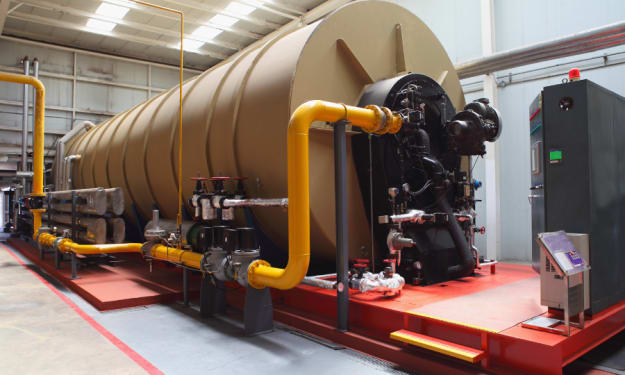
Saudi Arabia Boiler Market: Clean Energy Transition, Vision 2030, Emission Control & Modern Heating Systems
Saudi Arabia's boiler market grows through Vision 2030-driven industrialization, with rising demand in petrochemicals and power plants. Innovations like energy-efficient and biomass-fired models support sustainability goals, while Aramco expansions boost adoption of advanced systems amid rapid infrastructure projects. According to IMARC Group's latest research publication, Saudi Arabia boiler market size reached USD 902.70 Million in 2024. The market is projected to reach USD 1,631.91 Million by 2033, exhibiting a growth rate (CAGR) of 6.10% during 2025-2033.
By Jeffrey Wilson2 days ago in Futurism



Comments
There are no comments for this story
Be the first to respond and start the conversation.