
Earendel: The Most Distant Star Ever Detected
Space

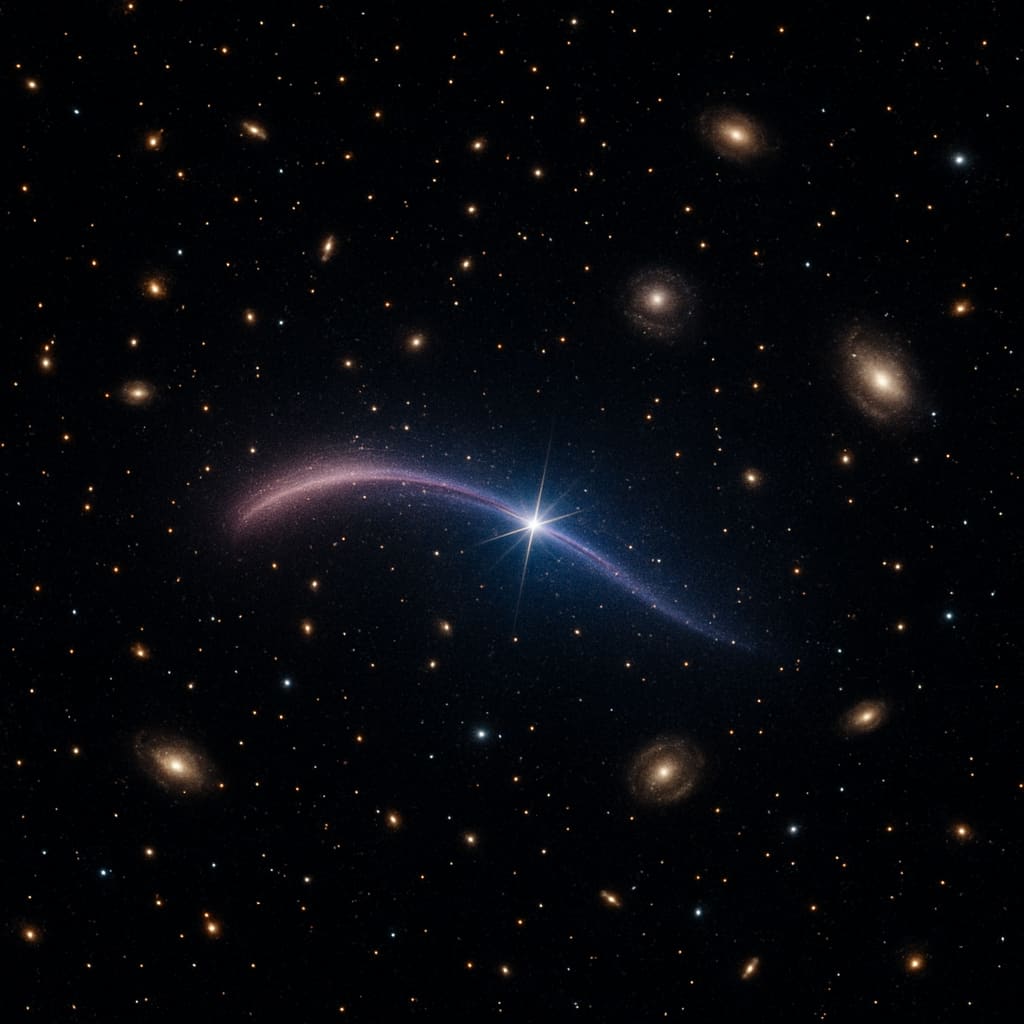
In the spring of 2022, astronomers spotted something extraordinary through the Hubble Space Telescope: a tiny glimmer of light from the edge of the observable universe. At first, many believed it could be a distant galaxy, or perhaps just a cluster of stars blurred together. But now, thanks to the unprecedented clarity of the James Webb Space Telescope (JWST), scientists have confirmed that this faint spark is, in fact, a single star.
That star is Earendel, whose name comes from Old English, meaning “morning star” or “ray of dawn.” It is more than just a poetic discovery; Earendel is the most distant star ever observed by humanity, a beacon shining to us from when the universe was still in its infancy.
A Window Into the Ancient Cosmos
Light doesn’t travel instantly—it takes time. That means when we look into the night sky, we are also looking into the past. The light from our Sun takes just over eight minutes to reach Earth, but the light from Earendel has been traveling for an almost unimaginable 12.9 billion years.
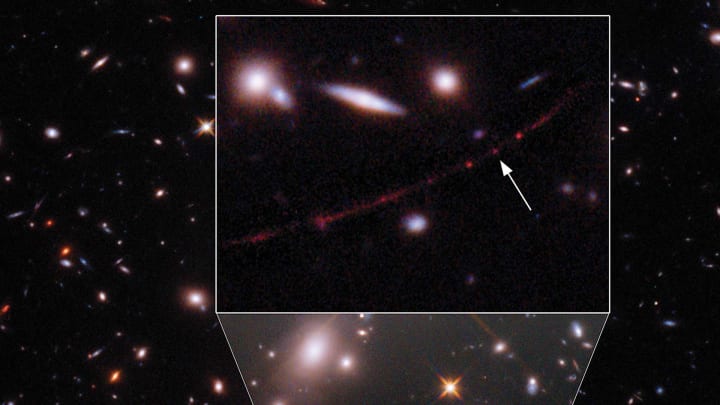
To put that in perspective: when Earendel’s light first began its journey, Earth did not exist. The Milky Way had not yet formed into its current shape. The universe itself was just over a billion years old—barely 7% of its present age. Observing Earendel is like finding a photograph of the cosmos as a toddler, long before it grew into the complex universe we know today.
Nature’s Own Telescope: Gravitational Lensing
The reason we can even see Earendel is a cosmic coincidence. A massive cluster of galaxies called WHL0137-08 happens to lie between us and the star. According to Einstein’s theory of general relativity, gravity bends space itself. When light from a distant source passes near a very massive object, it gets stretched, magnified, and bent—similar to the way a glass lens focuses sunlight.
This phenomenon, known as gravitational lensing, turned the galaxy cluster into a natural telescope. The cluster’s immense gravity acted like a cosmic magnifying glass, amplifying Earendel’s light thousands of times and allowing it to be detected. Without this lensing effect, even JWST would not have had a chance to pick out such a tiny and distant star.
Imagine standing at the bottom of a canyon, trying to spot a single firefly on the rim miles away. Now imagine that canyon walls happen to bend the firefly’s glow directly into your eyes, making it look bright enough to see. That’s essentially what gravitational lensing has done for Earendel.
Why This Discovery Matters
At first glance, Earendel might seem like just another star in a sky full of billions. But its distance and age make it one of the most scientifically valuable stars ever found. Here’s why:
- Clues about the first generations of stars.
Most stars we see today, including our Sun, are rich in heavier elements like carbon, oxygen, and iron—ingredients forged in the cores of earlier stars. But the earliest stars, sometimes called Population III stars, contained almost nothing but hydrogen and helium. If scientists can study Earendel’s spectrum—the specific fingerprints of light emitted by its atoms—they can determine whether it belongs to one of these extremely ancient populations.
- Testing models of cosmic evolution.
Finding and confirming Earendel gives astronomers proof that their models of how quickly stars formed after the Big Bang are on the right track. The star’s existence just one billion years into cosmic history shows that the universe was assembling into galaxies faster than some earlier theories suggested.
- Expanding the limits of observation.
Before Earendel, the most distant individual star we had detected was about 9 billion light-years away. Earendel pushes that boundary by several billion years, showing that with JWST and gravitational lensing, we may find even earlier stars. Each one pushes us closer to glimpsing the true “first lights” of the universe.
What We Know About Earendel
So far, astronomers estimate Earendel is a massive star, perhaps 50 times more massive than our Sun and millions of times brighter. Stars like this burn hot and fast, often living only a few million years before exploding in a brilliant supernova. That means Earendel itself is almost certainly long gone. What we see is its ghost, a message sent billions of years ago, still arriving at our doorstep today.
JWST is continuing to study Earendel and its host galaxy, known as the Sunrise Arc because of the elongated shape created by lensing. With more data, scientists may determine the star’s exact mass, temperature, and chemical makeup. Each measurement helps us understand not just Earendel, but also the cosmic era it represents.
A Star That Illuminates Our Origins
Earendel is more than just a distant pinprick of light—it is a story about where we come from. By peering back nearly 13 billion years, we are learning about the conditions that eventually led to the formation of galaxies, solar systems, and, ultimately, us.
In a way, Earendel lives up to its name: a ray of dawn, shining across time to remind us of the universe’s beginnings. And as telescopes like JWST continue their search, we may soon find even older and fainter stars, bringing us closer than ever to witnessing the very first starlight of the cosmos.
About the Creator
Keep reading
More stories from Holianyk Ihor and writers in Futurism and other communities.
Millions of Small Bodies Threatening Earth Will Soon Be Visible — Predictions from LSST and Next-Generation Sky Surveys
For decades, the night sky has looked like a familiar canvas, dotted with stars, planets, and the occasional streak of a meteor. Yet beneath this seemingly calm picture hides a dynamic swarm of small bodies — asteroids, comets, and other fragments left over from the birth of our Solar System. Many of them cross paths with Earth, sometimes uncomfortably close. Until now, only a fraction of these objects have been cataloged. But that is about to change.
By Holianyk Ihor4 months ago in Futurism
About Binding Prometheus
I want to start actively advocating on behalf of my own work, and the most valuable part of my canon is, without a doubt, Binding Prometheus, the play I have been working on since 2019 and only finished in 2023 as part of my MA. The play itself is an amalgamation of a million different inspirations. On one end, it evokes the Ancient Greek myth-play, deriving its own title from the earliest extant work of Western drama we have, Aeschylus’s Prometheus Bound. On the other end, it borrows significantly from the sci-fi bulwarks from over the years, namely Mary Shelley’s Frankenstein and Karel Capek’s Rossum’s Universal Robots. The play could be an episode of Black Mirror, I fear. I don’t know. I’ve only ever seen one episode of Black Mirror.
By Steven Christopher McKnight15 days ago in Futurism
OSS & BSS Market: API Ecosystems, Microservices & Market Expansion
According to IMARC Group's latest research publication, global OSS & BSS market size reached USD 65.81 Billion in 2025. Looking forward, IMARC Group expects the market to reach USD 148.26 Billion by 2034, exhibiting a growth rate (CAGR) of 9.4% during 2026-2034.
By Andrew Sullivan3 days ago in Futurism
A Dart at Dusk
Seconds ago, the sullen sun set on the two of us… my exuberant furry companion and me. A fresh breeze embraces us, delivering welcome relief from the day’s oppressive heat. His typical stumbling and staggering along — apace with a sloth — has turned into trip-trapping, high-stepping, almost skipping along.
By Angie the Archivist 📚🪶2 days ago in Petlife



Comments
There are no comments for this story
Be the first to respond and start the conversation.