
Millions of Small Bodies Threatening Earth Will Soon Be Visible — Predictions from LSST and Next-Generation Sky Surveys
Space

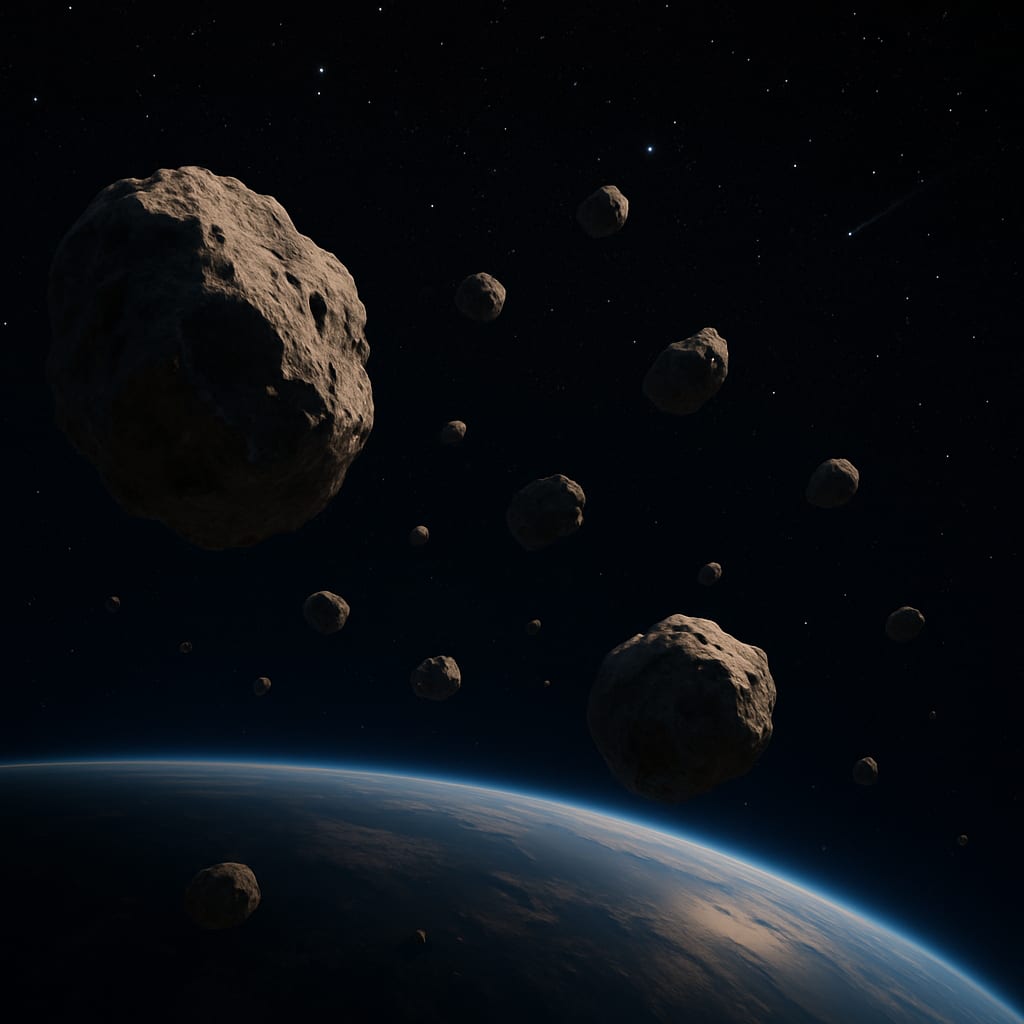
For decades, the night sky has looked like a familiar canvas, dotted with stars, planets, and the occasional streak of a meteor. Yet beneath this seemingly calm picture hides a dynamic swarm of small bodies — asteroids, comets, and other fragments left over from the birth of our Solar System. Many of them cross paths with Earth, sometimes uncomfortably close. Until now, only a fraction of these objects have been cataloged. But that is about to change.
Thanks to revolutionary observatories like the Legacy Survey of Space and Time (LSST) at the Vera Rubin Observatory in Chile, astronomers are preparing for an explosion of new discoveries: millions of small bodies that will finally come into focus. This surge of data could transform not only our understanding of the Solar System’s history but also our ability to protect Earth from future cosmic threats.
Why Small Bodies Matter
At first glance, a chunk of rock a few hundred meters across may not sound like much. But history has shown us otherwise. The Tunguska event of 1908, when a relatively small asteroid exploded over Siberia, flattened more than 2,000 square kilometers of forest. In 2013, a 20-meter object burst over Chelyabinsk, shattering windows across an entire city and injuring more than a thousand people.
These were wake-up calls. Scientists estimate that there may be over a million near-Earth objects (NEOs) large enough to cause local or regional damage, yet only about 34,000 have been tracked so far. The gap is enormous, and every uncharted asteroid is a potential risk. At the same time, these bodies are time capsules. They preserve the chemistry of the early Solar System — water, organics, and minerals that may explain how Earth became habitable. Studying them offers clues to our own origins.
Enter the LSST: The Sky’s New Watchtower
The Vera Rubin Observatory, expected to begin operations in 2025, will be unlike any telescope before it. Its flagship project, the LSST, is designed to image the entire southern sky every few nights with breathtaking depth and speed.
How powerful is it? The telescope’s 8.4-meter mirror and 3.2-gigapixel camera will capture images so wide and detailed that each night produces about 20 terabytes of raw data. That’s roughly the storage equivalent of 5,000 full-length HD movies — every night.
With this capability, LSST will:
- Detect objects only a few dozen meters wide, even hundreds of millions of kilometers away.
- Discover millions of new asteroids, including thousands on Earth-crossing orbits.
- Track faint comets, trans-Neptunian objects, and even rare interstellar visitors like ‘Oumuamua.
In just ten years, LSST is expected to catalog far more small bodies than have been identified in the entire history of astronomy.
Beyond LSST: A Global Effort
LSST is the crown jewel, but it’s not alone. Around the world, other observatories are joining the hunt:
- NEO Surveyor (NASA, launch planned for 2027): A space-based infrared telescope built specifically to spot potentially hazardous asteroids that are difficult to see in visible light.
- ATLAS and Pan-STARRS (Hawai‘i): Ground-based systems already credited with hundreds of new comet and asteroid discoveries.
- ESA’s Flyeye Telescope (Italy): A wide-field “compound eye” observatory designed to catch fast-moving, nearby objects before they slip past unnoticed.
Together, these projects form a global network of cosmic sentinels, improving our odds of early detection. For the first time, humanity could track most of the objects capable of causing significant damage — not after they arrive, but decades in advance.
What the Future Holds
If predictions are correct, the numbers are staggering. By the mid-2030s, astronomers expect:
- A nearly complete catalog of all kilometer-sized NEOs — the “planet-killers” that could threaten civilization itself.
- Up to 10 million smaller bodies mapped throughout the Solar System.
- Routine early warnings for objects on risky trajectories, potentially giving Earth decades of preparation time.
Imagine it: instead of being blindsided, we could predict with precision that a hazardous asteroid will approach Earth in, say, the year 2085. With that kind of foresight, options like asteroid deflection or evacuation planning move from science fiction into practical policy.
A New Cosmic Perspective
Perhaps the most exciting part is not only the enhanced safety but the shift in perspective. What once looked like empty, starry darkness will be revealed as a buzzing ecosystem of moving points — millions of small bodies each with a story to tell. Some may hold water, metals, or even exotic chemistry. Others may be targets for future space mining or exploration missions.
In essence, LSST and its companion surveys will redraw our mental map of the Solar System. The void between planets will no longer be “empty space” but a vibrant arena filled with countless travelers.
Conclusion
We stand on the brink of a new era in astronomy. For centuries, humans gazed at the night sky with naked eyes, then telescopes, mapping only the brightest dots. Soon, with LSST and its partners, we will see the full picture: a Solar System alive with millions of hidden bodies, some benign, some dangerous, all fascinating.
By 2035, we may look back and realize that the greatest discovery was not just the asteroids themselves, but the newfound ability to live in a universe we can finally see clearly — and to plan accordingly.
The next decade won’t just change astronomy. It may very well change how we see our place in the cosmos.
About the Creator
Keep reading
More stories from Holianyk Ihor and writers in Futurism and other communities.
New Observations of Exoplanet WASP-52 b Reveal Helium and Water Despite Its Host Star’s Fierce Radiation
When astronomers first began discovering exoplanets in the 1990s, most of them were little more than faint dots of light in distant skies. Today, thanks to advanced telescopes and precise techniques, these alien worlds are no longer just points in the dark—they are objects we can study in detail, even down to the chemical makeup of their atmospheres. Recently, the hot Jupiter known as WASP-52 b has surprised astronomers with a remarkable discovery: signs of both helium and water vapor in its atmosphere. This is astonishing, considering the harsh radiation from its host star, which should, in theory, strip such fragile molecules away.
By Holianyk Ihor4 months ago in Futurism
About Binding Prometheus
I want to start actively advocating on behalf of my own work, and the most valuable part of my canon is, without a doubt, Binding Prometheus, the play I have been working on since 2019 and only finished in 2023 as part of my MA. The play itself is an amalgamation of a million different inspirations. On one end, it evokes the Ancient Greek myth-play, deriving its own title from the earliest extant work of Western drama we have, Aeschylus’s Prometheus Bound. On the other end, it borrows significantly from the sci-fi bulwarks from over the years, namely Mary Shelley’s Frankenstein and Karel Capek’s Rossum’s Universal Robots. The play could be an episode of Black Mirror, I fear. I don’t know. I’ve only ever seen one episode of Black Mirror.
By Steven Christopher McKnight18 days ago in Futurism
United States Automotive Lighting Market Size and Forecast 2025–2033
Market Snapshot The United States Automotive Lighting Market is projected to grow from US$ 10.41 billion in 2024 to US$ 17.24 billion by 2033, registering a compound annual growth rate (CAGR) of 5.76% during the forecast period 2025–2033. This growth is being driven by rising vehicle production, rapid advancements in LED and adaptive lighting technologies, increasing demand for energy-efficient systems, and a strong regulatory focus on road safety.
By Aaina Oberoi3 days ago in Futurism



Comments
There are no comments for this story
Be the first to respond and start the conversation.