
Did you know … The word robot was used for the first time in Prague in 1921?
The rise of the robots may become a reality soon



It was on 2nd January 1921, in the then Czechoslovakia (today, the Czech Republic), where the word ‘robot’ was first introduced and used in public.
In 1920, Czech writer, playwright, and journalist Karel Čapek (1890 – 1938) first wrote the science fiction play R.U.R., which stands for Rossumovi Univerzalni Roboti (Rossum’s Universal Robot). The original term ‘roboti,’ which was invented by Čapek, derived from the Czech word ‘robota,’ which means forced labour. Later on, the word 'robot' was added to the English language in 1923.
Since then, the word 'robot' has been widely used in both fiction and non-fiction. In both cases, referring to autonomous machines capable of performing jobs to help humans.
***
From Prague, with Love
Considered one of the classics of twentieth-century theatre, the speculative fiction play R.U.R., was performed in three acts for the first time on 2nd January, 1921 at Hradec Králové (the National Theatre in Prague) in the then Czechoslovakia. The play is about artificial humanoid workers who are not mechanical but instead they are made of synthetic organic material and look exactly like humans. In Čapek’s play, each humanoid robot can do the work of several humans and thus humans can have more free time for enjoying life.
It doesn't take long for the humanoid robots to realise that despite having no passion, no history, no soul they are stronger, smarter, faster, and more capable than humans, yet, they are treated like slaves without too much consideration.
After this realisation, the robots rise up against their human masters and kill them all but one, leading to the extinction of the human race.
Karel Čapek’s play looks into a future in which all workers are automatons, or “robots” – a word this play introduced and made a permanent part of the language and human culture and society. In the play, robots revolt when their manufacturing formula is changed to make them more irritable and to give them the human ability to hate. The resulting catastrophe makes for a powerful and deeply moving theatrical experience. Yet, it carries a profound message.
In a scene at the end of the third act, one of the last remaining humans, knowing himself and his species to be doomed, says: “It was a great thing to be a man. There was something immense about it.”
Since then, the concept and narrative of man vs. robot and robots rising up against their human creators has been repeated in many other works of fiction.
The play’s profound impact on science fiction and popular culture is evident, as it laid the groundwork for countless fictional and non-fictional narratives for over a century exploring the relationship between humans and artificial beings.
As it has happened many times, what once belonged to science fiction transpassed to the realm of science and technology.
According to IBM, the first robot equipped with artificial intelligence was Shakey, developed by the Artificial Intelligence Centre at Stanford Research Institute (now SRI International) between 1966 and 1972.
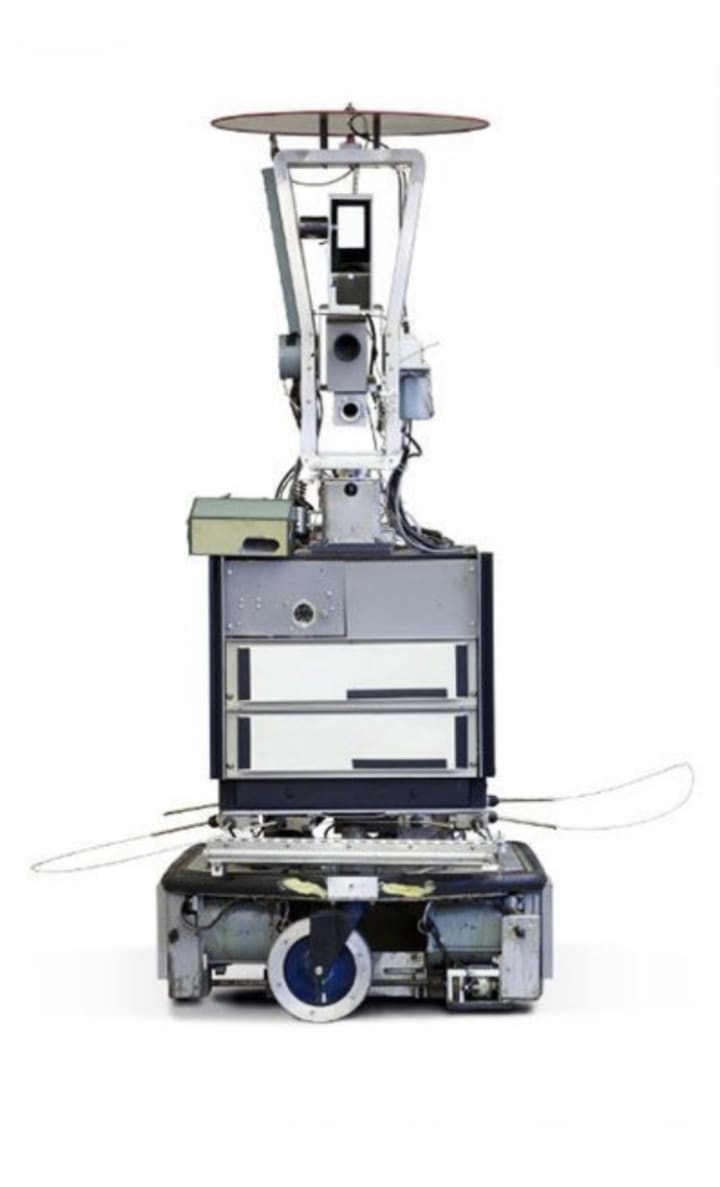
Shakey was a pioneering mobile robot that integrated perception, planning, and problem-solving capabilities, enabling it to navigate and interact with its environment autonomously. This groundbreaking project marked a significant milestone in the integration of artificial intelligence and robotics.
Since then, artificial intelligence has gained significant attention in the field of robotics as the way to build an artificial neural network that gives human-like intelligent capabilities to robots and humanoids.
However, many believe that if humans make a slight error in the current developments of artificial intelligence and AI-embedded robots, more precisely in terms of deciding for or against embedding human emotions into robots, in the future, human masters could see R.U.R.’s plot become a reality.
Will this eventually happen at some point in the future? Only time will tell. For now, we can only hope that humans make the right decisions at the time of embedding advanced AI into robots.
If you are interested in reading an English translation of R.U.R by Paul Selver and Nigel Playfair you can find it here below through Standard eBooks as a free download.
Read more on AI and robotics:
About the Creator
Susan Fourtané
Susan Fourtané is a Science and Technology Journalist, a professional writer with over 18 years experience writing for global media and industry publications. She's a member of the ABSW, WFSJ, Society of Authors, and London Press Club.
Keep reading
More stories from Susan Fourtané and writers in Futurism and other communities.
Robotic massage: A revolution in self-care and wellness
Your local masseur got replaced by a robot. Which one is better? Only time will tell. Most people welcome a massage after long sports training, running a marathon, after a stressful day or week at work, during rather stressful times, after a long writing day, and so many other situations that leave every muscle in the body sore and tense.
By Susan Fourtané 10 months ago in Futurism
About Binding Prometheus
I want to start actively advocating on behalf of my own work, and the most valuable part of my canon is, without a doubt, Binding Prometheus, the play I have been working on since 2019 and only finished in 2023 as part of my MA. The play itself is an amalgamation of a million different inspirations. On one end, it evokes the Ancient Greek myth-play, deriving its own title from the earliest extant work of Western drama we have, Aeschylus’s Prometheus Bound. On the other end, it borrows significantly from the sci-fi bulwarks from over the years, namely Mary Shelley’s Frankenstein and Karel Capek’s Rossum’s Universal Robots. The play could be an episode of Black Mirror, I fear. I don’t know. I’ve only ever seen one episode of Black Mirror.
By Steven Christopher McKnight11 days ago in Futurism
Ambulance Services Market: Advanced Life Support, Technology Use & Market Forecast
According to IMARC Group's latest research publication, global ambulance services market size reached USD 58.2 Billion in 2024. Looking forward, IMARC Group expects the market to reach USD 116.8 Billion by 2033, exhibiting a growth rate of 7.22% during 2025-2033.
By Suhaira Yusuf4 days ago in Futurism
A Failed Artist, A Disillusioned Poet, An Underpaid Game Show Host
I took my son and niece to Gori, a small town in Georgia where Joseph Stalin was born. They talked me into visiting the Stalin's Museum, the largest in the post-Soviet space. I had resisted going there because I just can't stand the monster and know enough about him, or so I thought.
By Lana V Lynx6 days ago in FYI


Comments (23)
"Thanks for sharing!"
Great I hope you will be in the future a master of story
Well deserved Top Story… a fascinating read and cautionary tale.🤗
### 🖤 **Last words:** **Love has no color, if it does—it can be measured by the depth of the heart.** Black skin color, black tea, or black night— everything brings its own beauty, if there is a mind to see.
Wonderful top story that is relevant to today's dynamics. Fascinating that the word robot was used so early in the 20th century!
🎉 Congrats on your Top Story! 📰✨ Super proud of you—so well deserved! 💪👏 Keep shining! 🌟😊
Great work
Well done on getting Top Story for this one Susan. I thought it might, straight after I'd read it. Really well written and informative piece. Congratulations!
Thank you, Susan, for providing a background on the robot. I learned something new this morning. Only time will tell, but it's scary to think of robots evolving and going against mankind. Congratulations on your top story. This is an excellent one! 🥰🥰🥰
Great work !
… and congratulations on your top story. A deserved win.
Yes, and have read the Czech play. Thanks for bringing it back to life. I considered it prophetic that the robot translates literally as ‘slave’ and I can see this to be the most scary future scenario for humanoid robots… that they should be marketed as such. Well done for making this connection with ‘AI’
Informative. Forced labor makes sense.
Back to say congratulations on your Top Story! 🎉💖🎊🎉💖🎊
Very well written, congrats 👏
Wow! This is fascinating. My heart broke a little when you wrote that 'robota' is the Czech word for 'forced labour.' Thinking about that as the word's (and the invention's) root origin brings up an interesting mix of feelings inside. Thank you for writing this and congratulations on Top Story!!
so fascinating! these stuff usually don't capture my attention but here I was hooked til the end. Congrats on TS!
What a fascinating and interesting piece—I love to see a science related article win Top Story! ♥️
I really think that RUR's plot would become the reality in the near future. No doubts about that for me. Your pieces was so fascinating!
This was a fantastic read. I thoroughly enjoyed it. Science and technology are topics that always grab my interest. I will definitely download the English version and read it. https://youtu.be/D_8Pma1vHmw?si=TeHNqPMuwVqCJzDy
This is so interesting <3
I had no idea where the word Robot came from until now Susan. This is a really interesting and well researched essay! Could we become slaves to Robots in the future, rather than the other way around?
Thanks for this great historical and linguistic lesson. I think I did know this but can't be certain and robot devices are becoming more and more commonplace