
Dangers of AI
If we don't control it, it will eventually control us.

Artificial intelligence (AI) has been one of the most transformative technologies of the last decade. With its ability to process vast amounts of data and make decisions in real-time, AI has revolutionized the way we work, learn, and interact with each other. However, as with any powerful tool, AI also has its dangers. In this article, we'll explore some of the ways that AI can be dangerous and what we can do to mitigate those risks.
The potential for AI to automate employment and replace human workers is one of the most pressing risks of this technology. As AI develops, it can perform activities that were previously believed to be the sole responsibility of human labour. As an illustration, chatbots using AI may now respond to customer service questions and machine learning algorithms can scan medical images to assist in disease diagnosis. Even if some of these improvements may be advantageous, millions of workers could be made redundant, especially in low-skilled positions.
AI also poses the risk of amplifying and sustaining current prejudices and inequality. The data that AI algorithms are educated on determines how objective they are. An AI system's decision-making will be biassed if the data it utilised to train itself had biases or inequities. A facial recognition algorithm that has been trained on mostly white faces, for instance, would have trouble identifying people with darker skin tones. Results from this may be unjust and discriminatory, especially in professions like law enforcement and employment.
AI has the capacity to be weaponized and employed maliciously. Cybercriminals may, for instance, run more complex and focused phishing attacks using AI-powered bots, or even employ them to impersonate people online. Similar to this, totalitarian countries might monitor their citizens and put down opposition by using AI-powered surveillance technologies. This might suppress the freedom to free speech and other important human rights.
Yet, the possibility of AI being incorporated into autonomous weapon systems may be the biggest threat. These are weapons that can choose and attack targets on their own. Although they are not yet widely used, autonomous weapons systems pose a serious danger to international security. Such systems might be more prone to mistakes or malfunctions because there is no human monitoring, which could result in unintended injury or even war. Moreover, autonomous weapons systems might be challenging to manage or contain, increasing the danger of an arms race and its possibly disastrous results.
So what can we do to lessen the risks associated with AI? Making sure AI is created and used in an ethical and responsible manner is an important first step. To ensure that AI is used for the benefit of society, it is necessary to take actions to reduce the likelihood of bias and discrimination in AI systems. It also entails having an open and honest discussion about the advantages and disadvantages of AI, both inside the technological sector and in general society.
To assist workers in making the shift to the new economy, investing in education and reskilling programmes is another crucial step. It's critical that we provide people the skills they need to thrive in the new environment as AI and other smart technologies continue to change the labour market. This can entail funding STEM education, encouraging lifelong learning, and offering financial assistance to those who lose their jobs to automation and AI.
In order to control the creation and application of AI, we must cooperate on a worldwide scale. To create global norms and standards for the ethical use of AI, governments, business, and civil society must work closely together. Also, it will be necessary to create new institutions and legal frameworks that can keep up with the quickly changing field of AI technology.
In conclusion, AI has immense potential to improve the world, but it also presents serious risks. The concerns of AI are real and must be considered, including the threat posed by autonomous weapons systems, the loss of jobs, and the maintenance of bias and inequity.
About the Creator
Keep reading
More stories from writers in Futurism and other communities.
About Binding Prometheus
I want to start actively advocating on behalf of my own work, and the most valuable part of my canon is, without a doubt, Binding Prometheus, the play I have been working on since 2019 and only finished in 2023 as part of my MA. The play itself is an amalgamation of a million different inspirations. On one end, it evokes the Ancient Greek myth-play, deriving its own title from the earliest extant work of Western drama we have, Aeschylus’s Prometheus Bound. On the other end, it borrows significantly from the sci-fi bulwarks from over the years, namely Mary Shelley’s Frankenstein and Karel Capek’s Rossum’s Universal Robots. The play could be an episode of Black Mirror, I fear. I don’t know. I’ve only ever seen one episode of Black Mirror.
By Steven Christopher McKnight26 days ago in Futurism
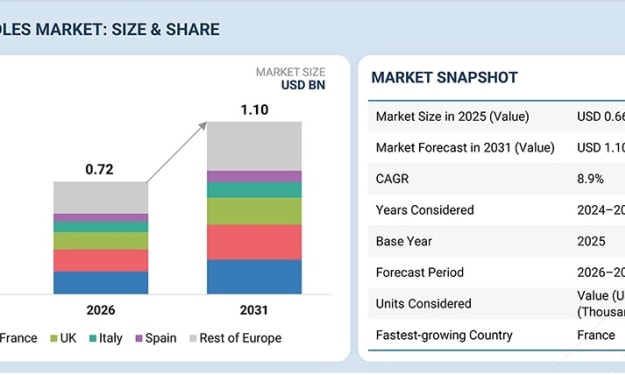
Europe Pen Needles Market Poised for Steady Expansion, Reaching US$1.10 Billion by 2031 Amid Diabetes Growth and Home-Care Shift
Europe’s pen needles market is entering a period of sustained, value-driven growth as chronic disease burden, demographic shifts, and home-based care adoption reshape injectable therapy delivery across the region. Valued at US$0.66 billion in 2025, the market increased to US$0.72 billion in 2026 and is projected to expand at a resilient CAGR of 8.9% from 2026 to 2031, reaching a forecasted US$1.10 billion by 2031.
By Juan Martinezabout 6 hours ago in Futurism
10 Times Rotten Tomatoes and I Disagreed
***Disclaimer*** I will be ranking these movies in the following manner: The greater the divide between Rotten Tomatoes and I, the higher up on the list (and I am referring to the critic's score, not the audience score). I will also show Rotten Tomatoes' score on each one in addition to my score. I am curious to know what everyone thinks, please let me know in the comments below!
By Madison "Maddy" Newtona day ago in Geeks


Comments
There are no comments for this story
Be the first to respond and start the conversation.