
China Stunned by US Jet: SR-72 Hypersonic Aircraft to Fly at Over Mach 5 in 2025, Triggering Shock and Panic in Beijing
"Lockheed Martin’s SR-72 Set to Redefine Aerial Supremacy as China Scrambles to Respond to America’s Hypersonic Breakthrough"

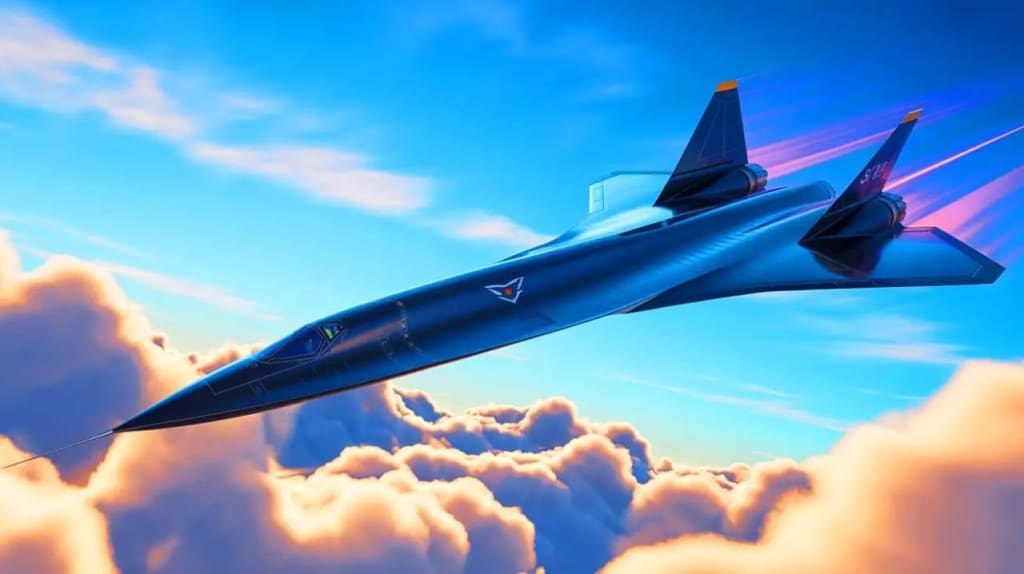
China Stunned by US Jet: SR-72 Hypersonic Aircraft to Fly at Over Mach 5 in 2025, Triggering Shock and Panic in Beijing
The United States is preparing to usher in a new era of aerial dominance with the anticipated flight of the SR-72 hypersonic aircraft in 2025. Known as the “Son of Blackbird,” the SR-72 is the successor to the legendary SR-71 Blackbird and is capable of flying at speeds exceeding Mach 5—over 3,800 miles per hour. The announcement has reportedly stunned Chinese defense analysts, triggering alarm in Beijing over the strategic imbalance this aircraft may create.
Unveiling the SR-72
Developed by Lockheed Martin’s advanced Skunk Works division, the SR-72 is built for speed, stealth, and high-altitude operations. Unlike conventional jets, this aircraft uses a revolutionary hybrid propulsion system that includes both a turbine engine and a scramjet. This system allows it to take off from a conventional runway, transition to hypersonic speed, and fly at altitudes and velocities that render existing air defense systems ineffective.
The SR-72 is designed primarily for intelligence, surveillance, and reconnaissance (ISR) missions, with the added capability to deliver rapid, precise strikes deep within enemy territory. Lockheed Martin officials claim that the aircraft will be able to reach any point on the globe in under an hour—making it a formidable asset in future conflicts.
Beijing on High Alert
Reports from Chinese military think tanks suggest that Beijing views the SR-72 as a serious threat to its regional defense architecture, particularly its anti-access/area-denial (A2/AD) strategy. The aircraft’s high-speed capability allows it to breach Chinese airspace before traditional warning systems can react.
The concern is not merely about surveillance; the SR-72's ability to potentially carry hypersonic missiles or precision-guided bombs means it could conduct first-strike missions with minimal warning. For a country like China, which relies heavily on missile defense systems and early-warning radars, this represents a major vulnerability.
The Hypersonic Arms Race Intensifies
China is no stranger to hypersonic technology and has made substantial advances with its own systems like the DF-ZF hypersonic glide vehicle. However, the SR-72 represents a leap in air-breathing hypersonic aircraft—something China has yet to match operationally.
To close the gap, Beijing is accelerating its own hypersonic programs. In 2024, Chinese researchers revealed the development of the “Nanqiang No. 1,” a hypersonic passenger aircraft prototype that could fly at Mach 6. Although designed for civilian use, such technologies are often dual-purpose and could feed into future military designs.
Technical Marvels and Military Strategy
One of the most impressive aspects of the SR-72 is its engineering. Sustaining speeds over Mach 5 requires materials that can withstand temperatures beyond 1,000 degrees Celsius. To solve this, Lockheed Martin has incorporated advanced carbon composites and titanium alloys in its construction.
In addition, the SR-72 may be equipped with artificial intelligence to assist in navigation, mission planning, and threat detection—reducing pilot workload and enhancing responsiveness in hostile environments. The aircraft may eventually be fully autonomous, further expanding its versatility.
Geopolitical Implications
The SR-72 doesn’t just represent technological advancement—it also sends a powerful message. As tensions between the U.S. and China continue to rise over issues like Taiwan, the South China Sea, and global cyber warfare, this hypersonic jet serves as a reminder of America’s aerospace superiority.
Military analysts believe that the aircraft could shift the balance of power in contested zones, giving the U.S. a critical edge in any potential conflict scenario. It’s not surprising, then, that Chinese state media has voiced concerns, calling the SR-72 a “destabilizing weapon” and urging global arms control talks.
Economic and Industrial Impact
Beyond military significance, the SR-72 is revitalizing the American defense industry. Lockheed Martin and its partners are generating thousands of high-tech jobs and investing in research that could spill over into the civilian aerospace sector. Technologies pioneered in the SR-72 project—such as advanced engines, materials science, and AI—could eventually lead to hypersonic commercial airliners and faster space launches.
Conclusion
As the SR-72 prepares to make its maiden flight in 2025, it represents more than just a new aircraft—it is a bold leap into the future of aerial warfare. Its potential to operate at Mach 5 and beyond has alarmed adversaries and thrilled military strategists.
For Beijing, the SR-72 is a wake-up call that the hypersonic arms race is no longer a theoretical competition. It is real, fast, and flying at the edge of the atmosphere.
About the Creator
Adnan Rasheed
Author & Creator | Writing News , Science Fiction, and Worldwide Update| Digital Product Designer | Sharing life-changing strategies for success.
Keep reading
More stories from Adnan Rasheed and writers in Futurism and other communities.
2025: The Year of the Humanoid Robot Factory Worker
2025: The Year of the Humanoid Robot Factory Worker The industrial landscape is undergoing a seismic shift, and 2025 is proving to be the pivotal year in which humanoid robots officially become mainstream factory workers. What once existed only in the realm of science fiction is now a tangible reality, reshaping manufacturing as we know it. With breakthroughs in artificial intelligence, robotics, and human-machine collaboration, humanoid robots are no longer experimental novelties — they are productive, cost-effective, and increasingly indispensable components of modern production lines.
By Adnan Rasheed9 months ago in Futurism
About Binding Prometheus
I want to start actively advocating on behalf of my own work, and the most valuable part of my canon is, without a doubt, Binding Prometheus, the play I have been working on since 2019 and only finished in 2023 as part of my MA. The play itself is an amalgamation of a million different inspirations. On one end, it evokes the Ancient Greek myth-play, deriving its own title from the earliest extant work of Western drama we have, Aeschylus’s Prometheus Bound. On the other end, it borrows significantly from the sci-fi bulwarks from over the years, namely Mary Shelley’s Frankenstein and Karel Capek’s Rossum’s Universal Robots. The play could be an episode of Black Mirror, I fear. I don’t know. I’ve only ever seen one episode of Black Mirror.
By Steven Christopher McKnight19 days ago in Futurism



Comments
There are no comments for this story
Be the first to respond and start the conversation.