
Can We Create Artificial Gravity? The Future of Gravity in Space
Space

Gravity is the invisible force that keeps our feet on the ground, makes apples fall from trees, and holds entire planets and galaxies together. It’s such a constant in our lives that we barely notice it until it’s gone. In space, gravity disappears, and astronauts enter a world of weightlessness. But as cool as zero gravity looks, it comes at a cost. Extended time in microgravity weakens bones, shrinks muscles, disrupts blood flow, and confuses the body’s balance system.
That’s why the idea of artificial gravity has moved beyond science fiction and into serious scientific discussions. But is it actually possible to create gravity in space? The short answer: yes. The long answer involves engineering, physics, and a touch of imagination.
What Is Artificial Gravity?
Artificial gravity refers to the simulation of gravitational force in environments where it doesn’t naturally exist like aboard a spaceship or space station. The most promising and realistic method is based on centrifugal force.
Imagine a spinning carnival ride or a rotating Ferris wheel. The faster it turns, the more you feel pressed against the walls. That pressure mimics the effect of gravity. Now imagine scaling that concept up to a rotating spacecraft. If designed correctly, the people inside would feel a pull toward the outer edge just like being “pulled down” by gravity on Earth.
How Would It Work?
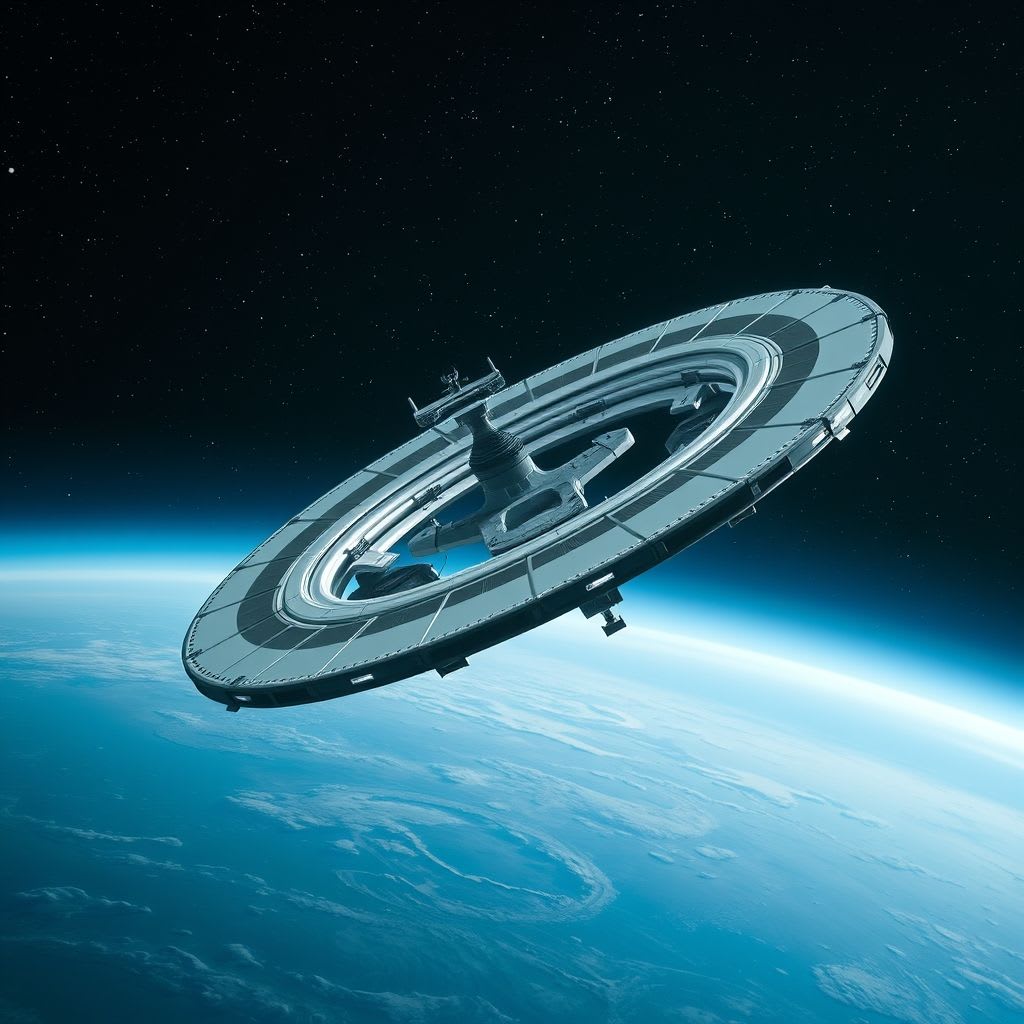
The most popular design is a rotating module something shaped like a ring, cylinder, or torus (a donut like structure) that spins around a central axis. The inner surface of the ring acts as the floor, and as the station rotates, the force pushes people and objects toward that floor, simulating gravity.
But there’s a catch: creating the sensation of Earth’s gravity (1g) depends on the right balance of radius and rotation speed. For example, if the radius of a rotating habitat is 100 meters, it would need to complete one full rotation every 30 seconds to produce 1g at the outer edge.
However, spinning too quickly or having a small radius can cause side effects like dizziness, nausea, and even motion sickness due to varying forces acting on different parts of the body your head might feel less gravity than your feet. Engineers have to fine-tune the design to avoid these issues.
Has Anyone Tried It?
The idea has been around for decades. One of the most iconic representations appeared in the 1968 film 2001: A Space Odyssey, which featured a massive rotating space station with artificial gravity.
In reality, though, we haven’t gotten there yet. The International Space Station (ISS) still operates entirely in microgravity. Astronauts rely on exercise, strict schedules, and medications to combat the health effects of weightlessness.
But that could change. Agencies like NASA, ESA, and private companies are seriously considering artificial gravity for future missions especially for trips to Mars or long term Moon habitats. Designs like the Stanford Torus and the Von Braun Station propose large, rotating space habitats with full artificial gravity, although they remain in the concept and modeling stages for now.
Alternatives to Spinning
Spinning spacecraft aren’t the only theoretical approach to artificial gravity, but they’re by far the most practical. One alternative involves constant acceleration if a spacecraft could accelerate in one direction at 9.8 m/s², it would create a force equivalent to Earth’s gravity. But maintaining that level of acceleration requires massive amounts of fuel, making it highly impractical with today’s technology.
Another option is magnetic levitation, but this only works for objects with magnetic properties and doesn't create the universal "downward" force that people need to feel grounded. So far, it’s not viable for simulating gravity for humans.
Why It Matters
Artificial gravity could be the key to successful long term space exploration. As we begin to dream about colonizing Mars, building orbital cities, or embarking on deep space missions, the ability to create a gravity like environment becomes essential not just for physical health, but for mental well being, digestion, sleep, and more.
Imagine a Mars-bound spacecraft where astronauts can walk, exercise, and eat meals without floating forks and spinning soup. Or an orbital hotel where tourists can enjoy a gravity like experience without the dizzying effects of free fall. Artificial gravity could make all of that possible.
So… Can We Do It?
Yes, we can create artificial gravity. We know the physics. We have the basic technology. The only roadblocks are cost, engineering complexity, and scale. Building a large rotating spacecraft or module isn’t easy but it’s not impossible.
For now, astronauts still float, exercise, and adapt. But in the not so distant future, spinning habitats could become as normal in space travel as seatbelts in cars are on Earth. Artificial gravity isn’t just a scientific challenge it’s a step toward making space truly livable.
As humanity pushes further into the cosmos, gravity may no longer be a given. It may become a choice engineered, optimized, and perhaps even customizable. The future of gravity is being built, one rotating ring at a time.
About the Creator
Keep reading
More stories from Holianyk Ihor and writers in Futurism and other communities.
Why Everything We See Is Actually the Past: A Journey Through Space and Time
Every time you open your eyes, you become a time traveler or at least an archaeologist of light. What we see isn’t the present. It’s the past, captured and delivered to us by one of the universe’s most reliable messengers: light. This idea may sound poetic, even philosophical, but it’s grounded in solid physics. Our entire visual experience is a reflection of what was, not what is. And understanding why begins with the nature of light and the limits of its speed.
By Holianyk Ihor7 months ago in Futurism
About Binding Prometheus
I want to start actively advocating on behalf of my own work, and the most valuable part of my canon is, without a doubt, Binding Prometheus, the play I have been working on since 2019 and only finished in 2023 as part of my MA. The play itself is an amalgamation of a million different inspirations. On one end, it evokes the Ancient Greek myth-play, deriving its own title from the earliest extant work of Western drama we have, Aeschylus’s Prometheus Bound. On the other end, it borrows significantly from the sci-fi bulwarks from over the years, namely Mary Shelley’s Frankenstein and Karel Capek’s Rossum’s Universal Robots. The play could be an episode of Black Mirror, I fear. I don’t know. I’ve only ever seen one episode of Black Mirror.
By Steven Christopher McKnight14 days ago in Futurism
Test Preparation Market Outlook: Trends, Growth & Demand
📊 Test Preparation Market Overview The global test preparation market encompasses a wide range of services and solutions designed to help learners prepare for academic, professional, and language proficiency exams. These include standardized tests like SAT, ACT, GRE, GMAT, TOEFL, and IELTS, as well as certification and licensing assessments across industries. Traditionally dominated by in-person coaching and printed study materials, the market has shifted significantly toward online delivery, mobile apps, and technology-enhanced instruction. Digital platforms now account for a growing share of user engagement due to flexibility, convenience, and scalable access to resources.
By James Smith7 days ago in Futurism


Comments
There are no comments for this story
Be the first to respond and start the conversation.