
Blockchain Gaming Market Trends: Interoperable NFTs, Layer-2 Scaling & Industry Outlook to 2033
How blockchain transparency, secure transactions, and trustless systems are improving player confidence, fraud prevention, and economic fairness within decentralized gaming platforms

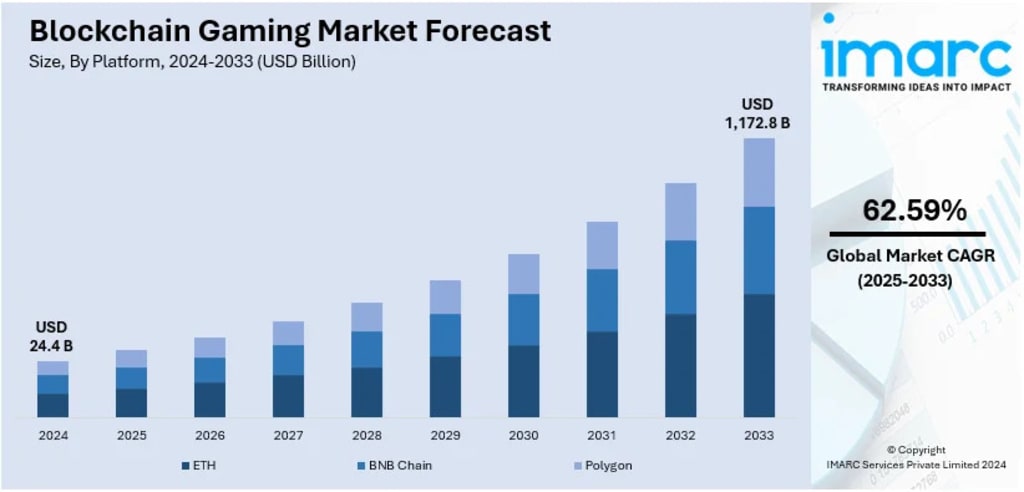
Rising consumer demand for true digital ownership, innovative play-to-earn models, and seamless NFT integration are reshaping the gaming landscape, fueled by blockchain transparency, growing venture capital investments, and expanding Web3 gaming platforms. According to IMARC Group's latest data, the global blockchain gaming market size was valued at USD 24.4 Billion in 2025. Looking forward, IMARC Group estimates the market to reach USD 1,172.8 Billion by 2033, exhibiting a CAGR of 62.59% from 2026-2033.
Blockchain gaming represents one of the fastest-evolving sectors in digital entertainment, where players can genuinely own in-game assets, trade them freely across platforms, and even earn real income through gameplay. Unlike traditional games where items vanish if a server shuts down, blockchain games give players permanent ownership through NFTs and cryptocurrency tokens. This shift has caught the attention of major gaming studios, tech giants, and millions of players worldwide who see gaming not just as entertainment but as a viable economic opportunity. The sector is growing rapidly across mobile, PC, and web platforms, with role-playing games leading adoption as developers create rich virtual economies powered by decentralized technology.
Blockchain Gaming Market Growth Drivers:
- Explosive Growth of Play-to-Earn Gaming Models
Players are flocking to blockchain games where they can actually earn money while playing, with popular titles generating substantial income for dedicated gamers in regions like Southeast Asia, Latin America, and Africa. Games like Axie Infinity demonstrated that players could earn hundreds of dollars monthly through strategic gameplay and asset trading. Industry data shows that play-to-earn games accounted for roughly 62% of blockchain gaming revenue recently. This model has created entire guilds and scholarship programs where experienced players mentor newcomers, sharing earnings and creating new economic ecosystems. The Philippines saw gaming become a legitimate income source during economic downturns, with entire communities forming around blockchain games.
- NFT Integration Revolutionizing Digital Ownership
Non-fungible tokens have transformed how players view in-game items, turning virtual swords, characters, and land into actual assets that can be sold, traded, or used across multiple games. Role-playing games dominate with 33.8% market share as players collect unique characters and equipment that hold real-world value. Gaming NFTs now represent around 42% of the broader NFT market, with the in-game assets segment alone capturing significant market share. Players spend hundreds or thousands on rare items knowing they truly own them, unlike traditional games where developers can delete items at will.
- Massive Institutional and Venture Capital Investment
Major gaming companies and investment firms are pouring billions into blockchain gaming infrastructure and game development, validating the sector's long-term potential despite market volatility. Companies like Polygon Labs, Immutable, and King River Capital launched a USD 100 million Web3 gaming fund in March 2024, while prominent investors including Supercell backed Web3 gaming startups with multi-million dollar rounds. Although funding declined from over USD 10 billion in 2022 to USD 293 million recently as the market matured, investments now focus on quality projects with sustainable business models rather than speculative ventures. Traditional gaming giants like Ubisoft and innovative startups alike are building blockchain divisions.
Get Instant Access to the “Blockchain Gaming Market” Sample Report
Blockchain Gaming Market Trends:
- Ethereum Dominance with Layer 2 Solutions Scaling Performance
Ethereum maintains leadership with 32.05% platform market share as developers leverage its robust smart contract ecosystem, while Layer 2 solutions like Polygon, Optimism, and Ronin solve previous scalability issues that plagued early blockchain games. Games that once suffered from high gas fees and slow transactions now run smoothly through these scaling solutions, making gameplay feel as responsive as traditional titles. The Ronin network specifically processed hundreds of thousands of daily transactions for Axie Infinity at minimal cost. BNB Chain and other alternatives are gaining ground, but Ethereum's established developer community, security track record, and compatibility with major wallets keep it dominant.
- Rising Focus on Sustainable Tokenomics and Long-Term Value
Developers are moving away from speculative token models toward sustainable economies with real utility, revenue sharing, and deflationary mechanisms that protect long-term value for players and investors. The industry learned hard lessons from early play-to-earn games where token inflation destroyed economies within months. Studios now design complex sinking mechanisms where tokens get burned through crafting, upgrades, and marketplace fees. The Blockchain Game Alliance's report shows sustainable business models ranked as the third most important growth driver at 27.5%, with high-quality game launches taking priority over token speculation.
- Emergence of Cross-Platform Interoperability and Metaverse Integration
Players increasingly expect their digital assets to work across multiple games and virtual worlds, driving partnerships between developers to create interconnected gaming metaverses where characters, items, and currencies transfer seamlessly. Major platforms like The Sandbox and Decentraland enable players to carry assets between experiences, while game studios collaborate through shared blockchain infrastructure. Over 73% of blockchain games target mobile platforms to maximize accessibility, recognizing that true metaverse experiences need cross-device compatibility. Recent partnerships demonstrate this vision, with gaming-specific blockchains like GUNZ for Off the Grid and SANDchain offering dedicated infrastructure.
Recent News and Developments in Blockchain Gaming Market
- December 2024: The Blockchain Game Alliance released its 2025 State of the Industry Report at the Global Blockchain Show Abu Dhabi, revealing that the Middle East and North Africa region grew from just 0.5% of the blockchain gaming workforce in 2021 to 19.8% currently, marking the fastest regional growth in industry history.
- October 2024: Ubisoft, the French gaming giant behind Assassin's Creed and Far Cry, released Champions Tactics: Grimoria Chronicles, its first major Web3-enabled game integrated into the Oasys layer-2 Home Verse blockchain ecosystem.
- November 2024: Animoca Brands announced plans for a USD 2.4 billion reverse-listing on the US Nasdaq exchange, representing one of the largest blockchain gaming companies going public and demonstrating institutional confidence in the sector's future.
Note: If you require specific details, data, or insights that are not currently included in the scope of this report, we are happy to accommodate your request. As part of our customization service, we will gather and provide the additional information you need, tailored to your specific requirements. Please let us know your exact needs, and we will ensure the report is updated accordingly to meet your expectations.
About the Creator
Andrew Sullivan
Hello, I’m Andrew Sullivan. I have over 9+ years of experience as a market research specialist.
Keep reading
More stories from Andrew Sullivan and writers in Futurism and other communities.
Remote Towers Market Developments: Virtual ATC, 360-Degree Vision & Market Expansion to 2033
Driven by airport modernization, rising air traffic volumes, cost-efficiency needs, and adoption of digital air traffic control technologies improving safety, operational flexibility, and centralized management across regional and smaller airports. According to IMARC Group's latest research publication, global remote towers market size reached USD 472.5 Million in 2024. Looking forward, IMARC Group expects the market to reach USD 2,337.4 Million by 2033, exhibiting a growth rate (CAGR) of 18.47% during 2025-2033.
By Andrew Sullivanabout 21 hours ago in Futurism
AI-Enabled Identity Management in Healthcare Transforming Digital Trust
The healthcare industry is rapidly evolving with digital-first ecosystems, AI-powered platforms, and interoperable health systems. As hospitals, clinics, payers, and digital health startups continue to adopt advanced technologies, one foundational challenge remains constant—securely managing identities. Identity management in healthcare has become a critical pillar for ensuring patient safety, regulatory compliance, and seamless access to care across complex digital environments.
By Steve Waugh4 days ago in Futurism
Saudi Arabia Dust Control Solutions Market: Industrial Demand, Environmental Compliance & Growth Outlook
Rising construction activity driven by Vision 2030 mega-projects, expanding mining operations, and growing awareness about worker health and safety are fueling demand for dust suppression systems in Saudi Arabia. According to IMARC Group’s latest research, the The Saudi Arabia dust control solutions market size reached USD 167.1 Million in 2025. Looking forward, IMARC Group expects the market to reach USD 238.7 Million by 2034, exhibiting a growth rate (CAGR) of 4.04% during 2026-2034.
By Faisal Al-Harbi2 days ago in Futurism




Comments
There are no comments for this story
Be the first to respond and start the conversation.