
Remote Towers Market Developments: Virtual ATC, 360-Degree Vision & Market Expansion to 2033
How cloud-based architectures, secure communication networks, and digital redundancy systems are improving reliability and scalability of remote tower operations


Driven by airport modernization, rising air traffic volumes, cost-efficiency needs, and adoption of digital air traffic control technologies improving safety, operational flexibility, and centralized management across regional and smaller airports. According to IMARC Group's latest research publication, global remote towers market size reached USD 472.5 Million in 2024. Looking forward, IMARC Group expects the market to reach USD 2,337.4 Million by 2033, exhibiting a growth rate (CAGR) of 18.47% during 2025-2033.
How AI is Reshaping the Future of Remote Towers Market
- Enhanced Situational Awareness Through Computer Vision: AI-powered image processing analyzes high-definition camera feeds in real-time, automatically detecting aircraft movements, tracking runway incursions, and identifying weather hazards. Controllers gain instant visibility even during fog or low-light conditions.
- Predictive Conflict Detection and Resolution: Machine learning algorithms continuously monitor flight paths, analyzing historical traffic patterns and real-time data to predict potential conflicts minutes before they occur. The system suggests optimal resolutions, enabling controllers to proactively manage airspace.
- Automated Object Tracking and Identification: AI engines like AIMEE automatically track aircraft across airfields using radar and video data fusion. The technology tested on 40,000+ flights at London Heathrow alerts controllers when aircraft clear runways, recovering 20% of capacity lost to visibility issues.
Download the Complimentary “Remote Towers Market” Analysis Sample
Remote Towers Industry Overview:
The remote towers sector is experiencing rapid transformation through digital infrastructure modernization and government-backed initiatives. Norway's Avinor pioneered centralized operations with its Bodø Remote Tower Centre managing 23 airports using Indra's InNOVA system, demonstrating how consolidation reduces costs while improving service coverage. Germany's DFS Aviation Services opened its Braunschweig facility providing remote management for Braunschweig-Wolfsburg Airport. The U.S. FAA allocated $100 million through its Contract Tower Competitive Grant Program (2022-2026) with $20 million distributed annually for tower modernization projects, including remote tower certification. Australia's Western Sydney International Airport will launch with Digital Aerodrome Services in 2026, featuring 20+ high-definition cameras with night vision and object tracking capabilities.
Remote Towers Market Trends & Drivers
Aviation infrastructure modernization is driving accelerated adoption across regional and smaller airports seeking cost-effective control solutions. Over 52% of airports globally are evaluating or deploying remote tower systems to replace aging physical infrastructure while reducing capital and operational expenses. The FAA's Contract Tower program provides funding specifically for remote tower construction and equipment acquisition, with certification processes actively under evaluation. Seven Norwegian airports received Kongsberg remote tower systems in July 2024, featuring real-time data integration and high-resolution surveillance enabling efficient management of low-density traffic regions. Poland's Warsaw Modlin Airport awarded Saab a contract for Digital Tower integration centralized in Warsaw, improving operational flexibility.
Technological advancements in sensors, cameras, and network infrastructure are expanding remote tower capabilities and reliability. High-definition 4K camera arrays with panoramic views, infrared capabilities, and zoom functionality provide controllers with enhanced visual clarity surpassing traditional tower visibility during adverse weather. AI-powered analytics, satellite communications, and 5G networks enable real-time data transmission with minimal latency critical for safe operations. London Heathrow's £2.5 million Digital Tower Laboratory deployed 20 ultra-HD cameras integrated with AI platform AIMEE to recover capacity during low-visibility conditions. Belgium's skeyes advanced its DITO project introducing remote capabilities with intelligent monitoring systems.
Growing air traffic volumes and airspace complexity are necessitating scalable air traffic management solutions that remote towers uniquely provide. Rising commercial aviation activity, drone operations, and advanced air mobility vehicles create congestion requiring more efficient control systems. Remote towers enable single operators to manage multiple airports from centralized facilities, maximizing controller utilization without proportional infrastructure expansion. The FAA's $12.5 billion Brand New Air Traffic Control System includes telecommunications modernization transitioning from outdated copper lines to fiber networks supporting remote operations. North America leads adoption through government investments in infrastructure upgrades, with regulations like the FAA Reauthorization Act of 2024 Section 612 specifically authorizing remote tower program development using wireless telecommunications.
Leading Companies Operating in the Global Remote Towers Industry:
- Adacel Technologies Limited
- Avinor AS
- Black Box Corporation
- Frequentis Group
- Indra Sistemas S.A
- Kongsberg Gruppen ASA Rohde & Schwarz GmbH & Co.
- Saab AB
- Searidge Technologies Inc
- Skysoft-ATM
- Thales Group
Remote Towers Market Report Segmentation:
By Operation Type:
- Single/Sequential
- Multiple/Simultaneous
- Contingency
- Supplementary Remote Tower
Contingency represents the largest segment due to its critical role in providing backup air traffic control capabilities during emergencies and system failures.
By System Type:
- Airport Equipment
- Remote Tower Module
- Network Solution
Remote tower module accounts for the majority of shares due to its essential role in data processing, video management, and controller interface functionality.
By Application:
- Communication
- Information and Control
- Flight Data Handling
- Surveillance
- Visualization
Communication dominates the market as it enables critical real-time interaction between air traffic controllers and aircraft, forming the foundation of safe air traffic management operations.
By End User:
- Military Airport
- Commercial Airport
Commercial airport accounts for the largest market share driven by the high volume of civil aviation traffic and increasing adoption of cost-effective remote tower solutions at regional and international airports.
Regional Insights:
- North America (United States, Canada)
- Europe (Germany, France, United Kingdom, Italy, Spain, Russia, Others)
- Asia Pacific (China, Japan, India, South Korea, Australia, Indonesia, Others)
- Latin America (Brazil, Mexico, Others)
- Middle East and Africa
Europe enjoys the leading position owing to early adoption of remote tower technology, presence of major manufacturers like Saab, Thales, and Frequentis, and strong regulatory support through Single European Sky initiatives.
Recent News and Developments in Remote Towers Market
- January 2025: Indra announced its advanced air traffic control system was enabling remote operation of 23 Norwegian airports. The InNOVA ATC system features high-resolution digital cameras, enhanced real-time data transmission, and intelligent monitoring capabilities ensuring seamless air traffic management from Avinor's centralized facility.
- November 2024: DFS Aviation Services inaugurated its Remote Tower Control Center in Braunschweig, Germany, enabling remote air traffic management for Braunschweig-Wolfsburg Airport. The facility received official operational approval from Lower Saxony aviation authorities, marking Germany's expansion of centralized ATC capabilities.
- July 2024: Kongsberg delivered remote tower systems to seven Norwegian airports managed by Avinor. The deployment included high-definition cameras, real-time data integration, and comprehensive control solutions designed to provide efficient air traffic management for regional airports with lower traffic density.
Note: If you require specific details, data, or insights that are not currently included in the scope of this report, we are happy to accommodate your request. As part of our customization service, we will gather and provide the additional information you need, tailored to your specific requirements. Please let us know your exact needs, and we will ensure the report is updated accordingly to meet your expectations.
About the Creator
Andrew Sullivan
Hello, I’m Andrew Sullivan. I have over 9+ years of experience as a market research specialist.
Keep reading
More stories from Andrew Sullivan and writers in Futurism and other communities.
Advanced Process Control Market Trends: Smart Manufacturing, AI Integration & Industry Outlook to 2033
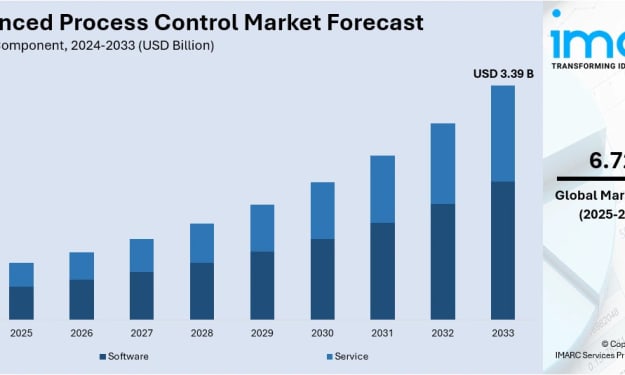
Rising manufacturing complexity, adoption of Industry 4.0, demand for real-time optimization, energy efficiency goals, and AI-driven analytics are accelerating advanced process control adoption across process-intensive industries. According to IMARC Group's latest research publication, the global advanced process control market size reached USD 1.83 Billion in 2024. Looking forward, IMARC Group expects the market to reach USD 3.39 Billion by 2033, exhibiting a growth rate (CAGR) of 6.72% during 2025-2033.
By Andrew Sullivanabout 23 hours ago in Futurism
Electric School Bus Market: Clean Mobility Initiatives, Fleet Electrification & Market Growth
According to IMARC Group's latest research publication, The global electric school bus market size was valued at USD 35.5 Billion in 2024. Looking forward, IMARC Group estimates the market to reach USD 335.3 Billion by 2033, exhibiting a CAGR of 28.33% during 2025-2033.
By James Whitman7 days ago in Futurism
Free £5 voucher
Dear fellow Beckenham resident, Anyone else reading this may need to adapt for context I thought you would be interested to know that Tesco Elmers End is offering a free £5 (or more) voucher to any Beckenham resident. All you need to do to get this amazing offer is to make a complaint through their new, super-sexy, high-tech, AI chatbot service.
By Raymond G. Taylor6 days ago in Futurism
~ Fired ~
— Ai Intrusion ~ Are you Next ~ Is Ai Evolution after your job? — Few workplaces haven't been affected. Ai is in supermarkets, at doctors' offices, and even monitoring farms. I just can't think of anything this machine is not getting into, can you? For instance: Education ~ Law and Tech jobs will one day have a major influence or be taken over by these inanimate machines, with accuracy and vigor. From mechanics' diagnoses to a wide variety of everyday jobs, including fast food workers, with this input having the ability to cut their unnecessary work hours. I'm certain all of us have been touched by this with our short stories and colorful headings, have you? Even comments are very questionable 'Non-Robot' insertions.
By Jay Kantor6 days ago in Journal



Comments
There are no comments for this story
Be the first to respond and start the conversation.