
AI-Enabled Identity Management in Healthcare Transforming Digital Trust
Meeting HIPAA and GDPR Requirements with Identity Management


The healthcare industry is rapidly evolving with digital-first ecosystems, AI-powered platforms, and interoperable health systems. As hospitals, clinics, payers, and digital health startups continue to adopt advanced technologies, one foundational challenge remains constant—securely managing identities. Identity management in healthcare has become a critical pillar for ensuring patient safety, regulatory compliance, and seamless access to care across complex digital environments.
From electronic health records to telemedicine apps and wearable integrations, healthcare systems now interact with multiple users, devices, and platforms simultaneously. Without a robust identity framework, organizations risk data breaches, operational inefficiencies, and compromised patient trust. This is where modern identity management strategies, backed by AI and healthcare-focused app development expertise, are redefining how digital healthcare operates.
Understanding Identity Management in Healthcare
Identity management in healthcare refers to the processes, technologies, and policies used to accurately identify patients, providers, staff, and systems while controlling access to sensitive medical data. Unlike other industries, healthcare identity management must handle highly fragmented data, strict privacy regulations, and life-critical workflows.
Patients often interact with multiple healthcare entities such as hospitals, labs, pharmacies, and insurance providers. Each interaction generates data that must be correctly attributed to the right individual. Errors in identity matching can lead to duplicate records, delayed treatments, or even medical mistakes.
Modern healthcare identity management systems go beyond simple authentication. They incorporate patient identity matching, role-based access control, consent management, and secure data exchange to ensure that the right people access the right information at the right time.
Why Identity Management Matters More Than Ever in Healthcare
Healthcare organizations are among the most targeted sectors for cyberattacks globally. At the same time, regulatory frameworks demand stronger controls over patient data usage and sharing. Identity management in healthcare sits at the intersection of security, compliance, and user experience.
As digital health adoption accelerates, identity systems must scale across mobile apps, cloud platforms, AI engines, and third-party integrations. A weak identity framework can expose systems to breaches, insider threats, and compliance penalties, while a strong one enables innovation without compromising trust.
Real-Life Challenges Healthcare Organizations Face
Healthcare identity challenges are deeply rooted in operational complexity. Patient records are often fragmented across departments and systems, leading to mismatched or duplicate identities. Staff members require different access levels based on roles, shifts, and responsibilities. Patients expect seamless digital experiences without repeated verification steps.
In addition, healthcare organizations must comply with regulations such as HIPAA, GDPR, and regional health data protection laws. These regulations require strict identity verification, audit trails, and access controls. Without a well-designed identity management strategy, meeting these requirements becomes resource-intensive and error-prone.
The Role of AI in Modern Healthcare Identity Systems
Artificial intelligence is reshaping identity management in healthcare by improving accuracy, automation, and fraud detection. AI-driven identity solutions can analyze patterns across large datasets to detect duplicate records, flag anomalies, and continuously improve identity matching.
Machine learning algorithms help healthcare organizations reduce patient matching errors by analyzing demographic data, behavioral signals, and historical records. AI also supports adaptive authentication, where access requirements change dynamically based on user behavior and risk levels.
In digital health applications, AI-enabled identity systems enhance user experience by reducing friction while maintaining high security standards. This balance is critical for patient engagement and clinical efficiency.
How Identity Management Supports Interoperability
Interoperability is a cornerstone of modern healthcare, enabling data exchange between different systems and providers. Identity management in healthcare plays a vital role in making interoperability secure and reliable.
Accurate identity resolution ensures that patient data shared across platforms is correctly matched and contextualized. This is especially important in telemedicine, remote patient monitoring, and value-based care models where data flows continuously between stakeholders.
Without strong identity management, interoperability efforts can introduce risks rather than benefits. Secure identity frameworks enable healthcare organizations to unlock the full potential of connected care while safeguarding sensitive information.
Identity Management and Patient Trust
Trust is fundamental in healthcare. Patients expect their personal and medical data to remain private, secure, and accessible only to authorized individuals. Identity management in healthcare directly influences patient confidence in digital health platforms.
When patients experience secure logins, transparent consent controls, and consistent data access across providers, trust grows. Conversely, identity-related errors or breaches can severely damage an organization’s reputation and patient relationships.
Healthcare app developers must design identity systems that prioritize both security and usability. This patient-centric approach is essential for long-term digital health adoption.
Key Components of an Effective Healthcare Identity Strategy
A robust identity management strategy in healthcare includes accurate patient identity matching, secure authentication, authorization controls, and continuous monitoring. It must also support consent management and audit logging to meet compliance standards.
Healthcare organizations benefit from identity systems that integrate seamlessly with electronic health records, telehealth platforms, and third-party services. Scalability and flexibility are essential, as healthcare ecosystems continue to evolve with new technologies and care models.
By aligning identity management with clinical and operational goals, healthcare providers can reduce administrative burden and improve care delivery.
The Impact of Identity Management on Digital Health Outcomes
Effective identity management in healthcare contributes directly to improved outcomes. Accurate identity resolution reduces medical errors, enhances care coordination, and supports data-driven decision-making. Secure access controls protect patient data while enabling clinicians to work efficiently.
In digital health apps, identity systems influence user adoption and retention. Patients are more likely to engage with platforms that feel secure, intuitive, and reliable. Providers benefit from streamlined workflows and reduced risk exposure.
As healthcare continues to digitize, identity management becomes a strategic enabler rather than a technical necessity.
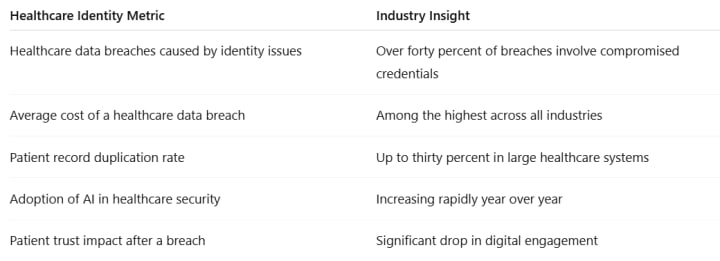
Industry Statistics Highlighting the Need for Strong Identity Management
Aligning Identity Management With Google E-E-A-T Principles
From an SEO and content perspective, identity management in healthcare aligns strongly with Google’s E-E-A-T framework. Experience is demonstrated through real-world healthcare challenges and implementations. Expertise is reflected in the technical and regulatory depth required to design identity systems. Trustworthiness is built through a focus on security, compliance, and patient safety.
Healthcare content that addresses identity management must be accurate, practical, and grounded in industry realities. This approach benefits both users and search engines by delivering genuine value.
The Future of Identity Management in Healthcare
Looking ahead, identity management in healthcare will continue to evolve with advancements in AI, biometrics, and decentralized identity models. Technologies such as blockchain-based identity and zero-trust architectures are gaining attention for their potential to enhance security and patient control.
Healthcare organizations that invest in future-ready identity systems will be better positioned to adopt emerging care models, expand digital services, and maintain compliance in a changing regulatory landscape.
App development companies with deep healthcare expertise will play a crucial role in shaping this future by building identity solutions that are secure, scalable, and patient-centric.
Conclusion
Identity management in healthcare is no longer optional—it is a foundational requirement for secure, efficient, and trustworthy digital health ecosystems. As healthcare systems become more interconnected and data-driven, identity management ensures that innovation does not come at the cost of security or patient trust.
With its strong background in the healthcare niche, companies like IBM, TCS, Infosys, Appinventiv, Nvidia continues to support healthcare organizations in building robust identity frameworks that align with real-world needs and regulatory standards. By combining AI-driven technologies with healthcare-specific expertise, modern identity management solutions are transforming how care is delivered, accessed, and protected.
About the Creator
Keep reading
More stories from Steve Waugh and writers in Futurism and other communities.
AI-Driven Data Mining in Healthcare and Its Role in Modern EMR-Driven Patient Care
Healthcare systems generate massive volumes of data every single day, from electronic medical records and diagnostic images to wearable device metrics and patient engagement apps. Making sense of this data is no longer optional. Data mining in healthcare has become a foundational capability for organizations that want to improve patient outcomes, reduce operational inefficiencies, and enable evidence-based decision-making.
By Steve Waugh4 days ago in Futurism
Blockchain Gaming Market Trends: Interoperable NFTs, Layer-2 Scaling & Industry Outlook to 2033
Rising consumer demand for true digital ownership, innovative play-to-earn models, and seamless NFT integration are reshaping the gaming landscape, fueled by blockchain transparency, growing venture capital investments, and expanding Web3 gaming platforms. According to IMARC Group's latest data, the global blockchain gaming market size was valued at USD 24.4 Billion in 2025. Looking forward, IMARC Group estimates the market to reach USD 1,172.8 Billion by 2033, exhibiting a CAGR of 62.59% from 2026-2033.
By Andrew Sullivanabout 20 hours ago in Futurism
The concept of human reproduction in space is rapidly becoming a reality.
One uncomfortable subject is becoming more difficult to ignore as spaceflight transitions from infrequent government missions to something more akin to everyday travel and employment: what happens to human reproductive health when we are away from Earth?
By Francis Damia day ago in Futurism
Writing About Writing: The Rainbow Trap
The good thing about living in modern times is that LGBTQ representation in media is increasing. Not just in niche and Independant media, either, but also in mainstream media. Books, movies, TV shows, comics... they're finally catching on that LGBTQ+ people form a significant part of their audience, and deserve to see themselves on screen and in fiction, not just as victims in documentaries and true crime shows.
By Natasja Rose3 days ago in Writers


Comments
There are no comments for this story
Be the first to respond and start the conversation.