
AI startups bring Socrates and free AI to higher education
AI startups OpenAI and Anthropic are competing for college students’ attention with free AI

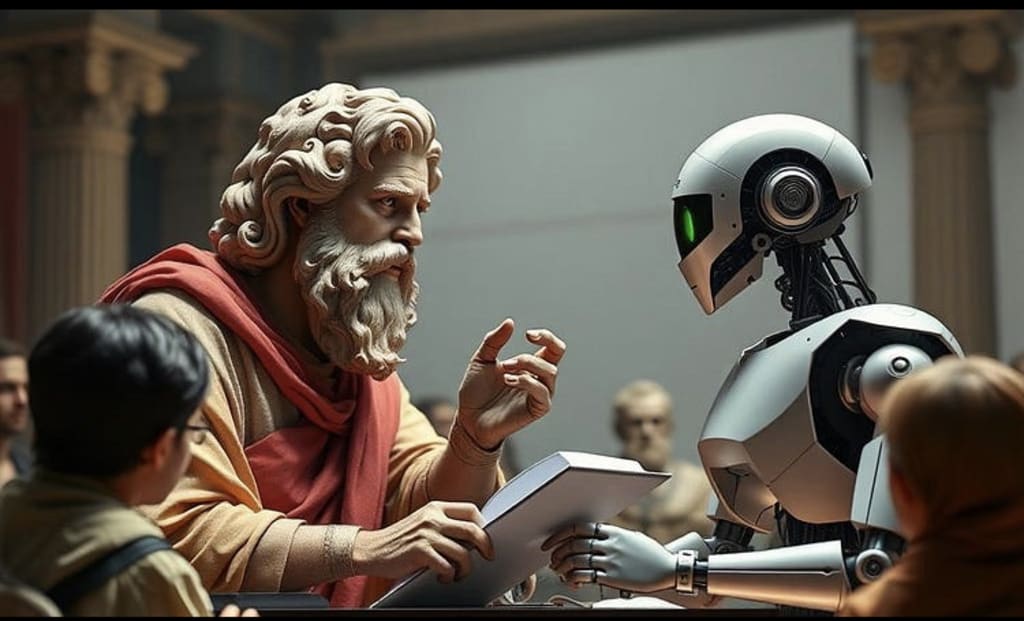
When Socrates taught his students through his questioning method centuries ago in Ancient Greece, he never thought he would be an integral part of an Artificial Intelligence tool used in education.
Socratic questioning in the 21st century has been reimagined to help college students to develop their critical thinking skills with a twist: using AI.
***
This week has been a busy one for higher education with the announcements of two leading AI startups: OpenAI and Anthropic.
First, Anthropic launched Claude for Education, a university-focused version of its chatbot and announced its partnership with Northeastern University, London School of Economics (LSE), and Champlain College. Anthropic also partnered with Internet2, which builds university technology infrastructure, and with Instructure, the maker of Canvas in order to increase equitable access to tools that support the integration of AI in universities.
According to an Anthropic’s press release, the new ‘Learning Mode’ feature is set to change the way Claude interacts with students by using Socratic questioning in order to guide students through problems rather than just providing answers.
Socratic questioning is an educational method named after Greek philosopher Socrates that focuses on discovering answers by asking questions of students. Examples of these questions can be “How would you approach this? or “What evidence supports your conclusion?” By working around these questions Claude helps students to develop critical thinking skills.
“As social scientists, we are in a unique position to understand and shape how AI can positively transform education and society,” said Larry Kramer, President and Vice-Chancellor of LSE in Anthropic’s press release.
Whilst Anthropic takes the Socratic approach to win the AI college war, OpenAI launched ChatGPT Edu already in May 2024. Of course, this came with multiple college partnerships and last month the startup committed $50 million to accelerate AI research across 15 colleges through its NextGenAI Consortium initiative.
Earlier this year, OpenAI partnered with California State University committing to bring ChatGPT Edu to all CSU campuses. In proper AI college wars’ style, OpenAI announced this week that ChatGPT Plus ($20/month) will be offered free of charge for all U.S. and Canadian college students throughout the month of May.
ChatGPT Plus includes features such as large files uploads, Deep research, and advanced voice features, all of which can help students through finals.
VP of Education at OpenAI Leah Belsky said in a statement: “Today’s college students face enormous pressure to learn faster, tackle harder problems, and enter a workforce increasingly shaped by AI. Supporting their AI literacy means more than demonstrating how these tools work.”
I have lived and followed the adoption and evolution of technology in education for practically all my life, first as teacher and early adopter of education technology, then as a reporter and journalist working as a staff member of a publication specialising on technology in higher education, I can say that like it or not, AI in education is here to stay and well on its way to shape the way the next generation interacts and works with AI.
From the two options discussed above, my preference would be to favour Anthropic’s Claude because of its Socratic questioning approach. Developing critical thinking is one thing that still differentiates a human from a machine. As AI evolves into the future, this might also change. For now, I believe introducing Socratic questioning in AI for education develops human intelligence rather than shutting it down, as it could happen.
Anthropic is an Artificial Intelligence startup company founded in 2021 with headquarters in San Francisco, California.
OpenAI is a leading AI startup company founded in 2015 and headquartered in San Francisco, California.
About the Creator
Susan Fourtané
Susan Fourtané is a Science and Technology Journalist, a professional writer with over 18 years experience writing for global media and industry publications. She's a member of the ABSW, WFSJ, Society of Authors, and London Press Club.
Reader insights
Outstanding
Excellent work. Looking forward to reading more!
Top insights
Compelling and original writing
Creative use of language & vocab
Easy to read and follow
Well-structured & engaging content
Excellent storytelling
Original narrative & well developed characters
Eye opening
Niche topic & fresh perspectives
Heartfelt and relatable
The story invoked strong personal emotions
Masterful proofreading
Zero grammar & spelling mistakes
On-point and relevant
Writing reflected the title & theme
Keep reading
More stories from Susan Fourtané and writers in Futurism and other communities.
About Binding Prometheus
I want to start actively advocating on behalf of my own work, and the most valuable part of my canon is, without a doubt, Binding Prometheus, the play I have been working on since 2019 and only finished in 2023 as part of my MA. The play itself is an amalgamation of a million different inspirations. On one end, it evokes the Ancient Greek myth-play, deriving its own title from the earliest extant work of Western drama we have, Aeschylus’s Prometheus Bound. On the other end, it borrows significantly from the sci-fi bulwarks from over the years, namely Mary Shelley’s Frankenstein and Karel Capek’s Rossum’s Universal Robots. The play could be an episode of Black Mirror, I fear. I don’t know. I’ve only ever seen one episode of Black Mirror.
By Steven Christopher McKnight16 days ago in Futurism




Comments (5)
I enjoyed your article about AI. I had a Xray last week. AI Xray was quick and correct.
It is a fascinating article. Unique use for AI
Oh wow, I didn't even know about ChatGPT Edu. There's a small typo in this sentence: “As social scientists, we are in a unique position to understand and. shpe how AI can positively transform education and society,”
This was such an interesting article Susan. You're right - AI is here to stay. I must admit, I like the idea of using it to develop critical thinking skills (I think that's something that's missing everywhere right now) rather than just regurgitating an answer. Well done and thanks - you've definitely made me see a positive side to AI.
This is a fascinating article. Thank you again, Susan for another great read.