
“AI Replacing Jobs? These 7 Careers Are Already Dying”
"From Creatives to Coders—Nobody’s Safe Anymore"
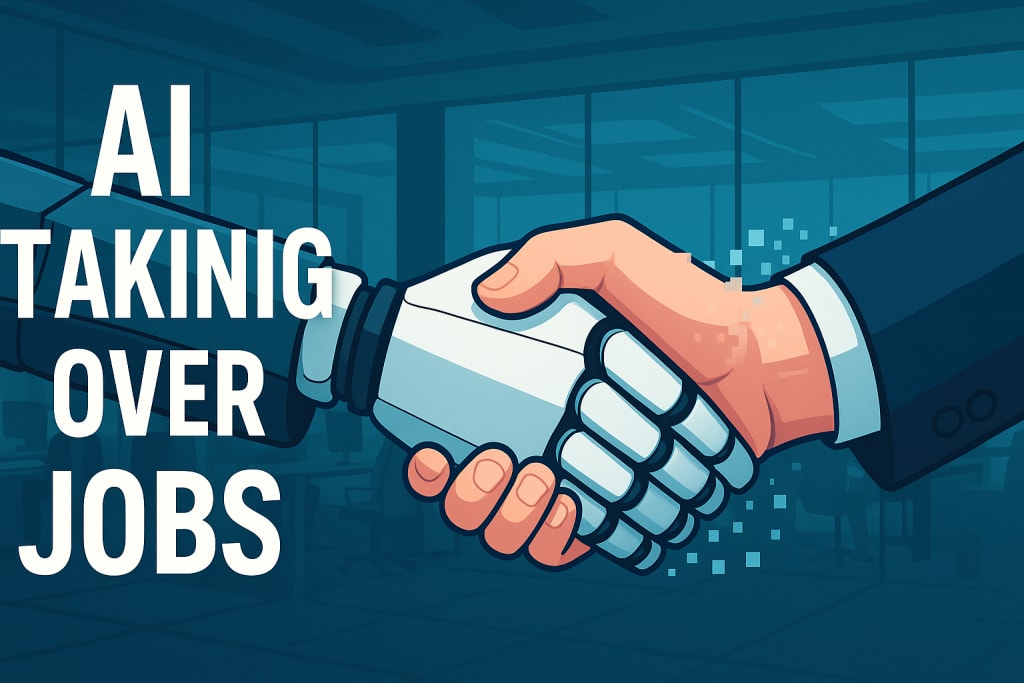
Artificial Intelligence was once a distant sci-fi fantasy. Today, it’s your co-worker. Tomorrow? It could be your replacement.
While AI promises convenience and progress, it’s also causing a silent disruption across industries. We’re not talking decades down the road—it’s happening now. Here are 7 careers already on life support thanks to AI, automation, and machine learning.
---
1. Customer Service Agents
ChatGPT, Google Bard, and a swarm of chatbots are now handling support tickets, live chats, and phone calls.
Companies are discovering that AI works 24/7, never takes lunch breaks, and never gets emotional. Human agents are being downsized or outsourced—and in some sectors, eliminated entirely.
---
2. Entry-Level Coders & Developers
You’d think coders would be safe. But low- to mid-level programming tasks are now being handled by AI like GitHub Copilot and ChatGPT’s code interpreter.
While expert developers are still needed, junior roles are shrinking. Startups now build MVPs with skeleton crews and AI tools, bypassing the need for large dev teams.
---
3. Content Writers & Copywriters
Need a blog post, product description, or ad copy? AI can generate it in seconds.
Tools like Jasper, Copy.ai, and ChatGPT are churning out SEO content at scale—fast, cheap, and often good enough. Freelancers are already feeling the squeeze, and agencies are shifting budgets to AI subscriptions over human writers.
---
4. Translators & Transcribers
Real-time translation tools like DeepL and Google Translate, powered by neural networks, are getting scarily accurate.
Add to that AI transcription tools like Otter.ai and Whisper, and you’ve got a full-fledged replacement for many language service roles. What once required human nuance now takes milliseconds and costs cents.
---
5. Graphic Designers (Entry-Level)
With tools like Midjourney, DALL·E, and Canva AI, creating logos, banners, and social media graphics is becoming a drag-and-drop job.
Freelancers offering basic design services on Fiverr or Upwork are struggling to compete—not just on price, but on speed and volume. Brands now generate hundreds of visuals in a single click.
---
6. Paralegals and Legal Researchers
AI in law? Absolutely.
Tools like Harvey.ai and Casetext are analyzing case law, generating contracts, and researching precedents faster than any intern. Law firms are using AI to reduce billable hours and minimize junior staff.
---
7. Data Entry Clerks
Spreadsheets, databases, form-filling—these are the first to go in any AI revolution.
OCR tech, RPA bots, and AI data tools now handle repetitive data tasks with nearly 100% accuracy. Entire departments that once focused on manual input are being automated out of existence.
---
Not Just Blue Collar Anymore
The first wave of AI disruption hit factories and call centers. This wave? It’s hitting laptops and white collars.
The reality is harsh: automation doesn’t discriminate. If your job is repetitive, rule-based, or digital—it’s vulnerable.
---
What You Can Do About It
It’s not all doom and gloom. Here’s how to stay ahead:
Learn AI: Use it before it uses you. Familiarize yourself with tools in your industry.
Shift to Strategy: AI can do tasks, but not judgment. Move up the value chain.
Build a Personal Brand: Become known for insights, not just output.
Focus on Human Skills: Empathy, ethics, storytelling—AI can’t replicate these (yet).
---
Final Thoughts: Adapt or Fade
AI is not the enemy. Stagnation is. The workforce is evolving, and the people who thrive will be those who embrace the shift, not fear it.
So ask yourself: are you replaceable? Or are you ready to lead the next wave?
About the Creator
Keep reading
More stories from GadgetGround and writers in Futurism and other communities.
“The Rise and Fall of Instagram: Is It Already Too Late?”
It was once the crown jewel of social media. A platform where filters, likes, and hashtags ruled our digital lives. But today, Instagram feels… different. Cluttered. Confused. And maybe, just maybe—past its prime.
By GadgetGround8 months ago in Futurism
About Binding Prometheus
I want to start actively advocating on behalf of my own work, and the most valuable part of my canon is, without a doubt, Binding Prometheus, the play I have been working on since 2019 and only finished in 2023 as part of my MA. The play itself is an amalgamation of a million different inspirations. On one end, it evokes the Ancient Greek myth-play, deriving its own title from the earliest extant work of Western drama we have, Aeschylus’s Prometheus Bound. On the other end, it borrows significantly from the sci-fi bulwarks from over the years, namely Mary Shelley’s Frankenstein and Karel Capek’s Rossum’s Universal Robots. The play could be an episode of Black Mirror, I fear. I don’t know. I’ve only ever seen one episode of Black Mirror.
By Steven Christopher McKnight17 days ago in Futurism
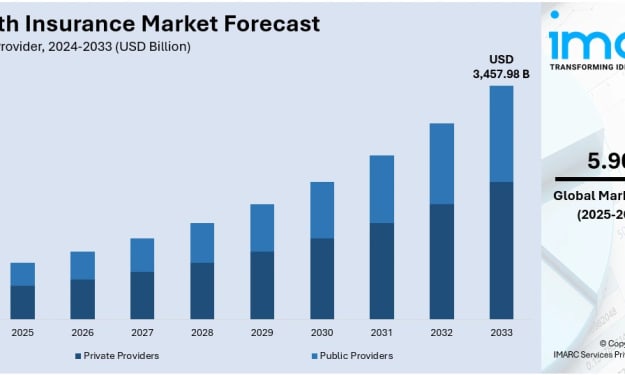
Health Insurance Market: Preventive Care Focus, Value-Based Models & Industry Trends
According to IMARC Group's latest research publication, global health insurance market size reached USD 1,949.84 Billion in 2024. Looking forward, IMARC Group expects the market to reach USD 3,457.98 Billion by 2033, exhibiting a growth rate (CAGR) of 5.90% during 2025-2033.
By Andrew Sullivan5 days ago in Futurism


Comments (1)
AI's impact is huge. Customer service agents are being replaced left and right. And content writers are feeling the heat too. I wonder how long it'll be before even more jobs are affected. Do you think there are any industries that'll be able to fully resist AI's takeover? It's not just entry-level coders getting hit. Graphic designers are seeing changes too. How do you think these professionals can upskill to stay relevant? Maybe focus on more complex, creative aspects that AI can't easily replicate?