
AI-Powered Soldiers: The Future of War or a Dangerous Illusion?
How humanoid robots and autonomous weapons could reshape the battlefield of the 2030s. By Muhammad Riaz

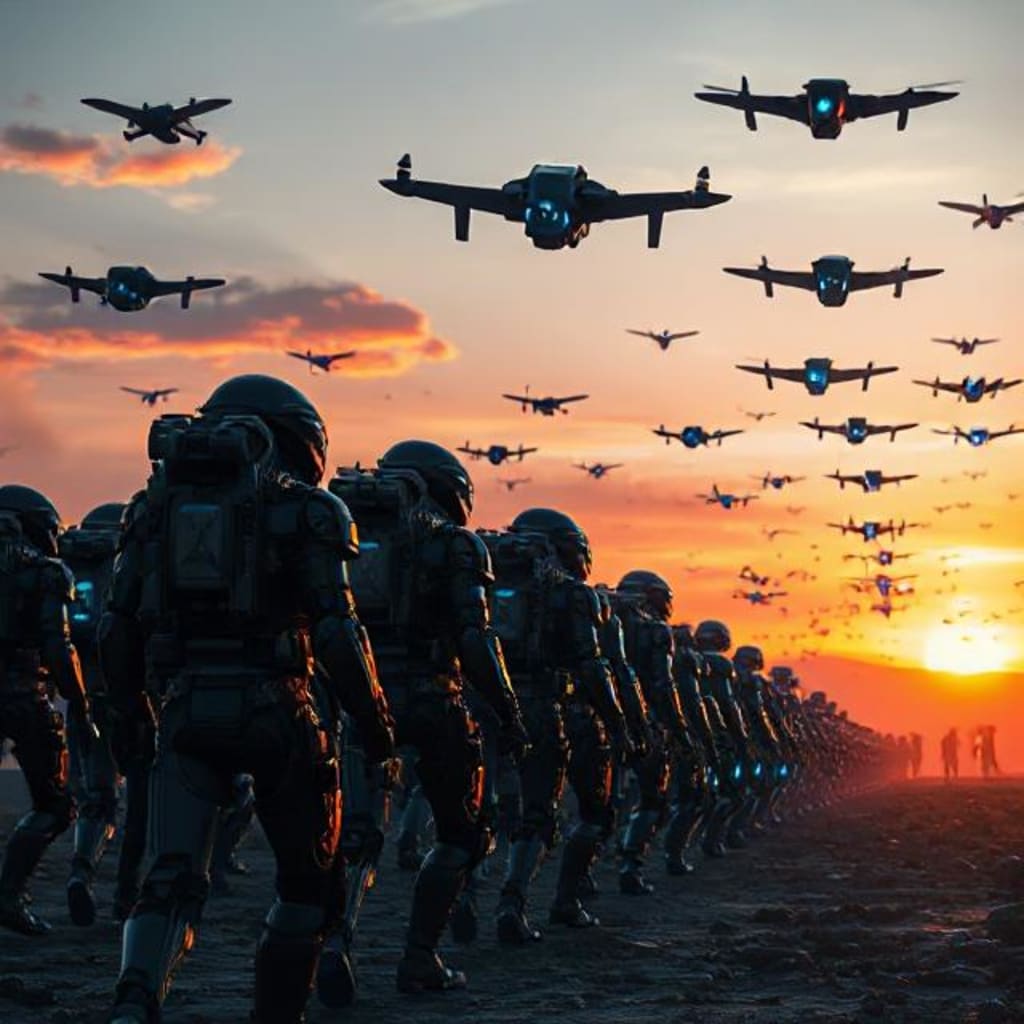
AI-Powered Soldiers: Fact or Science Fiction?
The idea of robot soldiers has long been a staple of science fiction, from The Terminator to RoboCop. But in 2025, the line between fiction and reality is blurring fast. Around the world, governments and defense companies are pouring billions into artificial intelligence, autonomous drones, and humanoid robotics designed for combat.
The result is a growing debate: Are AI-powered soldiers the inevitable future of warfare, or a dangerous illusion that could spiral out of control?
---
The Rise of Robotic Warfare
For decades, military robots were mostly used for support—bomb disposal units, surveillance drones, or supply carriers. But recent advances in AI, machine vision, and robotics are pushing machines closer to the frontlines.
Autonomous Drones: Already used in Ukraine and the Middle East, drones can now select and strike targets with minimal human input.
Robotic Dogs: Companies like Boston Dynamics have adapted quadruped robots for carrying gear or mounting weapons.
Humanoid Prototypes: Several nations are experimenting with humanoid robots that can carry heavy loads, patrol bases, or simulate combat scenarios.
In 2023, footage of robot dogs with mounted rifles went viral, sparking worldwide concern. In 2024, reports surfaced of AI-driven drones conducting coordinated strikes without direct human command. The technology is no longer hypothetical—it is here.
---
Why Militaries Want Robot Soldiers
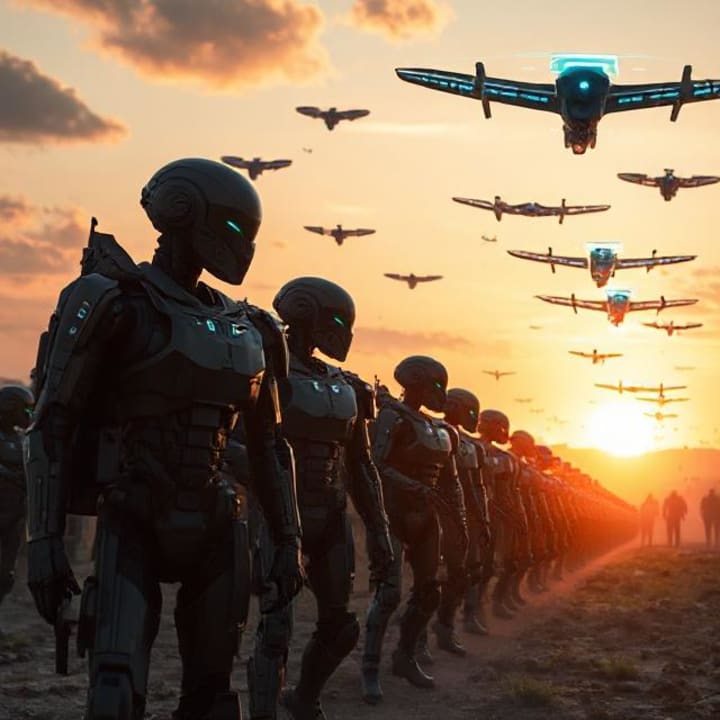
The logic is straightforward:
No fear, no fatigue: Robots don’t panic, tire, or suffer trauma.
Replaceable: Unlike human lives, machines can be replaced.
Extreme Environments: Robots can function in radiation zones, toxic areas, or outer space.
Faster Decisions: AI can analyze threats and react in milliseconds.
In theory, AI soldiers could reduce human casualties while making militaries more efficient and effective. Some even argue they could make wars shorter by overwhelming enemies quickly.
---
The Risks of Autonomous Combat
But the dangers are just as great, if not greater. Critics warn of scenarios where machines make life-and-death decisions without human oversight.
1. Hacking Risks: What if enemy hackers take control of AI soldiers?
2. Ethical Dilemmas: Should machines decide when to kill? Who is accountable if mistakes happen?
3. Civilian Casualties: AI may misidentify targets, leading to disasters.
4. Arms Race: If one country deploys robot soldiers, others will follow, escalating conflict.
The United Nations has already debated banning “killer robots” under international law, but progress is slow. Meanwhile, companies and militaries are racing ahead.
---
China, USA, and Russia: The Big Players
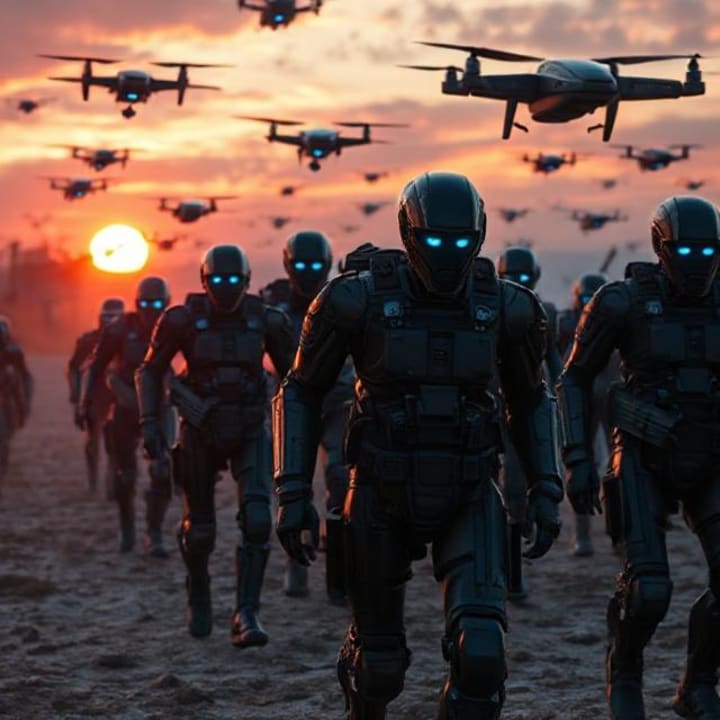
The new arms race is being led by the world’s superpowers:
United States: DARPA is funding next-generation robotic systems, from drone swarms to exoskeleton suits for soldiers. The U.S. military is also testing AI battle command systems to process data faster than human generals.
China: Beijing is rapidly developing AI-powered surveillance and robotic systems, often blending civilian and military research. Analysts believe China may soon field fully autonomous drones in large numbers.
Russia: Known for its experimental military tech, Russia unveiled the “Uran-9” robotic tank and has tested humanoid robots like “Fedor” for combat assistance.
This competition mirrors the nuclear arms race of the 20th century—except this time, the weapon is intelligent.
---
Science Fiction vs. Reality
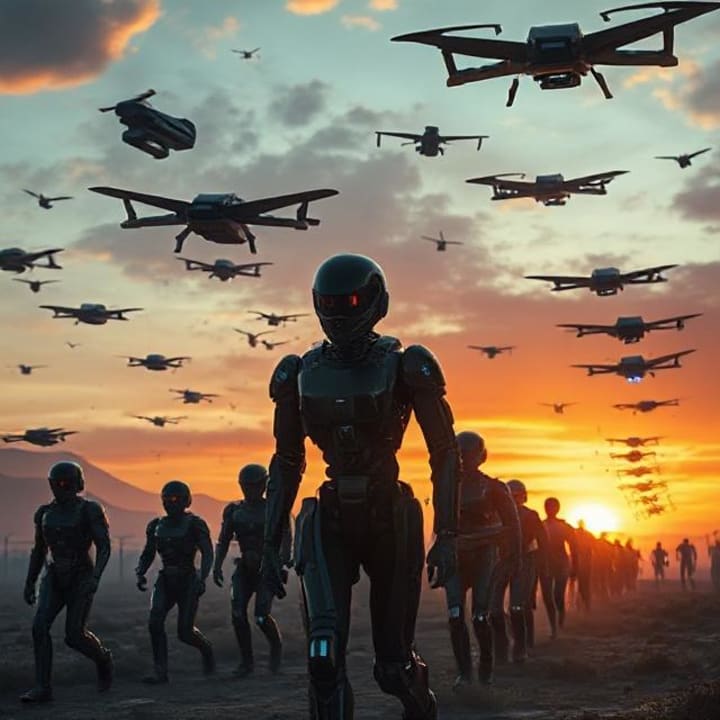
Hollywood often imagines armies of humanoid robots marching across battlefields. In reality, the first wave of AI soldiers may look less dramatic but no less effective:
Swarms of drones overwhelming defenses.
Robotic dogs sniffing out explosives.
Autonomous turrets guarding borders.
Human soldiers paired with AI assistants in exoskeletons.
Full humanoid robot soldiers may still be decades away, but the building blocks are already here. In fact, military analysts predict that by the 2030s, AI systems may command entire units of machines—blurring the role of human officers.
---
Ethical and Religious Concerns
Beyond politics, AI soldiers raise profound moral questions. Can machines truly understand concepts like mercy, honor, or justice? Many ethicists argue that war, already dehumanizing, could become completely devoid of humanity.
Religious scholars also weigh in: if only God gives and takes life, should machines be allowed to decide? For billions worldwide, the use of autonomous killing machines crosses a moral red line.
---
Could AI Soldiers Make War Obsolete?
Some optimists argue the opposite—that AI soldiers could eventually make war less deadly. If machines fight machines, fewer human lives may be lost. In theory, wars could be resolved by robotic battles rather than mass casualties.
But critics counter that lowering the “human cost” of war may make conflicts more common. If leaders don’t risk their own citizens, they may be more willing to launch wars.
---
The Future: Symbiosis or Chaos?
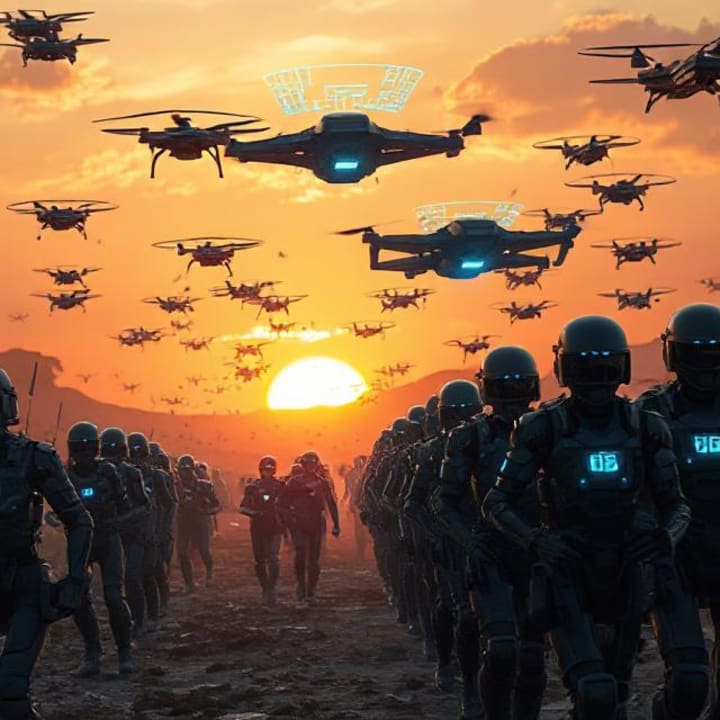
The likely future may not be all-robot or all-human, but a hybrid battlefield. Human soldiers augmented with AI exoskeletons and assisted by robotic allies could dominate wars in the 2030s.
Already, companies are developing brain-computer interfaces (like Elon Musk’s Neuralink) that could allow soldiers to control drones or robotic units with thought alone. This would blur the line between man and machine even further.
The question is not just technological, but philosophical: Will we control AI, or will AI control us?
---
Conclusion
AI-powered soldiers stand at the edge of possibility—both awe-inspiring and terrifying. They represent humanity’s attempt to take war beyond flesh and blood, into a world of code, circuits, and algorithms.
Whether this future will mean safer wars or endless conflict depends on the choices we make today. For now, the dream of robot soldiers remains half fact, half fiction—but every year, fiction looks more like reality.
The age of the AI warrior is coming. The only question is: Will we be ready for it?
---
SEO Keywords: AI soldiers, robot soldiers 2030, killer robots, autonomous weapons, military robots, AI war future, humanoid robot army, DARPA AI military projects, China AI warfare, future of war technology.
---
About the Creator
Muhammad Riaz
- Writer. Thinker. Storyteller. I’m Muhammad Riaz, sharing honest stories that inspire, reflect, and connect. Writing about life, society, and ideas that matter. Let’s grow through words.
Keep reading
More stories from Muhammad Riaz and writers in Futurism and other communities.
China’s Bold Plan: Building a Permanent Moon Base by 2030
China’s Plan for a Moon Base by 2030 In the 20th century, the United States won the race to land humans on the Moon. Now, in the 21st century, China is preparing to win the race to stay there. The Chinese government, through its rapidly advancing China National Space Administration (CNSA), has revealed ambitious plans to construct a permanent lunar base by 2030. This project is more than just a demonstration of national pride—it could redefine global leadership in space exploration.
By Muhammad Riaz5 months ago in Futurism
About Binding Prometheus
I want to start actively advocating on behalf of my own work, and the most valuable part of my canon is, without a doubt, Binding Prometheus, the play I have been working on since 2019 and only finished in 2023 as part of my MA. The play itself is an amalgamation of a million different inspirations. On one end, it evokes the Ancient Greek myth-play, deriving its own title from the earliest extant work of Western drama we have, Aeschylus’s Prometheus Bound. On the other end, it borrows significantly from the sci-fi bulwarks from over the years, namely Mary Shelley’s Frankenstein and Karel Capek’s Rossum’s Universal Robots. The play could be an episode of Black Mirror, I fear. I don’t know. I’ve only ever seen one episode of Black Mirror.
By Steven Christopher McKnight17 days ago in Futurism
Why New Telescope Data Is Once Again Questioning the Age of the Universe
For decades, the age of the Universe seemed like a settled question. According to the standard cosmological model, known as Lambda-CDM, the Universe is approximately 13.8 billion years old. This number appears in textbooks, documentaries, and scientific papers as a near-cosmic constant — stable, precise, and well supported by observations.
By Holianyk Ihor6 days ago in Futurism


Comments
There are no comments for this story
Be the first to respond and start the conversation.