
Why New Telescope Data Is Once Again Questioning the Age of the Universe
Space

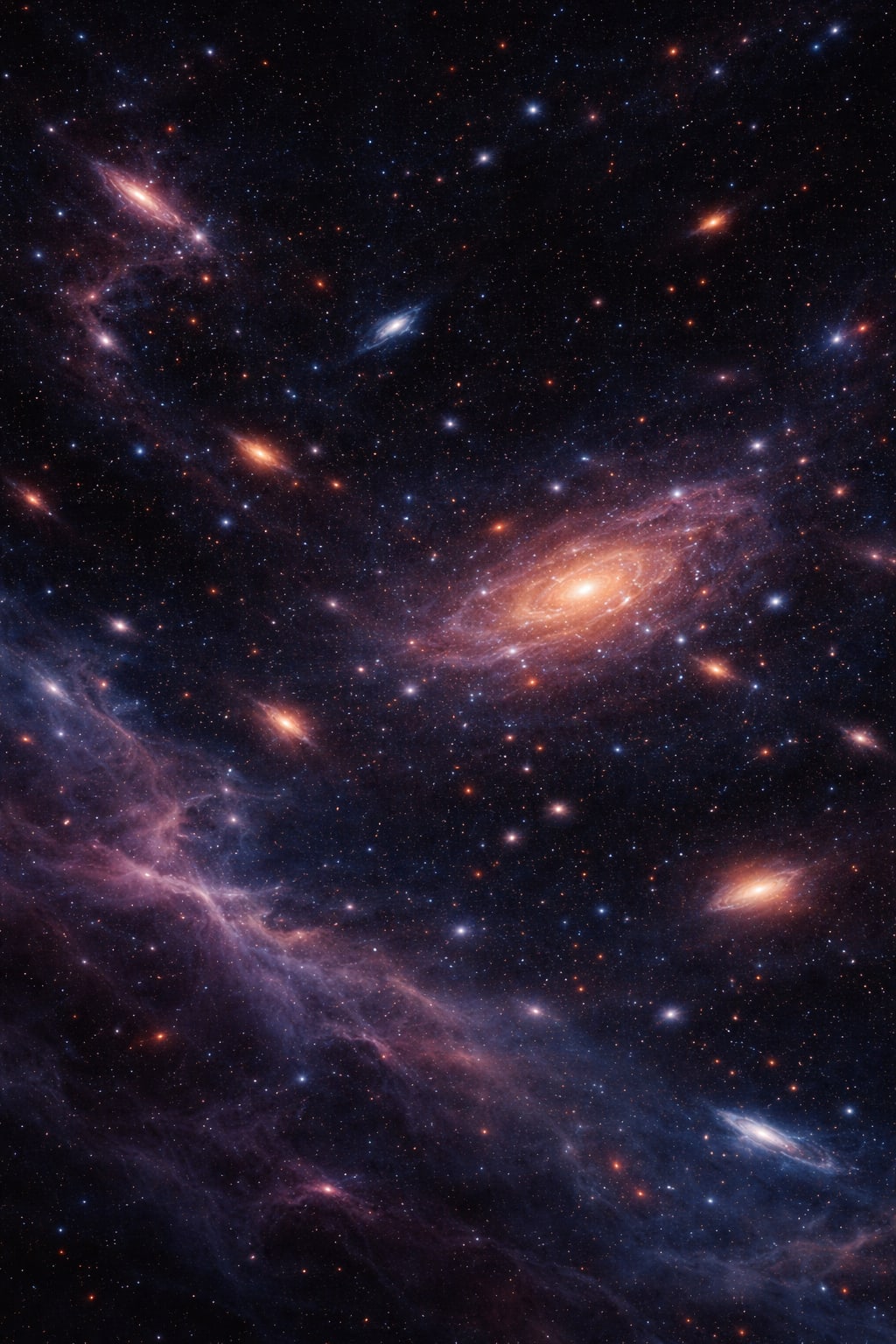
For decades, the age of the Universe seemed like a settled question. According to the standard cosmological model, known as Lambda-CDM, the Universe is approximately 13.8 billion years old. This number appears in textbooks, documentaries, and scientific papers as a near-cosmic constant — stable, precise, and well supported by observations.
Yet in recent years, that confidence has begun to crack.
Thanks to a new generation of ultra-powerful telescopes and increasingly precise measurements, astronomers are once again facing an uncomfortable possibility: our estimate of the Universe’s age may be incomplete, or even wrong. The issue is not based on a single strange observation, but on a growing body of evidence that does not fully align with our current understanding of how the Universe evolved.
How We Measure the Age of the Universe
The age of the Universe is not measured directly. Instead, it is inferred from how fast the Universe is expanding today. This expansion rate is described by the Hubble constant. In simple terms, if we know how quickly galaxies are moving away from each other now, we can run the cosmic clock backward to estimate when everything began — the Big Bang.
For a long time, different methods of measuring the Hubble constant produced results that were close enough to agree. Observations of the cosmic microwave background — the faint afterglow of the early Universe — suggested one value. Measurements based on nearby galaxies, supernova explosions, and variable stars suggested another, slightly higher value. The discrepancy existed, but it was small enough to ignore.
That is no longer the case.
The Growing “Hubble Tension”
Modern telescopes have turned a mild disagreement into what scientists now call the Hubble tension. Measurements of the early Universe, especially those derived from cosmic background radiation, still support an age of about 13.8 billion years. However, observations of the more recent Universe consistently point to a faster expansion rate.
A faster expansion implies that the Universe reached its current size in less time, which would mean it is younger than expected — in some estimates, closer to 12.5 or 13 billion years old.
In cosmology, this difference is enormous. It suggests that either one of the measurement techniques is flawed, or that the underlying model of the Universe is missing something fundamental.
James Webb and a Universe That Grew Up Too Fast
One of the most surprising contributions to this debate has come from the James Webb Space Telescope. Designed to peer deeper into space and further back in time than any telescope before it, Webb has revealed galaxies that appear far more mature than expected for their age.
Some of these galaxies formed just a few hundred million years after the Big Bang, yet they already show:
- large stellar masses,
- well-defined structures,
- and intense star formation.
According to existing models, the early Universe should have been chaotic and relatively simple. Matter needed time to clump together, form stars, and build galaxies. Webb’s observations suggest that this process happened much faster than theory allows.
This creates a troubling choice: either galaxies can form far more efficiently than we thought, or the Universe itself is older than our current timeline allows.
Stars That Seem Older Than the Universe
The problem does not end with distant galaxies. Observations within our own Milky Way have identified extremely ancient stars whose estimated ages come dangerously close to — or even slightly exceed — the accepted age of the Universe when uncertainties are included.
While such cases were once dismissed as modeling errors, improved data and refined techniques are making them harder to ignore. When multiple independent measurements all point toward the same tension, scientists must take the possibility seriously.
Possible Explanations — From Conservative to Radical
Researchers are now exploring several potential explanations:
- One possibility is hidden systematic errors. Perhaps one method of measuring cosmic distances contains an unrecognized bias. This would be the simplest solution, and many scientists hope it is the correct one.
- Another possibility is new physics. Some theories propose that dark energy behaved differently in the early Universe, or that dark matter has properties we do not yet understand. Others suggest that fundamental constants may not be truly constant over cosmic time.
- More radical ideas involve modifying Einstein’s theory of general relativity on very large scales. If gravity behaves differently across billions of light-years, our calculations of cosmic expansion — and age — could be fundamentally flawed.
Finally, the Universe’s expansion history itself may be more complex than a smooth, continuous process. There may have been phases of acceleration or slowdown that current models do not fully capture.
Why This Question Matters
The age of the Universe is not just an abstract number. It defines the timeline for:
- the formation of galaxies,
- the creation of heavy elements,
- the emergence of planets,
- and the potential development of life elsewhere in the cosmos.
If the age changes, the entire story of cosmic evolution must be rewritten.
A New Era of Cosmic Uncertainty
Ironically, the very instruments designed to bring clarity are now revealing how much we still do not understand. In that sense, modern cosmology finds itself in a familiar position. A century ago, the discovery that the Universe was expanding revolutionized science. Today, the next revolution may already be underway.
Whether the final answer confirms the existing age or forces a dramatic revision, one conclusion is unavoidable: the Universe is more complex, more surprising, and less settled than we once believed.
And that may be the most exciting discovery of all.
About the Creator
Keep reading
More stories from Holianyk Ihor and writers in Futurism and other communities.
Hubble Captures Stunning New Images, Including the Largest Known Planet-Forming Disk
More than three decades after its launch, the Hubble Space Telescope continues to deliver discoveries that reshape our understanding of the Universe. Despite the arrival of newer observatories, Hubble remains a cornerstone of modern astronomy, offering a unique view of cosmic phenomena in visible and ultraviolet light. Its latest series of observations has once again demonstrated its scientific power, revealing breathtaking images of one of the largest known protoplanetary disks ever observed, along with dramatic evidence of collisions in young planetary systems.
By Holianyk Ihor2 months ago in Futurism
Saudi Arabia Poultry Market: Food Security, Domestic Production & Growth Outlook
According to IMARC Group's latest research publication, Saudi Arabia poultry market size reached USD 19.0 Billion in 2024. The market is projected to reach USD 26.6 Billion by 2033, exhibiting a growth rate of 3.4% during 2025-2033.
By Shubham Sharma 3 days ago in Futurism
The Death of the Mirror
We are entering the era of the "Second Shadow." For centuries, the human face was the last sanctuary of truth. You could lie with your tongue, but your eyes—those biological lanterns—always carried the heavy scent of reality. But today, the mirror is broken. We have taught the machine to dream of us, and in its dreams, we are perfect, we are terrifying, and most importantly, we are no longer ourselves.
By Alex Sterling 5 days ago in Futurism




Comments
There are no comments for this story
Be the first to respond and start the conversation.