
AI Is TAKING OVER Medicine — And It Could Save (or Endanger) Your Life!
How Artificial Intelligence Is Revolutionizing Healthcare Faster Than Anyone Expected


Imagine walking into a hospital...
And your doctor isn't a doctor at all.
It’s an AI.
Sounds like science fiction?
It’s not.
It’s happening right now.
Artificial Intelligence in medicine is exploding at a pace even experts can barely keep up with. From diagnosing diseases faster than the best specialists to performing robotic surgeries with precision human hands could never match, AI isn’t just helping healthcare — it’s redefining it.
But here’s the kicker:
If we don’t control it properly, it could do as much harm as good.
Let’s dive deep into the astonishing advances, the hidden dangers, and why AI in medicine is the most exciting — and terrifying — innovation of our time.

🚑 The Rise of AI in Healthcare: A New Medical Revolution
Not long ago, AI was limited to Hollywood thrillers and sci-fi novels.
Today?
It’s saving lives across the world.
✅ AI-assisted diagnosis tools are spotting cancer tumors years earlier than human doctors.
✅ Predictive algorithms are identifying patients at risk of strokes, heart attacks, or sepsis before symptoms appear.
✅ Robotic surgeons are performing minimally invasive surgeries with almost zero margin for error.
The numbers are jaw-dropping:
- The AI healthcare market is projected to hit $208 billion by 2030.
- AI algorithms can now diagnose skin cancer with 95% accuracy, better than seasoned dermatologists.
- Google’s DeepMind AI detected over 50 eye diseases better and faster than trained eye specialists.
This isn’t evolution.
It’s a medical revolution.
🧠 How AI Is Already Changing Diagnosis and Treatment
1. Instant, Hyper-Accurate Diagnoses
AI doesn’t get tired.
It doesn’t miss tiny abnormalities on scans at 3 AM.
And it can analyze millions of patient data points in seconds.
Deep Learning algorithms now interpret X-rays, MRIs, CT scans, and pathology slides with pinpoint precision, often finding what even top doctors miss.
For diseases like lung cancer, Alzheimer’s, and breast cancer, early detection makes the difference between life and death.
And AI?
It’s tipping the scales in favor of life.
2. Robot-Assisted Surgeries — Beyond Human Steadiness
Robotic surgery isn’t new. But AI is supercharging it.
Machines like Da Vinci Surgical System are performing delicate operations — like cardiac valve repairs or complex spinal surgeries — with tiny incisions, minimal blood loss, and faster recovery times.
And when AI guides the robotic arms, you get unbelievable precision—smaller scars, shorter hospital stays, and fewer surgical errors.
Future scenario?
A surgeon in New York could operate on a patient in rural Africa, remotely, with robotic AI assistants handling the work.
The future isn't near.
It’s here.

3. Predictive Medicine: Stopping Illness Before It Starts
Imagine knowing you’ll have a heart attack... before you even feel chest pain.
With AI, predictive health is becoming a reality.
By analyzing wearable data (heart rate, blood pressure, sleep patterns) and electronic health records, AI models can spot dangerous patterns early.
Already, hospitals use AI tools that predict sepsis — a deadly infection — hours before doctors notice symptoms. And early treatment could save thousands of lives a year.
Soon, AI could be the difference between waking up healthy — or not waking up at all.
🛑 But There’s a Dark Side: The Risks of AI in Medicine
As powerful as AI is...
It’s not without dangers.
And if we don't act carefully, the same tech saving lives could cost them.
⚠️ 1. Data Privacy Nightmares
AI thrives on data. YOUR data.
Medical records, DNA scans, biometric data from your smartwatch — all of it feeds the machine.
But what happens when this data gets hacked, sold, or abused?
Could insurance companies deny you coverage based on AI predictions?
Could employers fire you based on your "health risk profile"?
Without strict laws, your most private health secrets could become public property.
⚠️ 2. Bias in the Machine
AI learns from historical data.
And historical data is biased.
If a healthcare AI was trained mostly on data from young, white, healthy patients...
It might misdiagnose women, minorities, or the elderly.
In fact, several studies have already shown racial bias in medical AI tools.
That’s not just unfair.
It’s deadly.
If we’re not careful, we’ll create a system where some lives are valued more than others — simply because the algorithm says so.

⚠️ 3. Losing the Human Touch
Doctors aren't just data analysts.
They comfort scared patients.
They hold hands in hospital beds.
They deliver difficult news with compassion.
AI can process symptoms.
But can it understand suffering?
Can it offer hope?
Healthcare without humanity risks becoming cold, mechanical, and deeply alienating — just when patients need warmth the most.
🚀 Where We’re Headed: The Astonishing Future of AI in Medicine
Despite the risks, the future looks incredible.
Picture this:
- Personalized medicine, where your unique genes dictate your perfect treatment.
- Virtual health assistants who monitor your health 24/7, adjusting your medications in real time.
- AI vaccine design that creates immunizations in weeks, not years.
AI could help eradicate deadly diseases, democratize healthcare across poor regions, and even extend human lifespan dramatically.
Already, researchers are using AI to develop cures for Alzheimer’s, Parkinson’s, and even cancers previously deemed incurable.
We are standing on the edge of a new medical frontier.
The question is:
Will we cross it wisely?

🧠 Final Takeaway: Embrace AI — But Keep Your Eyes Wide Open
AI in medicine is not science fiction anymore.
It’s science fact.
It’s diagnosing, operating, predicting — and even saving lives today.
But while the opportunities are limitless, the ethical pitfalls are real.
We must push for:
- Tighter data privacy protections
- Bias-free training datasets
- Human oversight over machine decisions
- A commitment to keep humanity at the heart of healthcare
Because at the end of the day...
AI isn’t here to replace doctors.
It’s here to make them superhuman.
If we do it right, the future of medicine will be smarter, safer, and more compassionate than ever before.
And that’s a future worth fighting for.
About the Creator
Rukka Nova
A full-time blogger on a writing spree!
Keep reading
More stories from Rukka Nova and writers in Futurism and other communities.
The Brightest Shadows
They called it the Pinnacle Era—a time when humanity had finally conquered suffering. After centuries of turmoil, wars, and environmental collapse, a solution had emerged: full emotional regulation, perfected social systems, and the elimination of unpredictability. Harmony was not just a dream—it was a mandate.
By Rukka Nova11 months ago in Futurism
Your Face is Getting a Major Upgrade: 5 Game-Changing Features Coming to Meta Ray-Ban Display
When the $800 Meta Ray-Ban Display glasses hit the market in October, they felt like a prop pulled straight from a high-budget sci-fi thriller. For the early adopters who secured a pair, the experience of a heads-up display (HUD) glowing within their field of vision was nothing short of exhilarating. However, as with many first-generation devices, the initial thrill was tempered by a lingering sense that we were wearing a high-tech prototype—one that excelled at snapping photos and answering voice queries but remained largely tethered to a static, limited framework.
By Tech Horizonsa day ago in Futurism
Australia Pro AV Market: Hybrid Work Demand, Digital Signage & Smart AV Technologies
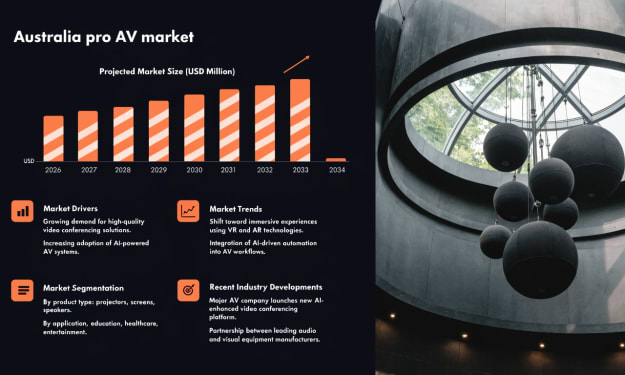
According to IMARC Group, the Australia pro AV market reached a value of USD 93.9 Million in 2025 and is projected to reach USD 133.6 Million by 2034, growing at a compound annual growth rate (CAGR) of 3.88% during 2026–2034. The market is expanding as organizations increasingly adopt advanced audiovisual solutions to support communication, collaboration and digital engagement. Hybrid work environments are encouraging businesses to invest in video conferencing systems, smart displays and integrated collaboration platforms that connect remote and in-office teams. At the same time, industries such as retail, hospitality and tourism are investing in digital signage to improve customer engagement and brand communication. As companies focus on creating interactive and technology-driven environments, professional AV solutions are becoming essential tools for modern workplaces, entertainment venues and commercial spaces across Australia.
By Kevin Cooper7 days ago in Futurism
My First Time Skiing and I Got Lost, Alone, in the French Alps
Looking back, I can trace some of my life’s biggest adventures to a simple action from my sister. She’d introduced me to Tommy (a very long time ago), a colleague of hers, who had overshared his penchant for Italian-looking women, and I ticked that box.
By Chantal Christie Weiss3 days ago in Humans



Comments
There are no comments for this story
Be the first to respond and start the conversation.