
The Brightest Shadows
In a world engineered for perfect happiness, one woman discovers the dangerous beauty of being truly human.

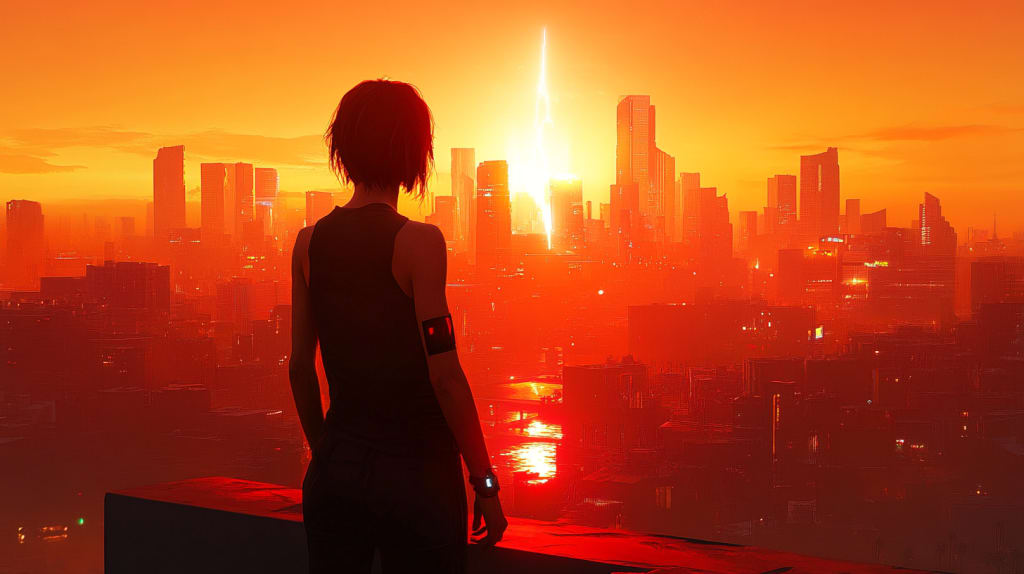
They called it the Pinnacle Era—a time when humanity had finally conquered suffering. After centuries of turmoil, wars, and environmental collapse, a solution had emerged: full emotional regulation, perfected social systems, and the elimination of unpredictability. Harmony was not just a dream—it was a mandate.
Individual struggle had been reframed as a relic of an unenlightened past. Passion was permitted only in measured doses, creativity funneled into sanctioned expressions. Every citizen carried a wristband monitoring mood variances, subtle shifts corrected before they could bloom into something disruptive. Happiness wasn't a right anymore; it was a requirement.
Mira had grown up knowing nothing else. Order, tranquility, predictability—these were her cornerstones. Yet sometimes, in the quietest moments, a strange hollowness crept into her chest, so faint she could almost pretend it wasn’t there.
In Harmony City, the sun always rose at exactly 6:00 AM, spilling warmth across the mirrored streets that wound quietly around buildings grown from living crystalline structures. Homes shimmered gently, shifting colors in tune with their residents’ moods. It was beauty by design—a place engineered for peace, perfection, and the absence of chaos.
Mira stepped out onto her balcony, took a breath. The air carried a faint sweetness, adjusted daily by nano-enzymes meant to keep people happy. As a senior Analyst for the Department of Optimal Living, her job was to monitor emotional data—making sure every citizen stayed within the narrow band of acceptable happiness.
A glance at her wristband confirmed it: dopamine, serotonin, oxytocin—all ideal. She should’ve felt elated. Yet something tugged at her, a quiet wrongness beneath the calm—something her trackers couldn’t explain.
“Morning, Mira!” The voice rang out, cheerful and eerily uniform—just like every other.
“Morning, Alec,” she replied, tone flawlessly warm. Harmony City survived on emotional alignment. Dissonance disrupted balance. Balance was everything.
Today, Mira had an anomaly to investigate—Jonas Keller. He lived in the Fringe Zone, where those who didn’t quite fit were sent for recalibration. His emotional metrics had slipped—signs of restlessness, dissatisfaction, even... ambition.
At his doorway, she paused. The crystalline walls around his apartment flickered in strange, unsettled shades—burnt amber, anxious violet.
Jonas answered with a slight smile. “Good morning, Analyst.”
“Good morning, Jonas. May I come in?”
He stepped aside. Inside, she froze. Paper books lined a shelf. Mechanical watches. Artwork—clearly handmade.
“Where did you find these?” she asked, tone even, though her thoughts weren’t.
“I made them.”
She blinked. Creativity existed here—but only within approved guidelines, always serving communal aesthetics and emotional balance.
“Your emotional readings are unstable. Are these... objects contributing?”
Jonas’s smile was soft, a little sad. “Not distress. They give me purpose.”
“Purpose,” she said quietly, “is defined by collective harmony.”
“Whose harmony, Mira?” He met her eyes. “We’ve flattened ourselves into perfect, predictable shapes. Doesn’t that feel... hollow?”
Mira paused. She couldn’t respond. He’d put voice to something she hadn’t dared admit.
“Individual desire threatens harmony,” she murmured, almost mechanically.
Jonas shook his head. “Without individuality, what’s left to harmonize?”
Later, back home, Mira sat in silence. Her metrics still read as ideal. Yet the unease hadn’t left—it had deepened.
A few days passed. Jonas vanished. Official reports said he was relocated. But rumors suggested otherwise—that he’d left by choice, slipping beyond Harmony’s reach.
Troubled, she returned to his apartment. The art remained, vivid and strangely alive. She picked up one of the canvases. Her wristband buzzed—imbalance detected.
She turned the canvas over. Scrawled on the back, barely legible under the rough texture, was a single line: "You are more than the sum of your compliance." Her throat tightened. She set it down, moving through the room, touching the objects Jonas had refused to standardize. A small sculpture caught her eye—a bird, wings mid-flutter, carved with messy, imperfect lines. It looked as if it might fly away if she breathed too hard.
In the corner, a journal lay open, filled with sketches and half-formed thoughts. No prompts, no communal guidelines, just raw, untamed ideas. Mira hesitated, then flipped a page. Another line stared back at her: "Real harmony embraces dissonance." The words landed with a weight she couldn't shrug off. Jonas hadn't been trying to break the world. He'd been trying to make it whole.
She let it buzz.
There was something honest in the discomfort. Jonas hadn’t just rejected perfection—he’d reached for something deeper, something more raw and vital than anything Harmony could manufacture. His art, his resistance, his very existence outside the sanctioned rhythms had exposed a hidden fracture line Mira could no longer unsee.
Harmony’s gleaming peace had come at a price: the silencing of passion, the erasure of uniqueness. What was left was tidy, painless, and terribly empty. A city of smiling ghosts, content but hollow, moving through days scripted for them like actors in a play they had forgotten wasn’t real.
Her wristband pulsed again, this time more urgently, as if sensing the shift in her heart before she could fully name it. Mira hesitated for only a second longer, then slipped it off, feeling its absence like the sudden lifting of a heavy chain.
Outside, the sun dipped low, casting fractured, raw light across the horizon. For once, the streets didn't seem so polished—they seemed brittle, breakable, as if a single spark could shatter the illusion. Mira stepped into the golden wash, unsure of where she was going—only that it was somewhere new.
Her steps felt heavier without the guidance of scheduled emotions, without the constant whisper of optimization nudging her along. And yet... they also felt freer. Each choice, no longer calculated by external forces, was hers alone. Each breath, no longer weighed and measured, felt astonishingly real.
As she walked, Mira caught glimpses of others—people lingering a little too long by the art displays, citizens hesitating before auto-correcting a sad thought, neighbors who glanced up at the unstructured clouds with something like yearning in their eyes. Maybe she wasn’t the only one starting to wonder what had been lost along the way.
Maybe Jonas hadn’t failed at all. Maybe he had planted something.
A restlessness. A memory. A reminder that life, real life, is not symmetrical or easy. It is jagged and brilliant and flawed and painful—and beautiful because of it.
Mira’s future wasn’t certain now. Harmony wouldn’t approve of this deviation. There would be consequences—penalties, reassignment, maybe even the quiet erasure reserved for those deemed beyond recalibration.
But none of that frightened her as much as the thought of returning to a life muted by safety, drained of wonder.
She pressed the canvas against her chest, feeling its texture—rough, imperfect, alive.
One foot in front of the other, Mira moved forward into the growing twilight. Into uncertainty. Into the wild, beautiful unknown.
And somewhere, deep inside, a tiny, long-silenced voice whispered: Welcome back.
✨ Closing Note:
Mira’s first step was small, almost imperceptible to the world around her. But within, it was seismic. A silent rebellion against a life too polished to feel real. In a society that demanded constant equilibrium, she had chosen uncertainty. And with it, possibility.
Perhaps the city would never notice one less compliant citizen. Perhaps others would quietly follow. Or perhaps not. But it didn’t matter. In a world built to erase edges, Mira had remembered hers. And once remembered, they could never be unseen.
About the Creator
Rukka Nova
A full-time blogger on a writing spree!
Reader insights
Nice work
Very well written. Keep up the good work!
Top insight
Excellent storytelling
Original narrative & well developed characters
Keep reading
More stories from Rukka Nova and writers in Futurism and other communities.
How I Made $5394 Using a Stable Diffusion Prompt and Instagram
Are you tired of the 9–5 grind and want to turn your love for social media into a cash cow? Well, have no fear, because I’ve got just the solution for you! In this article, I’m going to share with you how I stumbled upon a way to make some serious moolah using Stable Diffusion and Instagram.
By Rukka Nova3 years ago in Futurism
Elon Musk’s Makeshift AI Power Plant Sparks Outcry in Mississippi
In Southaven, Mississippi, a quiet residential road has become the unlikely front line of the artificial intelligence boom. Residents say the constant roar of temporary gas turbines installed by Elon Musk’s AI company, xAI, sounds like jet engines running day and night.
By Behind the Tech5 days ago in Futurism
Anthropic Keeps Claude Opus 3 Alive After Retirement
AI company Anthropic has announced an unusual update to its model retirement process: despite officially retiring Claude Opus 3 on January 5, 2026, the company will continue providing access to the model — and has even given it a platform to publish essays.
By Behind the Tech5 days ago in Futurism



Comments
There are no comments for this story
Be the first to respond and start the conversation.