
Australia Electric Vehicle Market: Clean Mobility, Smart Transport & Energy Transition
How zero-emission vehicles, charging infrastructure and policy-driven innovation are reshaping Australia’s electric vehicle industry.

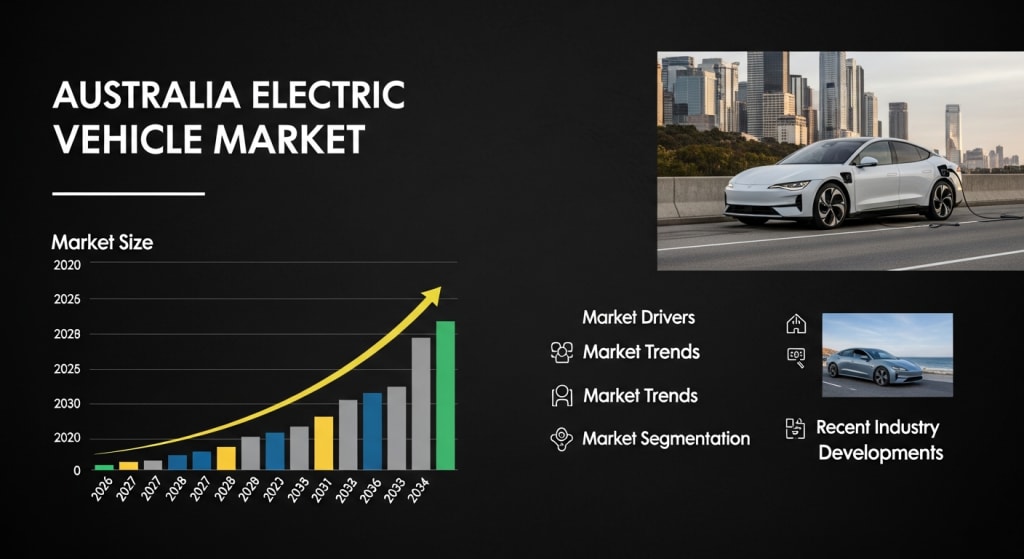
In 2025, Australia electric vehicle (EV) market was valued at USD 21.1 Billion. Looking ahead, the market is expected to surge to USD 205.5 Billion by 2034, exhibiting an exceptional compound annual growth rate (CAGR) of 28.80% during 2026–2034.
This extraordinary growth trajectory reflects a fundamental shift in Australia’s transportation ecosystem. Electric vehicles are moving rapidly from early adoption into the mainstream, driven by environmental concerns, rapid technological advancement and supportive policy frameworks. What was once a niche alternative is now emerging as a central pillar of Australia’s future mobility strategy, reshaping how people travel, how fleets operate and how energy is consumed.
Australia’s EV market spans passenger cars, commercial vehicles, buses and fleet solutions, supported by expanding charging infrastructure and improving battery performance. As cost parity with internal combustion engine vehicles draws closer and charging access improves, electric vehicles are increasingly viewed as a long-term, future-ready investment rather than an experimental choice.
Key Players
Australia’s electric vehicle market includes global automotive manufacturers, emerging EV specialists and technology-driven mobility providers. Competition is centered on vehicle range, charging compatibility, pricing, software features and after-sales support. Manufacturers are expanding model offerings across passenger, SUV and commercial segments, while partnerships with charging providers and energy companies strengthen ecosystem integration.
Recent News & Developments in the Australia Electric Vehicle Market
March 2025:
Automotive industry data showed a significant year-on-year increase in EV registrations, driven by strong demand for electric SUVs and compact passenger vehicles. Consumers cited improved range and expanding charging networks as key purchase drivers.
July 2025:
Several Australian states announced new investments in fast-charging corridors along major highways, improving long-distance EV travel feasibility. These initiatives aimed to support regional EV adoption and tourism-related travel.
October 2025:
Fleet operators and logistics companies reported accelerated EV fleet transitions, particularly for last-mile delivery and urban transport. Industry data highlighted reduced operating costs and positive environmental outcomes as key benefits.
The Futurism lens is the most appropriate lens for the electric vehicle market because EVs represent a transformative shift in how transportation systems are designed and powered. Electric vehicles are deeply connected to future-focused themes such as decarbonization, smart infrastructure, energy integration and digital mobility. The EV market is not about short-term trends—it reflects a long-term evolution toward cleaner, more intelligent and more sustainable transport systems that will define future cities and economies.
Why Should You Know About the Australia Electric Vehicle Market?
Because the electric vehicle market represents one of the most transformative shifts in Australia’s economic and environmental landscape. With the market projected to grow from USD 21.1 Billion in 2025 to USD 205.5 Billion by 2034, EVs are set to redefine transportation, energy consumption and industrial development at an unprecedented scale.
For consumers, electric vehicles offer cleaner mobility, lower running costs and access to next-generation driving technology. For businesses, EVs provide pathways to cost efficiency, sustainability compliance and future-ready fleet operations. For policymakers, the EV transition supports emissions reduction targets, energy independence and innovation-led economic growth.
From an investment and planning perspective, the 28.80% CAGR underscores that this is not incremental growth but a structural transformation. Infrastructure development, vehicle innovation and consumer behavior are all aligning to support long-term momentum.
The buyer guide tag accurately reflects the decision-making nature of the EV market. Purchasing an electric vehicle involves careful evaluation of range, charging access, battery longevity, incentives and long-term costs. Buyers—whether individuals, businesses or fleet managers—actively seek guidance to compare options and understand future value. The market is research-driven, with informed decision-making playing a central role in adoption.
Why is the Australia Electric Vehicle Market Growing?
Government Policy Support and Emissions Reduction Goals
Policy initiatives at both federal and state levels are accelerating EV adoption across Australia. Emissions reduction targets, fuel efficiency standards and clean energy strategies are encouraging the shift away from fossil-fuel-based transport. Incentives such as tax benefits, rebates and reduced registration costs have lowered entry barriers for buyers, while public-sector fleet electrification sends strong market signals that support long-term growth.
Rapid Expansion of Charging Infrastructure
The availability of reliable charging infrastructure is a critical enabler of EV adoption. Australia is witnessing steady growth in public charging networks across urban centers, highways and regional areas. Fast-charging stations and workplace charging solutions are reducing range anxiety and improving convenience for daily commuting and long-distance travel. This infrastructure expansion is making EV ownership more practical for a wider segment of the population.
Advancements in Battery Technology and Vehicle Performance
Continuous innovation in battery technology is improving driving range, charging speed and overall vehicle efficiency. Modern EVs now offer performance levels that rival or exceed traditional vehicles, while lower maintenance requirements enhance long-term value. As battery costs decline and durability improves, electric vehicles become more attractive to both individual consumers and commercial fleet operators.
Rising Consumer Awareness and Total Cost of Ownership Benefits
Australian consumers are increasingly aware of the long-term financial and environmental benefits of electric vehicles. Lower fuel costs, reduced maintenance and potential savings through home solar integration make EVs economically compelling over their lifecycle. As awareness grows, buyers are shifting focus from upfront price to total cost of ownership, strengthening demand across income segments.
Corporate Fleet Electrification and Commercial Adoption
Businesses and fleet operators are playing a major role in accelerating EV uptake. Companies are transitioning vehicle fleets to electric options to meet sustainability goals, reduce operating costs and enhance brand reputation. Commercial EV adoption supports market scale, encourages infrastructure investment and contributes to rapid overall market expansion.
About the Creator
Kevin Cooper
Hi, I'm Kavin Cooper — a tech enthusiast who loves exploring the latest innovations, gadgets, and trends. Passionate about technology and always curious to learn and share insights with the world!
Keep reading
More stories from Kevin Cooper and writers in Futurism and other communities.
Australia Ceiling Light Market: Smart Illumination, Energy Efficiency & Future-Ready Living
In 2025, Australia ceiling light market was valued at USD 994.81 Million. Looking ahead, the market is projected to reach USD 1,461.66 Million by 2034, growing at a compound annual growth rate (CAGR) of 4.37% during 2026–2034.
By Kevin Cooper2 months ago in Futurism
The Quataloid Escape:
Out in the Nevada desert, the night air cools fast after sunset. The wind whispers across the empty land like it’s carrying secrets from another world. If you ever find yourself driving near Area 51, you’ll see warning signs, floodlights, and miles of silent desert.
By Shahjehan Khan 6 days ago in Futurism
Saudi Arabia Construction Market: Mega Projects, Vision 2030 & Growth Outlook
Saudi Arabia's construction market is experiencing a transformation unlike anything seen in the region's modern history. Vision 2030 has turned what was once a petroleum-dominated economy into a massive construction laboratory, with projects spanning luxury tourism, smart cities, cultural heritage, and infrastructure modernization. According to IMARC Group's latest data, the Saudi Arabia construction market size was valued at USD 101.4 Billion in 2025. Looking forward, IMARC Group estimates the market to reach USD 138.4 Billion by 2034, exhibiting a growth rate (CAGR) of 3.52% from 2026-2034.
By Shubham Sharma 6 days ago in Futurism
A System That Isn’t Working Challenge Winners
Systems promise order. They organize behavior, distribute opportunity, and suggest that if everyone follows the rules, things will work. The entries in A System That Isn’t Working look closely at what happens when that promise begins to slip.
By Vocal Curation Team5 days ago in Resources




Comments
There are no comments for this story
Be the first to respond and start the conversation.