
Neutrino Mass Oscillations Measured Through Cosmology for the First Time
Space

In the vast stage of the universe, few players are as elusive as the neutrino. These ghostlike particles stream through everything—our planet, our bodies, even entire stars—without leaving a trace. Every second, trillions of them pass through you, yet you don’t feel a thing. For decades, scientists believed neutrinos were completely massless. But subtle experiments at the end of the 20th century proved otherwise: neutrinos do have mass, however tiny.
Now, cosmology has taken this mystery further. For the first time, researchers have measured the oscillation of neutrino mass by observing the large-scale structure of the cosmos itself. And the breakthrough comes thanks to the European Space Agency’s Euclid space telescope.
The Puzzle of the “Phantom Mass”
In particle physics, neutrinos have been a thorny riddle. Laboratory experiments with underground detectors and particle accelerators revealed one curious behavior: neutrinos can shift between three different “flavors”—electron, muon, and tau—as they travel. This strange oscillation hinted that neutrinos carry mass. Without mass, such transformations would be impossible.
Yet actually “weighing” a neutrino directly has remained beyond our reach. Their mass is so tiny that even the most sensitive instruments can only establish upper limits. Imagine trying to weigh a single snowflake while a blizzard rages around you—that’s the level of difficulty physicists face.
Cosmology, however, provides another path. While each neutrino is almost weightless, the number of them is astronomical. The early universe was flooded with neutrinos just seconds after the Big Bang, and they are still with us today in enormous quantities. Their collective mass has enough gravitational influence to shape galaxies, clusters, and the cosmic web itself. That means: if neutrinos have mass, their fingerprints should be visible in the structure of the universe.
Euclid’s Cosmic Detective Work
The Euclid mission, launched in 2023, was designed primarily to map dark matter, dark energy, and the geometry of the cosmos. But its wide and deep survey of galaxies turned out to be a gold mine for neutrino research.
Euclid measures the distribution of hundreds of millions of galaxies across space and time. If neutrinos are massive, their high-speed motion prevents matter from clumping together as effectively under gravity. This doesn’t erase cosmic structures, but it subtly smooths them out. Galaxy clusters become a little less dense, and the “cosmic web” of filaments stretches in slightly different patterns.
When researchers compared Euclid’s detailed maps with cosmological simulations, the signal was clear: the presence of neutrino mass was imprinted on the fabric of the universe. For the first time, cosmology provided numerical constraints on the sum of neutrino masses, consistent with—but obtained independently from—laboratory experiments.
Why This Discovery Matters
Physics and Cosmology in Harmony
For decades, particle physics and cosmology have developed along parallel paths. This result demonstrates they are deeply connected. Tiny quantum particles, nearly impossible to detect in the lab, reveal themselves by shaping the universe on the grandest scales.
Sharper Mass Limits
Euclid’s data suggest that the combined mass of the three neutrino types falls in the tens of millielectronvolts (meV) range, but certainly not more than a few hundred meV. That’s like saying: we may not know the exact weight yet, but we know with confidence that neutrinos are feather-light, far lighter than even the electron, which itself is already 500,000 times lighter than a proton.
Impact on Cosmic Evolution
Knowing how neutrinos influence the growth of structures helps refine our understanding of dark energy—the mysterious force driving the accelerated expansion of the universe. Neutrinos act as subtle “brakes” in cosmic growth, counterbalancing the effects of gravity.
Clues to New Physics
If future measurements find inconsistencies between laboratory results and cosmological ones, it could point to unknown particles or interactions. In other words, neutrinos might be the key to discovering physics beyond the Standard Model.
The Road Ahead
Euclid’s achievement is just the beginning. Over the next decade, other projects will add more precision: NASA’s Nancy Grace Roman Space Telescope, China’s large-scale cosmic surveys, and the ground-based Vera Rubin Observatory will all push the boundaries of cosmic cartography. Together, they will help refine the mass of neutrinos even further.
Meanwhile, particle physicists are pursuing direct measurements. Experiments like KATRIN in Germany are probing the electron neutrino’s mass with extraordinary sensitivity, and future accelerator-based projects may finally provide a laboratory-scale “weigh-in.” The synergy between telescopes and detectors promises a breakthrough: within the next decade, humanity may finally pin down the exact mass of the most elusive particle known.
The Cosmic Ghosts Leave a Mark
The story of neutrinos reads like a cosmic detective novel. For years, they evaded every attempt at capture, offering only indirect clues through oscillations. Now, thanks to Euclid, we see that their “ghostly” mass doesn’t just exist—it shapes the very scaffolding of the universe.
It’s a profound reminder: even the smallest particles can leave the largest imprints. Neutrinos, once thought to be massless phantoms, are now recognized as silent architects of cosmic history. And as we continue to measure them with greater precision, we may find that these ghost particles hold the keys to unlocking the deepest mysteries of matter, energy, and the fate of the universe itself.
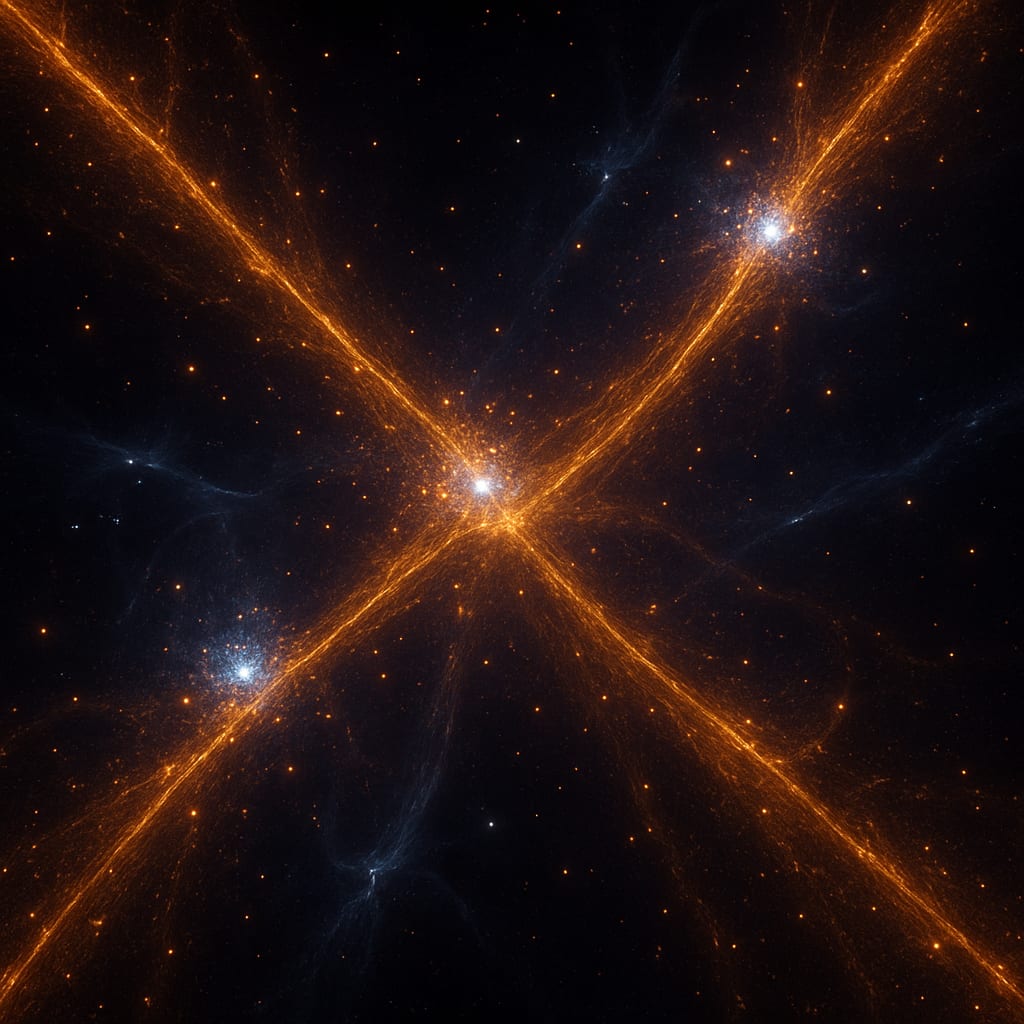
Suggested image for the article:
A sweeping cosmic panorama showing the “cosmic web”—delicate filaments of golden galaxies stretching across a dark expanse of space. Between the glowing strands, faint streams of bluish light represent neutrinos rushing invisibly through the cosmos. The image should evoke both grandeur and mystery: the vastness of the universe intertwined with the invisible presence of ghost particles.
About the Creator
Keep reading
More stories from Holianyk Ihor and writers in Futurism and other communities.
First Real-Time Evidence of Volcanic Activity on Venus
For decades, Venus has stood as one of the greatest enigmas of our Solar System. Shrouded in a thick, toxic veil of sulfuric acid clouds, it has often been described as Earth’s “evil twin.” With surface temperatures hot enough to melt lead, crushing atmospheric pressure 90 times greater than Earth’s, and skies forever hidden behind stormy clouds, Venus feels more like a furnace than a planet. Yet despite its hellish reputation, one scientific question has lingered longer than most: is Venus still geologically alive?
By Holianyk Ihor4 months ago in Futurism
About Binding Prometheus
I want to start actively advocating on behalf of my own work, and the most valuable part of my canon is, without a doubt, Binding Prometheus, the play I have been working on since 2019 and only finished in 2023 as part of my MA. The play itself is an amalgamation of a million different inspirations. On one end, it evokes the Ancient Greek myth-play, deriving its own title from the earliest extant work of Western drama we have, Aeschylus’s Prometheus Bound. On the other end, it borrows significantly from the sci-fi bulwarks from over the years, namely Mary Shelley’s Frankenstein and Karel Capek’s Rossum’s Universal Robots. The play could be an episode of Black Mirror, I fear. I don’t know. I’ve only ever seen one episode of Black Mirror.
By Steven Christopher McKnight15 days ago in Futurism
CBRN Defense Market: National Security, Risk Preparedness & Industry Expansion
According to IMARC Group's latest research publication, The global CBRN defense market size was valued at USD 21.55 Billion in 2024. Looking forward, IMARC Group estimates the market to reach USD 33.11 Billion by 2033, exhibiting a CAGR of 4.64% during 2025-2033.
By James Whitmana day ago in Futurism


Comments
There are no comments for this story
Be the first to respond and start the conversation.