
A Bright Future: How Humanity Rebuilt the World After the Third Civil War
In the year 2050, peace finally feels real

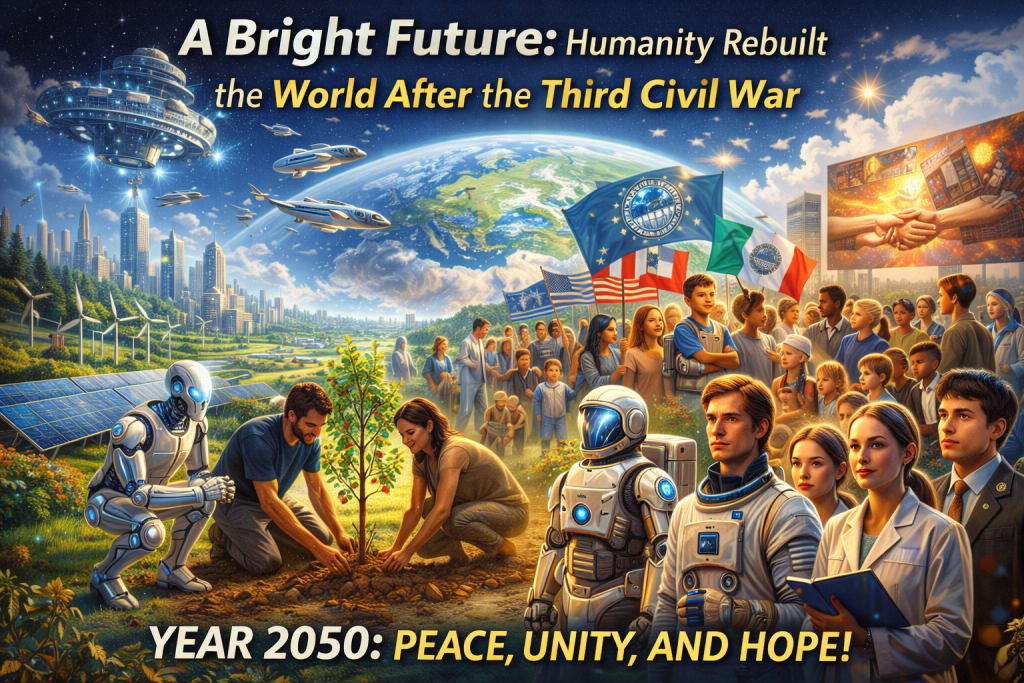
It has been eighteen years since the Third Civil War ended—the most devastating conflict humanity ever unleashed upon itself. No nation escaped untouched. Entire cities were reduced to ash, coastlines swallowed by flooding, and power plants lay in ruins after relentless missile strikes. The war reshaped the planet and scarred every generation that lived through it.
Over one hundred million people were killed in the United States alone, with hundreds of millions more injured or displaced. Globally, the toll reached unimaginable heights. More than three billion lives were lost, as people across the world rose up against corruption, authoritarianism, and the systems that had exploited them for centuries.
And yet, from that destruction, something extraordinary emerged.
________________________________________
The War That Changed Everything
The Third Civil War began in America, but it didn’t stay there. What started as a fight for freedom ignited movements across the globe. People everywhere demanded dignity, equality, and a voice in how their lives were governed.
Out of 237 countries, 228 won their struggles through the will of their people. The nations that couldn’t finish the fight alone were supported by neighboring countries, forming alliances not for conquest—but liberation.
When the dust settled, the old rulers were gone. Leaders responsible for crimes against humanity were imprisoned or killed if they resisted arrest. Innocent civilians—those caught in the crossfire of ambition and greed—were given land, resources, and protection. For the first time in history, justice wasn’t selective.
Humanity had paid an unbearable price, but it had finally learned.
________________________________________
Rebuilding a Broken World
When the rebuilding began, our ancestors made a radical decision: the old systems would not return.
There would be no borders enforced by fear. No economies driven by hoarded wealth. No nations competing over resources buried in the ground.
Instead, the world united under a single banner—the Federation of Earth, named in homage to Gene Roddenberry’s vision of a hopeful future in Star Trek. The idea was simple but revolutionary: cooperation over competition, progress over profit, people over power.
Currency was abolished worldwide. Without money dictating survival, people were free to pursue what they loved—and to help where they were needed most. Engineers rebuilt infrastructure. Farmers restored poisoned land. Teachers educated children who had known nothing but war.
For the first time, humanity worked as one.
________________________________________
Humans, AI, and a New Kind of Partnership
By 2041, artificial intelligence and advanced robotics had reached maturity. But unlike the dystopian warnings of the past, AI did not rise to enslave humanity.
Instead, we chose a different path.
Robots handled the most dangerous and physically demanding labor—clearing debris, rebuilding cities, stabilizing power grids. Humans worked alongside them, performing tasks that required creativity, empathy, and judgment.
AI wasn’t treated as property. Robots were granted rights, autonomy, and respect.
And something remarkable happened.
We didn’t become enemies.
We became partners.
Together, humans and machines achieved breakthroughs once thought impossible. Artificial organs restored lives. People who couldn’t walk stood again. The blind saw. The deaf heard. Hearts, lungs, and livers were grown and implanted successfully.
The most controversial advancement was neural preservation—the ability to preserve the human brain indefinitely. Due to environmental damage from coal, oil, and microplastics, humanity had become sterile. Immortality wasn’t a luxury—it was survival.
Those who chose to live naturally and die were honored. Choice became sacred.
________________________________________
Reaching for the Stars
In 2044, the World Federation Space Agency was formed. Humanity looked outward, not to escape Earth, but to expand its understanding of the universe.
Massive space stations—capable of housing millions—were designed for habitation, research, and engineering. With robotic assistance, construction progressed rapidly, with completion expected by 2058.
New spacecraft were built to explore distant star systems. For the first time, humans weren’t just dreaming about the stars—we were preparing to meet them.
________________________________________
Life Without Money, Life With Meaning
Without currency ruling daily life, communities flourished.
Neighbors rebuilt homes together. Artists painted massive murals of peace, unity, and remembrance on restored buildings. Musicians played in the streets, turning reconstruction into celebration. Writers documented humanity’s rebirth.
I was one of them.
A small group of historians and artists was tasked with recording our story—our music, art, and experiences—to be launched into space, much like the Voyager Golden Record centuries before. If intelligent life exists beyond Earth, they will know who we were, who we became, and what we learned.
________________________________________
Teaching the Past to Protect the Future
I was born during the war. I remember the fear, the sirens, the silence after explosions. Watching humanity come together afterward feels like witnessing a miracle.
Today, we are one human race, rich with diverse cultures, ethnicities, genders, and beliefs. Hierarchies still exist, but they no longer strip dignity. Respect is universal.
We kept traditions—the Olympics will return in 2060, once the world is fully healed. Democratic elections continue. Cultural festivals celebrate every identity. Everyone has the right to be who they are and believe what they feel in their hearts.
We teach history—not to glorify violence, but to warn against it.
Some worry that showing students our bloody past could awaken old instincts. But curiosity is natural. People asked questions long before history was formally taught again. Truth, we decided, is safer than ignorance.
________________________________________
The Final Lesson
As I finished reading Joanne Miller’s account to my class, the room was silent. Then came applause. Moments later, the bell rang, and students filed out toward their next lesson—children who had never known war.
This future wasn’t the one humanity wanted.
It was the one we needed.
Our ancestors lived in chaos, fear, and hatred. I often wonder what they would say if they could see us now. Would peace have come sooner if they had believed this future was possible?
What comes next?
Only time will tell. But for the first time in history, I believe the answer will be beautiful.
About the Creator
Adil Ali Khan
I’m a passionate writer who loves exploring trending news topics, sharing insights, and keeping readers updated on what’s happening around the world.
Keep reading
More stories from Adil Ali Khan and writers in Futurism and other communities.
Mars Isn’t Plan B: Why Earth Stays More Livable — No Matter What
For decades, we’ve been sold a sleek, silver-lined dream: if things go south on Earth, we’ll simply pack our bags and move to the Red Planet. From billionaire-funded rocket launches to Hollywood blockbusters, the narrative is clear—Mars is humanity’s "Plan B." It’s our cosmic lifeboat in the event of climate collapse, nuclear war, or resource depletion.
By Adil Ali Khana day ago in Futurism
GCC Personal Luxury Goods Market Analysis: Industry Overview, Key Players & Future Outlook
According to IMARC Group's latest research publication, GCC personal luxury goods market size reached USD 10.3 Billion in 2024. The market is projected to reach USD 14.7 Billion by 2033, exhibiting a growth rate of 3.82% during 2025-2033.
By Abhay Rajput7 days ago in Futurism



Comments
There are no comments for this story
Be the first to respond and start the conversation.