
3D Printing
How 3D Printing Has Shaped Industry and Science

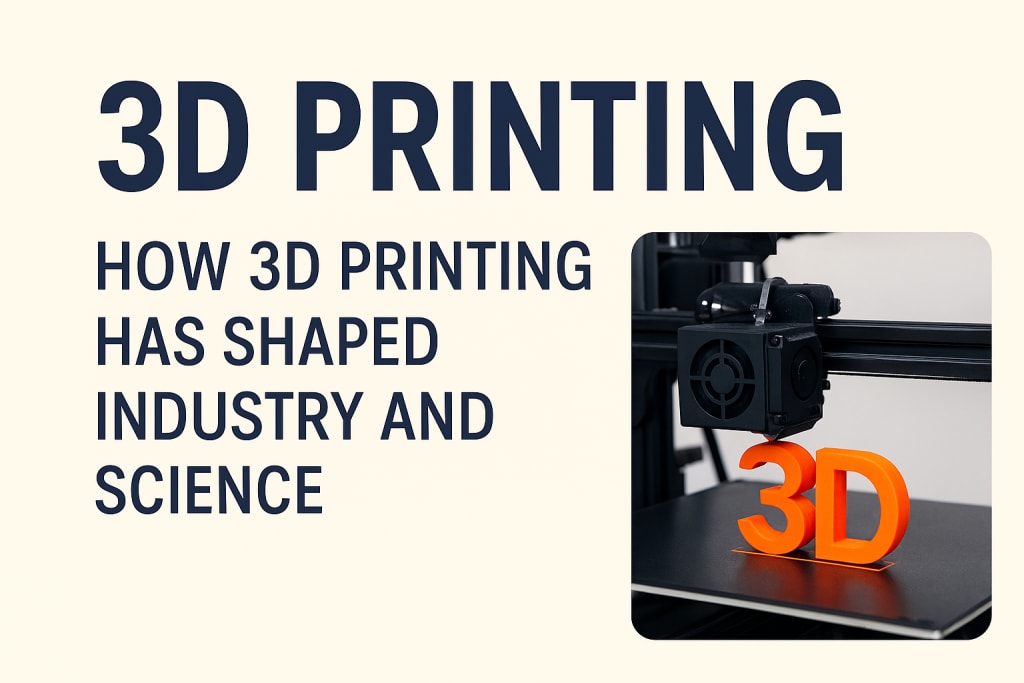
Start writing...3D Printing
How 3D Printing Has Shaped Industry and Science
In the past few decades, one of the most exciting technological revolutions has been 3D printing, also known as additive manufacturing. What started as a small idea in research labs is now transforming industries such as medicine, aerospace, construction, and even education. The history of 3D printing is full of fascinating inventors, groundbreaking innovations, and unexpected applications that continue to push the boundaries of human creativity.
The Origins: How 3D Printing Began
The history of 3D printing goes back to the early 1980s. In 1981, Dr. Hideo Kodama from Japan described a rapid prototyping system using a photosensitive resin cured by UV light. Although his work did not become commercially successful, it opened the door to what would later be called additive manufacturing.
In 1984, American engineer Charles Hull invented stereolithography (SLA), the first practical 3D printing process. His company, 3D Systems, commercialized SLA printers and gave engineers the ability to create accurate prototypes directly from digital files. This marked the official beginning of 3D printing technology.
Expanding Technologies in the 1990s
During the 1990s, several new 3D printing technologies appeared. At the University of Texas, Dr. Carl Deckard developed Selective Laser Sintering (SLS), a process that used lasers to fuse powdered material into solid shapes. Around the same time, Scott Crump, co-founder of Stratasys, introduced Fused Deposition Modeling (FDM). FDM printers worked by melting thermoplastic filaments and depositing them layer by layer.
These innovations made additive manufacturing more versatile and practical. Companies in the automotive and aerospace industry used 3D printing to create prototypes faster and cheaper than traditional manufacturing. The idea of rapid prototyping became central to industrial design.
From Prototypes to Medicine and Beyond
By the early 2000s, 3D printing in medicine became a reality. In 1999, researchers created a 3D-printed scaffold for a human bladder, showing the potential of bioprinting. Soon after, experiments with tissue engineering and organ scaffolds pushed the limits of healthcare innovation.
In 2005, Dr. Adrian Bowyer at the University of Bath in the UK launched the RepRap Project, aiming to design a self-replicating 3D printer. This open-source project helped spread 3D printing to homes, classrooms, and small workshops. For the first time, ordinary people—not just engineers at big companies—could build and share their own printers.
The 2010s: 3D Printing Goes Mainstream
The 2010s were a turning point when 3D printing technology moved from specialized labs to mainstream culture. Affordable desktop printers became available through companies like MakerBot, bringing additive manufacturing into schools, offices, and even homes.
At the same time, 3D printing in aerospace advanced rapidly. NASA successfully tested 3D-printed rocket engine components, while Airbus used 3D-printed titanium parts to reduce aircraft weight. These innovations showed that 3D printing could withstand extreme environments.
In medicine, 3D-printed prosthetics became widely available. In 2012, American doctors used a 3D-printed airway splint to save an infant’s life, proving that 3D printing in healthcare was not just theoretical—it was life-saving.
3D Printing Around the World
Today, 3D printing is a global phenomenon. In Germany and the Netherlands, companies like EOS lead in industrial metal printing. In China, 3D printing in construction has made headlines, with entire houses built in less than 24 hours. Dubai has ambitious goals to make 25% of all new buildings using 3D printing by 2030.
Universities and research institutes across Europe, Asia, and the United States are exploring bioprinting for organ and tissue development. The global expansion of 3D printing proves that this technology is no longer limited to one industry or one country—it is a worldwide revolution.
How 3D Printing Works
At its core, additive manufacturing builds objects layer by layer. Unlike traditional manufacturing, which removes material by cutting or drilling, 3D printing adds material only where it is needed. This reduces waste and allows for complex designs that are impossible with older methods.
There are multiple methods—SLA, SLS, FDM—and a wide range of materials: plastics, resins, ceramics, metals like titanium, and even biological cells. This diversity explains why 3D printing can be used for toys, airplane parts, prosthetics, and scientific research alike.
Transforming Industries
The impact of 3D printing can be seen in almost every industry:
Medicine: Customized prosthetics, dental implants, and experiments with printing organs.
Aerospace: Lightweight and durable components for rockets and airplanes.
Construction: 3D-printed buildings, reducing both cost and environmental waste.
Fashion and Art: Futuristic clothing designs and sculptures created layer by layer.
Education: Students use 3D printers to bring abstract concepts into tangible reality.
This is why experts often call 3D printing a revolution—because it changes not only how we make things, but also who can make them.
The Future of 3D Printing
The future of 3D printing looks limitless. Scientists are working on printing functioning human organs to solve the shortage of donors. Astronauts may one day 3D print tools on Mars instead of waiting for shipments from Earth. Factories could become rows of 3D printers instead of traditional assembly lines.
What makes 3D printing so powerful is its democratizing effect. Anyone—from large aerospace companies to teenagers at home—can turn ideas into reality. It is innovation that belongs to everyone.
Conclusion: A Layered Revolution
From the invention of stereolithography by Charles Hull to the rise of bioprinting and aerospace applications, the evolution of 3D printing is a story of human creativity and persistence. It has grown from a tool for engineers to a technology that touches our everyday lives.
About the Creator
Mohamed hgazy
Fiction and science writer focused on physics and astronomy. Exploring the human experience through imagination, curiosity, and the language of the cosmos.
Keep reading
More stories from Mohamed hgazy and writers in Futurism and other communities.
Atomic Atomic Saturation
Atomic Atomic Saturation I have always been fascinated by the moments in science when nature seems to quietly whisper: “This is as far as I will go.” One of these whispers emerges in the world of atomic physics, in a phenomenon known as atomic saturation. It is an elegant yet stubborn limit in the interaction between light and matter, a point beyond which the rules we expect no longer apply in a simple way.
By Mohamed hgazy7 months ago in Futurism
Australia Industrial Robotics for Assembly Lines Market: Automation Adoption, Operational Efficiency & Technology Innovation
According to IMARC Group, the Australia industrial robotics for assembly lines market was valued at USD 369.85 Million in 2025 and is projected to reach USD 1,049.60 Million by 2034, exhibiting a strong compound annual growth rate (CAGR) of 12.29% during 2026–2034. The accelerating shift toward advanced manufacturing and smart factory integration across Australia is significantly driving market expansion. Industrial robots deployed in assembly lines are increasingly becoming essential tools for improving productivity, precision and safety. As industries aim to enhance operational efficiency while managing labor shortages and cost pressures, robotics adoption is emerging as a strategic priority.
By Kevin Cooper3 days ago in Futurism




Comments
There are no comments for this story
Be the first to respond and start the conversation.