
10 Mind-Blowing Facts About Space You Probably Didn’t Know
"Unveiling the Cosmos: 10 Astonishing Space Facts That Will Blow Your Mind"

Introduction
Space has always been a source of wonder and mystery. From the twinkling stars in the night sky to the vast galaxies millions of light-years away, the universe holds secrets that continue to baffle and amaze us. While we’ve made incredible strides in space exploration, there’s still so much we don’t know.
In this article, we’ll dive into 10 fascinating facts about space that will leave you in awe and make you see the cosmos in a whole new light.
1. The Universe is Expanding Faster Than We Thought
One of the most mind-boggling discoveries in modern astronomy is that the universe is expanding at an accelerating rate. Scientists believe this is due to a mysterious force called dark energy, which makes up about 68% of the universe.
But here’s the kicker: we still don’t know what dark energy actually is. It’s one of the biggest unsolved mysteries in physics and could redefine our understanding of the cosmos.
2. There’s a Planet Made of Diamonds
Imagine a planet where the ground is covered in diamonds! Scientists have discovered a planet called 55 Cancri e, located about 40 light-years from Earth, that is believed to be made largely of carbon.
Under extreme pressure, this carbon has likely crystallized into diamonds, making the planet one of the most exotic worlds we’ve ever found. This glittering planet is twice the size of Earth and orbits its star so closely that a year there lasts only 18 hours!
3. Black Holes Aren’t Actually “Holes”
Contrary to popular belief, black holes aren’t empty spaces. They are incredibly dense objects with gravitational pulls so strong that not even light can escape.
The center of a black hole, known as the singularity, is a point where matter is compressed to infinite density. If you were to fall into a black hole, you’d be stretched out like spaghetti in a process called spaghettification—a terrifying fate!
4. The Moon is Drifting Away from Earth
Did you know that the Moon is slowly moving away from Earth? Every year, the Moon drifts about 3.8 centimeters further from our planet.
This is due to the gravitational interactions between Earth and the Moon. While this might not seem like much, over millions of years, it will have a significant impact on Earth’s tides and rotation speed.
5. There’s a Giant Cloud of Alcohol in Space
Yes, you read that right! In a region of space known as Sagittarius B2, there’s a massive cloud of gas that contains billions of liters of alcohol, specifically ethanol and methanol.
While it’s not exactly drinkable, this discovery has fascinated scientists. It shows that the building blocks of organic molecules exist even in deep space—perhaps hinting at the possibility of life beyond Earth!
6. The Sun’s Core is a Nuclear Powerhouse
The Sun, our closest star, is a massive ball of hydrogen and helium. At its core, temperatures reach about 15 million degrees Celsius, where nuclear fusion occurs.
This process converts hydrogen into helium, releasing enormous amounts of energy in the form of light and heat. Fun fact: It takes about 100,000 years for a single photon of light to travel from the Sun’s core to its surface before escaping into space!
7. There’s a Planet That Rains Glass
Meet HD 189733 b, a gas giant located 63 light-years from Earth. This planet is known for its extreme weather conditions, including winds that reach speeds of up to 8,700 kilometers per hour.
But the most bizarre feature? It rains molten glass. The planet’s atmosphere contains silicate particles, which condense into glass droplets and fall sideways due to the intense winds. Definitely not a vacation spot!
8. The Coldest Place in the Universe is on Earth
While space is incredibly cold, the coldest place in the universe isn’t out there—it’s right here on Earth!
In laboratories, scientists have used lasers to cool atoms to temperatures just a fraction of a degree above absolute zero (-273.15°C). This is actually colder than the natural temperature of space, which is about -270°C.
9. There Are More Stars in the Universe Than Grains of Sand on Earth
The universe is unimaginably vast. Astronomers estimate that there are about 1 septillion stars (that’s a 1 followed by 24 zeros) in the observable universe.
To put that into perspective, there are more stars in the universe than grains of sand on all the beaches and deserts on Earth. It’s a humbling reminder of how small we are in the grand scheme of things.
10. Time Moves Differently in Space
Thanks to Einstein’s theory of relativity, we know that time isn’t constant. In space, time moves differently depending on gravity and speed.
For example, astronauts on the International Space Station (ISS) age slightly slower than people on Earth due to the effects of time dilation. Over a six-month mission, an astronaut might be about 0.007 seconds younger than they would have been if they had stayed on Earth.
It’s not much, but it’s a fascinating glimpse into the strange nature of time!
Conclusion
The universe is full of wonders that challenge our understanding and ignite our curiosity. From diamond planets to black holes and alcohol clouds, space never ceases to amaze.
As we continue to explore the cosmos, who knows what other incredible discoveries await us? One thing’s for sure: the universe is far stranger and more beautiful than we could ever imagine.
About the Creator
Big Data Analytics in Education Market to Reach USD 115.7 Billion By 2033
Big Data Analytics in Education Market The global Big Data Analytics in Education market is expanding steadily as educational institutions increasingly rely on data to improve learning outcomes and operational efficiency. The market is expected to reach around USD 115.7 billion by 2033, increasing from USD 22.1 billion in 2023, which reflects a strong 18% CAGR during the forecast period from 2024 to 2033. The growth of digital learning platforms, online assessments, and cloud based learning systems has generated large volumes of educational data that require advanced analytics tools. These technologies help institutions analyze student behavior, academic performance, and administrative operations to support better decision making.
By Roberto Crum2 days ago in Futurism
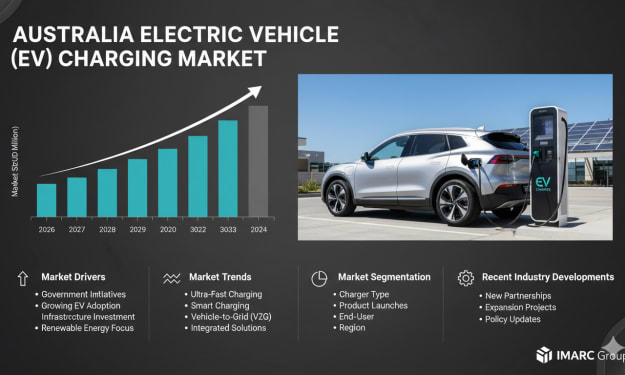
Australia EV Charging Market: Infrastructure Expansion, Smart Charging Tech & Government Incentives
According to IMARC Group, the Australia electric vehicle (EV) charging market reached USD 304.4 Million in 2025 and is projected to expand significantly to USD 1,692.2 Million by 2034, exhibiting a compound annual growth rate (CAGR) of 21.00% during 2026–2034. This rapid growth reflects the accelerating transition toward electric mobility across Australia. Increasing adoption of electric vehicles by consumers and commercial fleets is driving demand for a reliable and widespread charging infrastructure network. Governments and private investors are expanding public charging stations while businesses and residential property developers integrate charging solutions into new infrastructure. At the same time, advancements in smart charging technologies and energy management systems are strengthening Australia EV charging market share by improving efficiency, convenience, and grid integration.
By Kevin Cooper3 days ago in Futurism



Comments
There are no comments for this story
Be the first to respond and start the conversation.